Introduction
You slept eight hours. You drank your water. The mirror still shows tired, lined eyes staring back at you. The under-eye area ages faster than almost anywhere else on the face, and it's often the first thing people want to fix.
Botox comes up constantly as the answer. But whether it's actually the right answer depends entirely on what's causing the problem. Crow's feet respond beautifully to Botox. Hollow tear troughs, though — that's a different conversation entirely.
This guide covers exactly what Botox can and cannot do for the under-eye area — the procedure, realistic results, risks, and when a different treatment will serve you better. If you're considering this at a Bengaluru clinic, there's specific pricing context included too.
Key Takeaways
- Botox treats crow's feet and dynamic under-eye lines effectively — but its use directly beneath the eye is off-label
- Under-eye bags, tear trough hollows, and dark circles from pigmentation don't respond to Botox; those need different treatments entirely
- Results in this zone last 2–4 months — shorter than most other facial areas
- Provider skill is critical here: small dosing errors in the under-eye area carry a higher risk of complications than almost anywhere else on the face
Understanding the Different Types of Under-Eye Concerns
The under-eye area presents several distinct problems that look similar but have completely different causes. Getting this distinction right matters — the wrong treatment choice is the most common reason patients are disappointed with their outcomes.
Crow's Feet
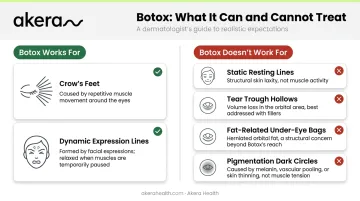
These are the fan-shaped lines radiating from the outer corners of the eyes when you smile or squint. They're caused by repeated contraction of the orbicularis oculi muscle. Early on, they only appear with expression. With age, they become visible at rest. Crow's feet are the most Botox-responsive concern in the periocular area and have FDA approval for this specific use.
Under-Eye Wrinkles and Fine Lines (Infraorbital Lines)
Not all under-eye lines are the same:
- Dynamic lines — appear during smiling or squinting; caused by muscle movement; Botox can target these
- Static fine lines — visible even at rest; caused by long-term collagen loss in the skin; much harder for Botox to eliminate
This distinction matters. Patients expecting Botox to erase deeply etched resting lines are often disappointed, because those lines aren't primarily a muscle problem.
Tear Trough Hollows
The tear trough is the groove between the lower eyelid and the cheek. It creates a hollow, shadowed look that reads as exhaustion regardless of how much you've slept. This is caused by volume loss and structural fat changes — not muscle activity. Botox does not address this. Dermal fillers do.
Under-Eye Bags and Dark Circles
- Bags result from fat pad protrusion, fluid retention, or skin laxity — none of which relaxing a muscle will fix
- Dark circles can stem from genetics, vascular pooling, pigmentation, or the shadow that tear trough hollows cast
Each needs a targeted approach:
- Fillers for structural shadows and hollow tear troughs
- Laser toning or chemical peels for pigmentation-driven discolouration
- Lifestyle adjustments for fluid retention and sleep-related puffiness
What Botox Can and Cannot Do for Under-Eye Wrinkles
Botox (botulinum toxin type A) works by temporarily blocking nerve signals to targeted muscles, causing them to relax. Where muscles are the main driver of wrinkle formation, it works well. Where they aren't, it doesn't.
What Botox Can Effectively Treat
Two areas deliver reliable results:
Crow's feet — FDA-approved since September 2013, using 24 units total (three 4-unit injections per side). Clinical trial data shows that at Day 30, 60% of patients were satisfied or very satisfied versus just 8% with placebo — a meaningful difference.
Fine dynamic lines directly under the lower eyelid — using a micro-Botox or "baby Botox" technique: multiple intradermal microdroplets targeting superficial muscle fibers. This is an off-label application, meaning it's based on clinical expertise rather than regulatory approval. Provider skill is everything here.
What Botox Cannot Effectively Treat
| Concern | Why Botox Doesn't Work |
|---|---|
| Static fine lines at rest | Collagen loss, not muscle activity |
| Tear trough hollows | Volume deficit, not muscle problem |
| Fat-related under-eye bags | Relaxing muscle can worsen laxity |
| Pigmentation-based dark circles | Not a neuromuscular issue |
The Risk of Getting It Wrong
Botox relaxes the orbicularis oculi muscle. In the under-eye zone, excessive relaxation creates real problems:
- Lower eyelid laxity or ectropion
- A "sad" or drooping appearance
- Worsening of under-eye bags if fat pad support is reduced
Conservative dosing and precise placement are what determine whether outcomes are good or problematic. If your primary concern is bags, hollows, or dark circles, Botox alone is the wrong tool — a different approach is needed.
The Under-Eye Botox Procedure: What to Expect
Before Treatment
The consultation involves examining the face across multiple expressions to map injection points accurately. Before your session:
- Disclose all medications and supplements — especially blood thinners and fish oil, which increase bruising risk
- The in-office session typically takes 15–20 minutes
- Topical numbing cream may be applied for comfort
- No downtime is required
The Injection
- An ultra-fine needle delivers small amounts of toxin — unit counts are significantly lower for the under-eye zone compared to the forehead
- Injections are administered with the patient seated upright
- For crow's feet, the standard FDA-labeled approach keeps injections approximately 1.5–2.0 cm temporal to the lateral canthus
- For off-label infraorbital use, published techniques use approximately 2–3 units per side across 4–8 intradermal points
Aftercare (First 24–48 Hours)
- Avoid rubbing or applying pressure to the treated area
- Skip strenuous exercise and saunas
- Limit alcohol consumption
- Avoid lying face-down
- Gentle facial expressions — smiling, squinting — in the hours after treatment may aid toxin distribution, though evidence for this in the under-eye area specifically is limited
Results, Duration, and Possible Side Effects
What to Expect and When
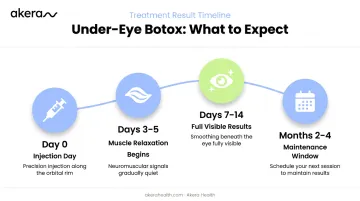
- Muscle relaxation begins within 3–5 days
- Full visible results appear at 7–14 days
- Under-eye Botox typically lasts 2–4 months — potentially shorter than forehead or glabellar areas due to the frequency of micro-expressions around the eyes
- Maintenance treatments are needed to sustain results; some patients find longevity improves with consistent sessions over time
What Good Results Look Like
Botox softens, rather than erases, under-eye lines. Realistic outcomes include:
- Subtle smoothing of dynamic lines during expressions
- A slightly more open, refreshed appearance
- Natural ability to smile and blink without restriction
If a result looks frozen or expressionless, that's a dosing or placement issue — not an inevitable outcome.
Side Effects
Common and temporary:
- Minor bruising, swelling, redness at injection sites (resolves within days)
- Mild headache
- Slight asymmetry between sides (addressable at follow-up)
Most patients experience only the above. A smaller subset encounter complications specific to the periocular area:
Rarer but more serious:
- Eyelid ptosis (drooping)
- Lower eyelid laxity
- Dry eyes from altered tear production
- Temporary weakness in adjacent muscles
For context: pooled safety data from upper-face onabotulinumtoxinA trials reported eyelid ptosis in approximately 1.1% of cases. An experienced dermatologist using conservative dosing substantially reduces these risks, though it does not eliminate them entirely.
Are You a Good Candidate for Under-Eye Botox?
Ideal Candidates
- Visible dynamic wrinkles around the eyes that appear with expression (smiling, squinting)
- Good general health with no neuromuscular conditions (myasthenia gravis, ALS, Lambert-Eaton syndrome)
- Realistic expectations — subtle improvement, not dramatic transformation
- Not pregnant or breastfeeding (safety data is insufficient for elective use)
Less Suitable Candidates
- Primary concern is tear trough hollowing, fat-related bags, or pigmentation-driven dark circles — Botox may be part of a combination plan but should not be the sole treatment
- Significant lower eyelid laxity, scleral show, or poor snap test: these increase ectropion risk
- Previous adverse reactions to botulinum toxin products
- Very thin lower eyelid skin
A Note on Consultations
The candidacy criteria above are only useful if your provider is willing to apply them honestly. A good consultation means being told when Botox isn't the right tool for your concern — not just proceeding because you've asked for it.
At Akera Health, consultations with Dr. Lavina Mittal are structured around accurate diagnosis first: identifying what's actually causing the concern before recommending any treatment. You should leave any pre-injectable consultation with a clear understanding of what the procedure addresses, what it doesn't, and what alternatives exist.
Alternatives and Complementary Treatments for the Under-Eye Area
Dermal Fillers for Tear Troughs
Hyaluronic acid fillers are the appropriate treatment for tear trough hollows and volume loss. They restore structure beneath the under-eye area, reduce shadowing, and produce results lasting approximately 9–18 months. A 2025 retrospective study of 155 patients found 68% improved by one grade on a validated assessment scale, with significant improvement maintained at 18 months.
Fillers add volume; Botox relaxes muscle. Many patients use both together — Botox for crow's feet and dynamic lines, fillers for hollows — targeting each concern with the right tool.
Energy-Based Treatments: RF Microneedling and Laser
For skin quality, texture, and laxity concerns that Botox alone cannot address:
- RF microneedling (Morpheus8 Pro at Akera Health) — stimulates collagen and elastin production, improving skin thickness and tightening around the eyes
- Laser toning — Akera Health's TriBeam Q-switched Nd:YAG laser targets excess melanin effectively, making it relevant for pigmentation-driven dark circles specifically
- Chemical peels — Akera Health offers these as a targeted option for hyperpigmentation-related dark circles, with consultations starting from ₹3,000

At-Home Maintenance
These don't replace professional treatments, but they support results between sessions:
- Retinol eye creams — a 12-week open-label study found approximately 33% improvement in lines among users of a retinoid/lactic acid eye cream
- Peptide formulations — support skin structure
- SPF daily — UV exposure accelerates collagen breakdown around the eyes
- Lifestyle habits — managing salt intake, allergies, and sleep quality reduces under-eye puffiness between treatments
Frequently Asked Questions
Is Botox good for wrinkles under eyes?
Botox is effective for dynamic wrinkles — those caused by muscle movement, including crow's feet and fine expression lines that appear when smiling. It is not effective for static resting lines, hollows, bags, or pigmentation-based dark circles. The right candidates see meaningful but subtle improvement.
How much does Botox cost for under-eye wrinkles in Bengaluru?
Crow's feet sessions in Bengaluru typically run ₹8,000–₹25,000 depending on the provider and units used. The under-eye area usually requires fewer units than the forehead. Contact the clinic directly for a quote based on your specific concerns.
How long does Botox last under the eyes?
Under-eye Botox typically lasts 2–4 months, which is slightly shorter than other areas due to the frequent micro-movements around the eyes. Results often improve with consistent maintenance, and some patients find they need fewer units over time as the targeted muscles gradually weaken.
What is the difference between Botox and fillers for under eyes?
Botox relaxes muscles to reduce dynamic wrinkles. Fillers add volume to address hollows, shadows, and tear troughs. They treat fundamentally different concerns and are sometimes used together for comprehensive under-eye rejuvenation, though they are not interchangeable.
What happens after 20 years of Botox?
Long-term Botox use is considered safe based on real-world evidence. Over many years, some patients need treatments less frequently as targeted muscles gradually weaken. That said, long-term safety data specific to the eye area is limited, so regular check-ins with a dermatologist remain advisable.