This guide covers everything you need to know about chin and jawline fillers — what they are, what concerns they treat, how the procedure works, how long results last, and whether you're a good candidate.
Key Takeaways
- Chin fillers improve projection and shape; jawline fillers define the lateral border — both are often combined in one session
- HA fillers are reversible and can be dissolved with an enzyme injection if needed; CaHA fillers offer deeper structural support but are not reversible
- Choose your filler type based on your correction goals — discuss both options with your dermatologist before treatment
- Clinical trials support results lasting approximately 12 months for most patients
- Complications are rare when treatment is performed by a qualified, experienced dermatologist
- Most patients achieve their goal in one session, with an optional touch-up around 4 weeks
What Are Chin and Jawline Fillers?
Dermal fillers are gel-like substances injected beneath the skin to restore volume, improve contour, and smooth lines. When applied to the lower face, they target two distinct anatomical areas:
- Chin fillers — focus on the chin point, adding forward projection, improving shape, and balancing the side profile
- Jawline fillers — work along the lateral jaw border to sharpen definition and recreate a more structured edge
Both are frequently used together in the same session for comprehensive lower face rejuvenation.
Types of Filler Materials Used
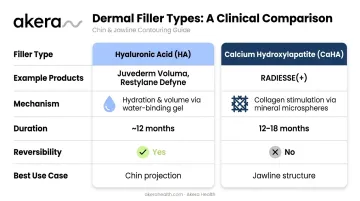
Hyaluronic acid (HA) fillers are the most commonly used option. HA is a sugar that occurs naturally in the body and binds water to provide immediate physical volume. Products like Juvederm Voluma and Restylane Defyne fall into this category.
Results typically last around 12 months in clinical studies. HA can also be dissolved with hyaluronidase if needed, which is a significant safety advantage over other filler types.
Calcium hydroxylapatite (CaHA) fillers, such as RADIESSE (+), work differently. The carrier gel provides immediate volume while calcium microspheres act as a scaffold, supporting fibroblast activity and collagen production over time.
CaHA offers structural support that makes it well-suited to the jawline. The key trade-off is reversibility — it cannot be dissolved with hyaluronidase, so results must run their course naturally.
| Hyaluronic Acid (HA) | Calcium Hydroxylapatite (CaHA) | |
|---|---|---|
| Example products | Juvederm Voluma, Restylane Defyne | RADIESSE (+) |
| How it works | Binds water for immediate volume | Gel + microsphere scaffold for volume and collagen stimulation |
| Duration | ~12 months | 12–18 months |
| Reversible? | Yes — dissolves with hyaluronidase | No |
| Best suited for | Chin projection, fine shaping | Jawline definition, structural support |
The right filler depends on your anatomy, the degree of volume loss, and what you want to achieve. A qualified dermatologist will assess all of these before recommending a product — and at a clinic like Akera Health, that assessment includes your skin type, facial structure, and long-term goals, not just the immediate concern.
What Concerns Can Chin and Jawline Fillers Address?
Weak or Receding Chin
A chin that lacks forward prominence can make the nose appear larger and the neck less defined. Fillers add projection at the chin point, improving the side profile and bringing facial features into better proportion. This makes them a well-suited option for mild-to-moderate chin retrusion.
Loss of Jawline Definition and Jowling
Ageing affects the lower face through several mechanisms at once:
- Mandibular bone remodelling
- Deep fat atrophy
- Superficial fat redistribution
- Ligament laxity
- Declining dermal collagen
The result is a softened jawline and early jowling. Fillers can replace some of that lost structural support along the jaw border, recreating a sharper, more youthful contour for mild-to-moderate changes.
Chin Wrinkles and Skin Texture
Fillers placed beneath the mentalis muscle can reduce over-contraction, softening horizontal chin creases and smoothing the dimpled "peau d'orange" texture that many people develop with age.
They also help with marionette lines where the corners of the mouth meet the jaw, by filling the prejowl sulcus and labiomandibular groove.
Facial Asymmetry
Minor soft-tissue differences between the left and right sides of the chin or jaw can be camouflaged with precisely placed filler. This is not a substitute for correcting significant skeletal asymmetry, but for subtle imbalances it can make a noticeable difference.
What Happens During a Chin or Jawline Filler Procedure?
Chin and jawline filler sessions are quicker than most people expect. The American Academy of Dermatology notes that most filler treatments take 15–30 minutes and generally require one office visit, though a review appointment with an optional touch-up is common.
What each stage looks like:
Consultation and facial assessment — The dermatologist evaluates your anatomy, skin quality, facial proportions, and aesthetic goals. At Akera Health, this analysis is personalised to your genetics, lifestyle, and specific concerns before any product selection is made.
Pre-treatment preparation — The area is cleansed and injection points are marked. A topical numbing cream is applied for comfort. Many fillers used for this area also contain lidocaine (0.3% in products like VOLUX XC and RADIESSE (+)) for added anaesthetic effect.
Injection — Small, precise amounts of filler are delivered at strategic points using a fine needle or blunt-tip cannula. Most patients describe mild pressure or a brief sting.
Immediate post-treatment — Results are visible straight away. Some swelling, redness, or tenderness at injection sites is normal and typically resolves within days. In clinical trials for Restylane Defyne, these reactions generally resolved within 1–2 weeks.

Aftercare Guidelines
- Avoid strenuous exercise for 24–48 hours
- Do not massage or apply pressure to the treated area
- Apply a cold compress to reduce swelling
- Avoid alcohol for the first 24 hours
- Stay well-hydrated
How Long Do Results Last?
Results vary by filler type, individual metabolism, and lifestyle. Here is what direct clinical evidence shows:
| Product | Area | Duration Finding |
|---|---|---|
| Juvederm Voluma XC | Chin | 57.6% responder rate at Month 12 |
| Restylane Defyne | Chin | Effectiveness assessed through 48 weeks |
| Juvederm Volux XC | Jawline | 61.3% responders at Month 12 |
| RADIESSE (+) | Jawline | 67.3% responders at Week 48; 43.5% at Week 60 without retreatment |
The data supports approximately 12 months of maintained correction for most patients. Response rates decline after that point, which is why a planned maintenance visit makes a measurable difference in how long your results hold.
Maintaining Your Results
- Schedule a touch-up every 6–12 months to preserve definition
- Apply a broad-spectrum SPF 50+ sunscreen daily to protect skin integrity
- Eat a diet rich in vitamin C and antioxidants to support collagen
- Stay hydrated to maintain overall skin quality
For patients interested in complementing filler volumisation with skin tightening, Akera Health offers Morpheus8 Pro RF Microneedling, which works beneath the skin's surface to stimulate collagen remodelling. No direct clinical evidence links RF microneedling to prolonged filler longevity specifically, but it addresses skin laxity as a separate concern and can complement a lower face rejuvenation plan.
Are Chin and Jawline Fillers Safe?
Chin and jawline fillers carry a strong safety record when performed by a qualified, experienced dermatologist. That said, it helps to understand what's common versus what's rare.
Common temporary reactions (based on pivotal trial data):
- Tenderness — reported in up to 81% of participants in Voluma chin trials
- Swelling, firmness, bruising — all frequently recorded but short-lived
- Nodules — reported in 1.5% of VOLUX XC jawline patients and 1.1% of RADIESSE (+) patients
These reactions are expected and resolve on their own within days to two weeks.
Rare but serious risks include vascular occlusion — accidental injection into a blood vessel. A 2021 JAMA Dermatology study across 1.6 million filler syringes found occlusion rates of 1 per 6,410 needle syringes and 1 per 40,882 cannula syringes. The risk is very low, but the consequences — including skin necrosis or, in rare cases, vision changes — are serious. Choosing a trained medical professional significantly reduces this risk and ensures you have someone equipped to respond if a complication does arise.

Knowing what to watch for after treatment is equally important. Contact your treating doctor immediately if you notice:
- Swelling or bruising lasting beyond two weeks
- Visible lumps that don't resolve
- Signs of infection: fever, warmth, or discharge
- Unusual pain, white or grey skin near injection sites, or any vision changes
Who Is a Good Candidate?
Good candidates typically:
- Are adults in good general health with realistic expectations
- Have mild-to-moderate chin retrusion or early-to-moderate jawline changes
- Prefer a non-surgical approach
- Understand that fillers complement but do not replace surgical correction for significant skeletal deficiency or severe skin laxity
Treatment should be postponed or avoided by those with:
- Active skin infection or cold sores in the treatment area
- Severe allergies to filler components, lidocaine, or bacterial proteins
- Bleeding disorders (particularly relevant for CaHA fillers)
- Pregnancy or breastfeeding — elective treatment should be deferred pending medical assessment
Connective tissue disorders and autoimmune conditions were excluded from most pivotal trials. If you fall into this category, each case warrants a one-on-one consultation before proceeding.
Frequently Asked Questions
How long do dermal chin fillers last?
Most chin fillers maintain correction for approximately 12 months, though individual results vary by filler type and metabolism. Your dermatologist can recommend a personalised maintenance schedule based on how your skin responds.
Is it safe to put fillers in your chin?
Yes — chin fillers are safe when performed by a qualified dermatologist. Common side effects like swelling and tenderness are temporary. Serious complications like vascular occlusion are rare, but they do occur — choosing a certified dermatologist significantly reduces that risk.
Can fillers help a saggy chin?
Fillers can address early sagging by restoring structural volume and support along the chin and jaw border. For more significant skin laxity, complementary treatments like RF microneedling may be recommended alongside fillers to improve skin tightening alongside volume restoration.
What is the difference between chin fillers and jawline fillers?
Chin fillers target the chin point to improve forward projection and shape. Jawline fillers define the lateral jaw border for a sharper, more structured edge. Both are frequently combined in a single session for a more cohesive lower face result.
How much do chin and jawline fillers cost in Bengaluru?
Cost depends on the filler type, the volume required, and the clinic's expertise. For accurate pricing tailored to your anatomy and goals, book a consultation directly with Akera Health's dermatologists at akerahealth.com/pages/contact.
How many sessions of chin filler do I need?
Most patients achieve their desired result in a single session, with an optional review and touch-up around 4 weeks if needed. Maintenance treatments every 6–12 months help sustain results.