Introduction
You follow a consistent skincare routine — cleanse, moisturise, SPF — and yet your skin still looks dull, feels perpetually dehydrated, or shows fine lines that no serum seems to touch. The frustration is real, and the reason is straightforward: topical products work on the surface, while many skin concerns originate deeper in the dermis.
Skin boosters address this from the inside out. These minimally invasive micro-injectables deliver hyaluronic acid (HA) — and in some formulations, amino acids, vitamins, or polynucleotides — directly into the dermis, where they restore moisture and stimulate the skin's own repair processes. They've grown in popularity precisely because they deliver visible, lasting improvements without reshaping or adding volume — a meaningful distinction from fillers and Botox.
This guide covers how skin boosters work, who they suit, what formulations are available, and how they compare to Botox and dermal fillers — so you can make an informed decision before your consultation.
Key Takeaways
- Skin boosters are HA-based micro-injectables that hydrate from within and can stimulate collagen production — without reshaping facial structure
- They suit most skin types and address dullness, dehydration, fine lines, and rough texture
- Results typically appear after 1–2 sessions, with effects lasting 6–9 months (varies by formulation)
- Unlike dermal fillers, skin boosters improve skin quality rather than adding volume
- Treatment must be administered by a certified dermatologist — not a spa or beauty salon
What Are Skin Boosters and How Do They Work?
Skin boosters are injectable formulations placed into the dermis to improve hydration, elasticity, texture, and radiance. A 2024 peer-reviewed review notes that the category includes HA-based products, polynucleotide (PN/PDRN) formulations, and other bioactive materials — a broader range than most people realise.
The Role of Hyaluronic Acid
HA is a naturally occurring glycosaminoglycan in the dermis with an exceptional capacity to bind water — up to 1,000 times its own volume. As skin ages and accumulates sun damage, natural HA levels decline, leaving skin drier, less elastic, and duller.
When injected into the dermis, HA doesn't simply sit there passively. Research shows cross-linked HA can mechanically stretch fibroblast cells, shifting them from a collapsed to an elongated morphology, which triggers significantly increased Type I collagen production. One study in older adults recorded a 6-fold increase in Type I procollagen staining after mid-dermal HA injection.
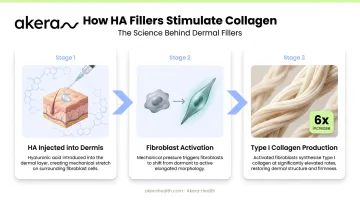
That said, this evidence comes from structural cross-linked HA studies. The magnitude of remodelling may vary across different booster formulations.
Injection Depth: It Depends on the Product
A common misconception is that all skin boosters are injected superficially into the papillary dermis. In practice, injection depth is product- and technique-specific:
- Non-cross-linked HA boosters : typically placed in the superficial to mid dermis
- Profhilo (IBSA) : uses a BAP (Bio Aesthetic Points) technique reaching deep dermal or subcutaneous levels
- Restylane Vital (Galderma) : the IFU specifies preferably deeper dermal placement
- Juvederm Volite (Allergan) : intradermal microdepot technique for superficial depressions and skin quality
This variation matters because depth partly determines how long results last and what kind of tissue response you get.
Skin Boosters vs. Dermal Fillers: The Key Difference
The distinction comes down to treatment objective and product rheology, not simply injection depth.
| Feature | Skin Booster | Dermal Filler |
|---|---|---|
| Primary goal | Hydration, elasticity, radiance, texture | Volume restoration, contouring |
| Mechanism | Distributed intradermal HA or bioactive; water retention + remodelling | Space-filling, structural support |
| Volume effect | Minimal (designed for skin quality, not projection) | Deliberate (creates structural correction) |
| Ideal candidate | Skin dehydration, dullness, fine lines, loss of elasticity | Volume loss in cheeks, lips, jawline |
The "zero volume" claim made about boosters isn't quite accurate — injected gel and bound water do cause some localised expansion. Even so, the intent and result are fundamentally different from structural filling.
Key Benefits of Skin Boosters for Your Skin
Deep, Sustained Hydration
Topical moisturisers work at the skin's surface. Injected HA works within the dermis, binding water at the tissue level and delivering hydration that persists far longer than any cream. In a 2023 randomised, double-blind, split-face trial involving 30 adults, three deep-intradermal non-cross-linked HA sessions produced 35% higher measured hydration versus saline controls, with improvements visible 10 days after the final session.
Improved Texture and Radiance
The same trial also found a 10% reduction in crow's-feet depth and measurable improvements in radiance and gloss. Patients typically notice smoother skin surface, reduced pore appearance, and a more brighter, more even complexion — concerns particularly relevant for those dealing with Bengaluru's combination of humidity, pollution, and UV exposure.
Collagen Stimulation Over Time
The hydration benefit is immediate; the structural benefit develops gradually. By activating fibroblasts, skin boosters can support new collagen formation over a treatment course, reducing the appearance of fine lines and early crepey texture. Most patients see meaningful structural improvement after a series of three sessions spaced two to four weeks apart.
Versatility Across Areas and Skin Types
Skin booster treatments can be applied to:
- Face (cheeks, forehead, perioral area)
- Neck and décolletage
- Under-eye area
- Hands
The under-eye and décolletage areas are particularly popular — both show early signs of ageing that topical products rarely address adequately.
Minimal Downtime
Sessions are quick and require little recovery. Most patients return to daily activities the same day, with only minor redness or swelling at injection sites that resolves within a few days.
Types of Skin Boosters: Which One Is Right for You?
Not all skin boosters are the same product, and the differences matter clinically.
HA-Based Formulations
These form the backbone of the skin booster category and include both cross-linked and non-cross-linked versions:
- Non-cross-linked HA — lower persistence, primarily hydration-focused; typically requires more frequent sessions
- Profhilo (IBSA) — thermally stabilised high- and low-molecular-weight HA without chemical cross-linking; a published protocol uses 5 bolus points over 2 sessions, 30 days apart
- Juvederm Volite (Allergan) — cross-linked HA with lidocaine; a 131-subject study found improved smoothness through month 6 and hydration through month 9
- Restylane Vital (Galderma) — stabilised non-animal HA; 3 treatments 4 weeks apart with elasticity benefits documented to 6 months; Galderma reports selected outcomes up to 15 months under defined protocols
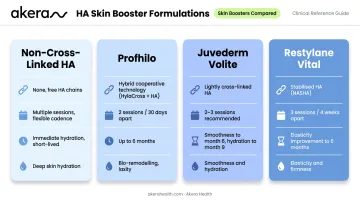
Cross-linking generally increases how long the product persists in the skin — but persistence isn't the same as volumising. Both types target skin quality, not structural lifting.
PN/PDRN-Based Formulations
- Rejuran (PharmaResearch) — salmon-derived polynucleotide injected into the dermis; the manufacturer recommends a 3–4 session course. PDRN is associated with adenosine A2A receptor activation, VEGF signalling, and fibroblast support, though much of the evidence comes from wound-repair and preclinical research. PN and PDRN are related but not interchangeable terms.
HA + Amino Acid/Vitamin Cocktails
Injectable HA complexes supplemented with amino acids and antioxidant vitamins have clinical evidence for improving hydration and viscoelasticity. Results are formulation-specific — outcomes from one cocktail shouldn't be assumed to apply to all.
Choosing the Right Formulation
Each formulation above behaves differently in the skin, which is why product selection should follow the concern — not the other way around. Key factors include:
- Your primary concern (dehydration vs. fine lines vs. texture vs. laxity)
- Skin type and sensitivity
- Desired duration of results
- Treatment area
At Akera Health, the dermatology team evaluates each patient's skin, lifestyle, and goals before recommending a protocol — because the same booster that works for deep dehydration may not be the right call for someone focused on fine line texture.
Who Should (and Shouldn't) Get Skin Boosters?
Ideal Candidates
Studies have included adults from their late 20s through older age. Skin boosters suit people experiencing:
- Persistent skin dehydration despite a good topical routine
- Dullness or fatigued-looking complexion
- Early fine lines and reduced elasticity
- Uneven texture, including post-acne surface irregularities
- Those wanting to maintain skin quality before visible aging becomes pronounced
Who Should Avoid or Discuss with Their Dermatologist First
Product guidelines and clinical literature support caution or exclusion for:
- Pregnancy and breastfeeding — safety not established; excluded from major product labelling
- Active infection or inflammation at the planned injection site
- Known hypersensitivity to HA or product components
- Severe bleeding disorders
Autoimmune conditions are not an absolute contraindication — suitability depends on disease activity, current treatment, and the specific product. A dermatologist consultation is the right place to work through this, not a blanket exclusion.
Medications and Supplements to Discuss
Galderma's labelling flags several medications and supplements that may increase bruising risk. Discuss the following with your dermatologist before your appointment:
- Prescription medications: Aspirin, NSAIDs, thrombolytics, and anticoagulants — do not stop any prescribed medication without medical guidance
- Supplements: Vitamin E, fish oil, and green tea extract carry mixed evidence for bleeding risk; your dermatologist will advise based on your full history
What to Expect: Your Skin Booster Treatment Journey
Before the Session
A dermatologist-led consultation comes first. At Akera Health, this involves a thorough skin assessment, review of medical history, realistic goal-setting, and selection of the appropriate formulation and number of sessions.
Pre-procedure preparation typically includes:
- Remove makeup and cleanse the treatment area
- Apply topical numbing cream — some products contain lidocaine; a separate topical anaesthetic may be applied beforehand
- Take pre-treatment photographs for comparative assessment
- Cleanse with antiseptic immediately before injection
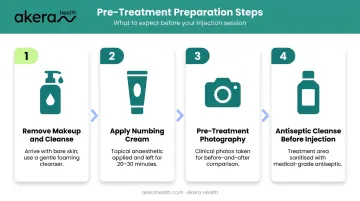
A hygienic, clinical setting is non-negotiable for both safety and outcomes.
During the Session
Microinjections or bolus injections are placed at precise depths using fine-gauge needles. The technique used varies by product:
- Micropuncture or serial puncture — for broad surface coverage
- Microdepot or BAP boluses — for deeper, targeted placement
After the injections, Akera Health applies a soothing post-treatment mask to support initial recovery.
After the Session
Post-care instructions vary by product and individual, but general guidance includes:
- Avoid makeup for at least 12 hours (Volite labelling specifies this)
- Avoid extended sun and UV exposure until initial reactions resolve
- Apply any recommended soothing or antibiotic cream as directed
- Maintain daily SPF use — Akera Health's SPF 50+ Sunscreen is a practical option for post-treatment skin protection
- Avoid vigorous exercise, saunas, and alcohol for at least 48 hours
When to Expect Results
- Within days: Initial softness and improved hydration
- After 1–2 sessions: Noticeable texture and radiance improvements
- After a full course (2–4 sessions): Optimal results; Akera Health notes visible improvement within one week of completing treatment
- Duration: Roughly 6–9 months for most HA formulations; some products support hydration through month 9 in clinical studies
Skin Boosters vs. Botox vs. Dermal Fillers
These three treatments are frequently compared but address fundamentally different concerns.
| Treatment | Primary Target | Core Mechanism | Best Outcome |
|---|---|---|---|
| Skin booster | Dermal skin quality | Intradermal hydration + formulation-dependent remodelling | Dullness, dehydration, elasticity, fine lines |
| Botox | Muscle-driven dynamic lines | Temporary localised muscle relaxation | Wrinkles from facial movement (forehead, crow's feet) |
| Dermal filler | Volume and contour | Space-filling and structural support | Volume loss in cheeks, lips, jaw; deep folds |
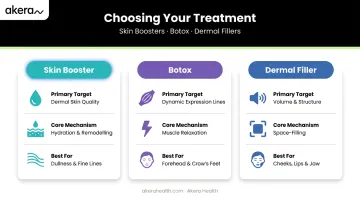
Because each treatment targets something different, none replaces the other. A patient with both skin quality concerns and structural volume loss may benefit from skin boosters and fillers together — they complement rather than compete.
That same logic extends further. Skin boosters pair well with Botox, chemical peels, laser toning, and RF microneedling (such as Morpheus8 Pro) for both texture improvement and targeted wrinkle reduction. A 2025 expert consensus discussed combining VYC-12L with energy-based devices, noting potential benefits with careful sequencing — though large-scale trial evidence on these combinations is still limited. Your dermatologist can guide you on the right sequencing and timing based on your specific skin concerns and goals.
Frequently Asked Questions
How long do skin boosters last?
Duration is product-specific, not a universal figure. Most HA-based skin boosters deliver hydration benefits for roughly 6–9 months after a course; some formulations like Juvederm Volite show hydration improvement through month 9 in clinical data, while Galderma reports selected Restylane Skinboosters outcomes up to 15 months under defined protocols. Individual metabolism and maintenance sessions also influence longevity.
Do skin boosters actually work?
Controlled and prospective studies support improvements in hydration, firmness, radiance, and surface texture. In one randomised split-face trial, three non-cross-linked HA sessions produced 35% higher hydration and a 27% improvement in firmness versus saline. Results are best sustained with a series of treatments and periodic top-ups.
Are skin boosters better than Botox?
Skin boosters and Botox serve different purposes. Skin boosters improve hydration, texture, and radiance from within the dermis; Botox temporarily relaxes muscles to soften dynamic expression lines like forehead furrows or crow's feet. Many patients benefit most from both treatments working together.
What are the side effects of skin boosters?
Common, temporary effects include redness, swelling, bruising, tenderness, and small injection-site bumps — most resolve within a few days. Serious complications are rare when treatment is performed by a qualified dermatologist under sterile conditions, which is why choosing a trained clinician matters.
How many sessions do you need?
Most patients complete 2–4 sessions spaced about 4 weeks apart, then maintenance every 6–12 months. Protocols vary by product: Profhilo uses 2 sessions 30 days apart, while Restylane Vital uses 3 sessions at 4-week intervals.
Can skin boosters be combined with other treatments?
Yes. Skin boosters pair well with Botox, dermal fillers, chemical peels, laser toning, and RF microneedling. Sequencing matters — a dermatologist will advise on the safest order and timing based on your skin goals and the treatments involved.