Understanding why this happens matters. According to a 2025 cross-sectional study of 150 adults, resting nasolabial folds were already visible in 36.7% of people aged 21–30 — well before most people expect to see them. By the 40s and beyond, the combination of collagen loss, volume redistribution, and cumulative sun exposure can make these folds significantly more pronounced.
This guide covers what causes nasolabial folds to deepen, which professional and at-home treatments actually work, and the prevention habits that slow their progression — with specific attention to Indian skin types and climate.
Key Takeaways
- Nasolabial folds are normal anatomy, but deepen with collagen loss, UV damage, smoking, and fat redistribution
- Folds that appear only during expressions in your 20s often become permanently visible by your late 30s–40s
- Hyaluronic acid fillers offer the strongest clinical evidence for fold reduction; RF microneedling rebuilds collagen gradually
- In India's high-UV climate, daily SPF 50+ sunscreen is the single most impactful preventive habit you can build
- Combining professional treatments with consistent home care — under dermatologist supervision — gives the best long-term results
What Are Nasolabial Folds and What Causes Them?
Nasolabial folds are formed by a dense network of fibrous tissue, facial muscles, and fat compartments — not simply by surface-level wrinkles. A foundational cadaver study identified superficial and deep muscle bundles alongside horizontal fibrous septa that support fold fat, confirming these are structural anatomical features, not skin-surface creases alone.
They deepen through a combination of biological and environmental factors — and the cause shapes the treatment.
Collagen and Elastin Loss
Skin gets its firmness and elasticity from collagen and elastin. As these proteins decline with age, skin loses its ability to spring back — and the nasolabial area becomes more permanently creased. Research comparing young adults (mean age 25) with older adults (mean age 75) found measurably rougher collagen fibrils and stiffer collagen bundles in older skin.
The process accelerates when midface fat compartments shrink and retaining ligaments weaken — changes that typically become visible from the 40s onward. Fat volume loss and ligament laxity are often the dominant drivers of fold depth in this age group, more so than surface skin changes alone.
Repeated Facial Movements
Every smile, laugh, and chewing motion creases the skin in the nasolabial area. Over years and thousands of repetitions, these dynamic lines gradually become static — etched into the skin surface even when the face is completely relaxed.
Sun Exposure and Photoaging
Beyond intrinsic aging, external factors can accelerate fold deepening significantly — and UV exposure is the most impactful. UV radiation reaches the dermis and triggers matrix metalloproteinases — enzymes that actively break down collagen and elastin. This process, called photoaging, compounds what chronological aging alone would cause. For people in India, where UV intensity stays high year-round, unprotected sun exposure is one of the most significant accelerators of fold formation.
Lifestyle and Genetic Factors
Several lifestyle habits compound the biological process:
- Smoking reduces type I and III collagen synthesis by 18% and 22% respectively, while simultaneously restricting blood flow to the skin
- Rapid or significant weight loss causes facial fat to recede, leaving skin hollow and folds more pronounced
- Weight fluctuations over time stretch and slacken skin repeatedly, accelerating laxity
- Genetic predisposition — a family history of early collagen degradation or skin laxity can accelerate fold formation regardless of lifestyle choices
How Nasolabial Folds Worsen Over Time
The progression follows a recognisable pattern, though timing varies between individuals:
| Age Range | Typical Fold Behaviour |
|---|---|
| Early–mid 20s | Visible mainly during expressions; some resting visibility in about 1 in 3 people |
| Late 20s–30s | Length, width, and area increase; upper fold changes become more prominent |
| 40s onward | Lower fold changes deepen; folds may be visible at rest; midface volume loss becomes a driver |
| 50s+ | Upper and lower fold changes continue; shadows and depth more pronounced |
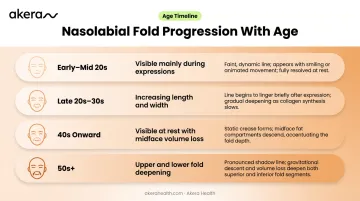
Understanding where you fall on this timeline helps you act before changes become harder to reverse.
Warning Signs Your Folds Are Deepening
Watch for these three signals that the process is accelerating:
- Folds visible at rest — if the crease is present even when your face is completely relaxed (not just when smiling), it has become static
- Cheeks appear to "fall" into the fold — this indicates significant volume loss in the mid-face, not just surface-level creasing
- Shadow and depth under normal lighting — early folds appear as faint lines; deepening folds cast visible shadows and create a hollow channel
Professional Treatment Options for Nasolabial Folds
The right treatment depends on fold severity, skin type, age, and your goals. For Indian skin types (Fitzpatrick III–V), treatment selection matters — some procedures carry a higher risk of post-inflammatory hyperpigmentation than others. A dermatologist assessment before starting any protocol helps identify your skin type, contraindications, and the most appropriate approach for your anatomy.
Dermal Fillers (Hyaluronic Acid Injections)
HA fillers are the most clinically supported option for nasolabial folds. A randomised split-face study of 100 subjects reported 6-month response rates of 64–65% with Global Aesthetic Improvement Scale scores of approximately 80% for both tested products. Results in the nasolabial area are immediate, with effects lasting typically 6–12 months.
Two approaches are used:
- Direct fold injection — fills the crease itself for immediate depth correction
- Midface/cheek volumisation — addresses the root cause (fat atrophy in the mid-face) and can produce more balanced, longer-lasting improvement; a 2025 clinical protocol recommends correcting midface deficits before addressing residual fold depth directly
Studies specifically assessing HA fillers in skin-of-colour cohorts confirm they are well-tolerated and effective — including an Indian patient study evaluating Restylane/Perlane in 30 patients. At Akera Health, dermatologists determine injection strategy during consultation, choosing between direct fold correction and midface volumisation based on individual anatomy and fold severity.
RF Microneedling and Skin Tightening
RF microneedling combines radiofrequency energy with fine needle penetration to stimulate collagen production in deeper skin layers. Clinical studies measuring improvement in facial wrinkles including nasolabial folds have shown meaningful results across 1–3 sessions spaced approximately four weeks apart.
This approach suits patients with mild-to-moderate folds who want gradual, natural-looking improvement without the immediate visual change of fillers. A 2023 review found RF microneedling carries a low reported risk of scarring or hyperpigmentation in skin of colour — a meaningful advantage for darker Fitzpatrick types.
Akera Health's Morpheus8 Pro protocol follows five structured steps:
- Skin analysis
- Topical anaesthetic application
- Microneedling penetration into the dermis
- Radiofrequency energy delivery for collagen remodelling
- Anti-inflammatory post-treatment mask
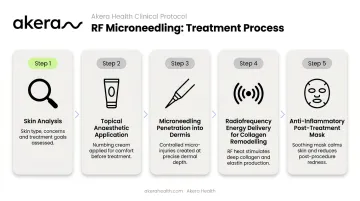
Session frequency is individualised by Akera's dermatologists based on fold severity and how the skin responds.
Botulinum Toxin (Botox)
Botox isn't typically used as a standalone treatment for nasolabial folds, but it plays a useful supporting role. By selectively relaxing specific lip-elevator muscles that pull and deepen the fold, it can reduce dynamic fold movement — most effectively as part of a combination approach with fillers. Effects generally last 3–5 months depending on dose, formulation, and the individual.
A clinical note: perioral Botox requires precision. Incorrect placement can affect smile mechanics, so this should only be performed by an experienced injector.
Laser Treatments and Chemical Peels
Laser resurfacing and chemical peels target nasolabial folds through collagen stimulation and skin texture improvement — making them more effective for surface-level fold quality than for deep structural correction. Published evidence includes statistically significant fold improvement with intraoral non-ablative Er:YAG laser and measurable softening following 2W laser treatment on the nasolabial area.
Important caveat for Indian skin: Fitzpatrick IV–VI skin carries a higher risk of pigmentary alteration with resurfacing procedures. Indian dermatological guidelines recommend superficial peels over deeper peels for darker skin tones, and laser modality selection should be made carefully.
Akera Health uses plant-based chemical peel solutions customised by dermatologists, alongside the TriBeam Q-switched Nd:YAG for laser toning — both chosen with Indian skin phototypes in mind.
How to Prevent Nasolabial Folds from Deepening
Prevention works best as a layered set of consistent habits. Starting earlier produces more noticeable long-term results.
Daily Broad-Spectrum Sunscreen
What to do: Apply a broad-spectrum sunscreen of at least SPF 30 (SPF 50+ for Indian climates) every morning as the final step of your morning routine. Reapply every two hours when outdoors.
Why it works: A randomised trial of 903 adults found that daily sunscreen use over 4.5 years produced 24% less measurable skin aging compared to discretionary use. UV radiation is the single most controllable external driver of collagen breakdown. The AAD recommends water-resistant, broad-spectrum SPF 30 or higher reapplied every two hours outdoors; the WHO advises protection whenever the UV Index reaches 3 or above, a threshold exceeded regularly across most of India.
Akera Health's SPF 50+ sunscreens are formulated for three skin types (oily/combination, normal, dry/sensitive) at ₹1,299. The dry/sensitive variant is especially suitable for the nasolabial fold area, which tends toward dryness.
Retinoids and Collagen-Boosting Skincare
What to do: Incorporate a retinoid (vitamin A derivative) into your nightly routine, starting at a low concentration and increasing gradually. Pair with a vitamin C serum in the morning for collagen synthesis support.
Why it works: A 2022 systematic review of randomised trials found topical tretinoin improved both fine and coarse photoaging wrinkles and increased collagen deposition in the dermis. Vitamin C is a direct cofactor in collagen hydroxylation — without adequate vitamin C, collagen cross-linking is impaired.
For Indian skin types: Start cautiously. Retinoids can cause irritation that triggers post-inflammatory hyperpigmentation in darker skin tones. Consult a dermatologist before selecting formulation and concentration.
Hydration and Moisturisation
Use a moisturiser containing hyaluronic acid, ceramides, or peptides twice daily. The evidence for each ingredient is consistent:
- Topical hyaluronic acid improved measurable skin appearance in a placebo-controlled trial of 40 women after 30 days
- Ceramide-containing creams significantly reduced transepidermal water loss (P<0.001) within 24 hours
- A 2026 systematic review found oral and topical peptides improved hydration, elasticity, and wrinkle appearance across multiple randomised trials
Well-hydrated skin appears fuller and smoother. Nasolabial folds appear shallower when the surrounding skin is plump and well-hydrated.
Lifestyle Modifications
Four habits with direct impact on fold progression:
- Quit smoking : collagen synthesis reduction of 18–22% is a measurable, documented consequence
- Maintain stable weight : repeated cycles of gain and loss stretch and slacken facial skin over time
- Prioritise sleep : 7–8 hours supports nightly skin repair and regeneration; poor sleep disrupts this process
- Sleep position : back sleeping or a contoured pillow reduces repetitive pressure on the cheek and mouth area

Long-Term Skin Care Habits That Help
Individual habits compound over time. The combination matters more than any single intervention.
- Schedule annual dermatologist check-ins from your late 30s onward — skin quality shifts over time, and both product and treatment recommendations need to keep up
- Incorporate gentle daily facial massage around the cheeks and nasolabial area to improve circulation and temporarily firm skin
- Target muscles around the mouth with facial exercises, which may help maintain tone with consistency over time
- Research links adequate protein, vitamin C, vitamin E, and omega-3 fatty acids to collagen production, antioxidant defence, and reduced oxidative skin ageing — vitamin C has the most direct role in collagen formation
No single habit eliminates folds. What works is layering professional guidance with consistent home care and realistic lifestyle awareness over years. At Akera Health, Dr. Lavina Mittal and the clinical team build personalised skincare plans around each patient's genetics, lifestyle, and skin concerns — because that compounding effect is where real, lasting change happens.
Frequently Asked Questions
How do I get rid of my nasolabial folds?
Treatment depends on severity. Mild folds may respond to topical retinoids and consistent moisturisation, while moderate to deep folds typically require professional options — hyaluronic acid fillers, RF microneedling, or laser treatments. Start with a dermatologist assessment — the best approach varies by anatomy and fold depth.
At what age do nasolabial folds start to appear?
Nasolabial folds begin as dynamic lines (visible only during expressions) in the early 20s. Research shows resting folds are already visible in about one-third of people aged 21–30. They typically become static — visible at rest — and progressively more prominent from the late 30s to 40s onward.
Are nasolabial folds permanent?
Nasolabial folds cannot be permanently eliminated — ongoing ageing, repeated facial movement, and structural changes continue throughout life. Fillers and RF microneedling can significantly reduce their appearance, and consistent prevention habits slow progression over time.
How long do dermal fillers last for nasolabial folds?
Hyaluronic acid fillers typically last 6–12 months in the nasolabial area. Duration varies by filler product, injection technique, individual metabolism, and lifestyle factors — smoking and high sun exposure can shorten results.
Can nasolabial folds be reduced without surgery?
Yes — and for most people, surgery is unnecessary. Dermal fillers have the strongest clinical evidence; RF microneedling, Botox, laser resurfacing, and chemical peels are also effective non-surgical options.
Does sunscreen really help prevent nasolabial folds?
Yes — daily sunscreen is one of the most evidence-backed preventive steps available. In India's high-UV environment, consistent SPF 50+ use year-round (not just in summer) makes a measurable difference in slowing collagen breakdown.