Radiofrequency microneedling addresses this from the inside out. It's a clinically backed, minimally invasive procedure that works below the skin's surface to stimulate the body's own repair mechanisms — and it's increasingly popular among dermatologists treating Indian skin tones specifically.
This guide covers how RF microneedling works, who it's suited for, what the procedure and recovery actually look like, and how long you can realistically expect results to last.
Key Takeaways
- RF microneedling combines needle-induced micro-injuries with targeted radiofrequency heat to stimulate collagen deep in the dermis
- Clinical research shows 34.35% mean improvement in acne scar scores after four sessions in an Indian patient cohort
- It's considered safe for all skin tones, including darker South Asian skin types, with lower PIH risk than ablative lasers
- Most patients need 3–4 sessions spaced 4–6 weeks apart; visible results continue improving for up to six months
- Akera Health's Morpheus8 Pro treatments start from ₹10,000 per session, with plans personalised by a board-certified dermatologist
What Is Radiofrequency Microneedling and How Does It Work?
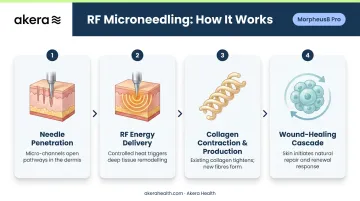
RF microneedling is a two-in-one procedure. Fine needles create controlled micro-injuries in the skin while simultaneously delivering radiofrequency energy through those needle tips into the dermis. The result: mechanical and thermal stimuli working together to trigger your skin's natural repair process.
The Mechanism, Step by Step
- Needles penetrate the skin at a precisely calibrated depth, creating fractional micro-channels
- Radiofrequency energy is released at the needle tips, generating controlled heat within the dermal tissue
- Heat causes immediate collagen contraction, followed by progressive remodelling and new collagen, elastin, and hyaluronic acid production
- The wound-healing cascade continues for weeks to months after the procedure
The thermal component is what separates RF microneedling from standard microneedling. Heat doesn't just stimulate new collagen — it remodels existing collagen fibres, producing firmer, thicker skin over time. Research from a 2023 comprehensive review confirms this dual mechanical-thermal mechanism and its histological effects.
RF Microneedling vs. Traditional Microneedling
| Feature | Traditional Microneedling | RF Microneedling |
|---|---|---|
| Mechanism | Needle micro-injury only | Needle injury + radiofrequency heat |
| Collagen stimulation | Surface-level | Deeper dermal remodelling |
| Skin tightening | Subtle | More significant |
| Results duration | Moderate | Longer-lasting |
| Safe for darker skin tones | Yes | Yes (lower PIH risk) |
One clinically meaningful advantage: because RF energy is delivered below the epidermis rather than targeting surface pigment, it is considered "colour-blind" — making it substantially safer for Indian and South Asian skin tones than many ablative laser treatments.
That skin-tone safety advantage only holds when the device is operated correctly — which is why calibration matters as much as the technology itself. At Akera Health, RF microneedling is performed using the Morpheus8 Pro, an upgraded version of the Morpheus8 platform offering deeper needle penetration and broader treatment coverage. A certified dermatologist adjusts settings including needle depth and RF intensity based on each patient's skin type, treatment area, and specific concern.
What Skin Concerns Can RF Microneedling Treat?
RF microneedling has published clinical evidence across multiple indications — from acne scars to laxity to pigmentation.
Conditions with direct clinical support:
- Atrophic acne scars — including pitted and rolling scars; the most extensively studied indication
- Fine lines and wrinkles — particularly periorbital and facial wrinkles
- Enlarged pores and uneven texture — documented in prospective studies of Asian skin types
- Mild-to-moderate skin laxity — body and facial improvement demonstrated at six months
- Stretch marks — a 2024 systematic review found fractional microneedle RF clinically effective for striae
- Hyperpigmentation/melasma — evidence supports RF microneedling, particularly when combined with PRP
Treatment areas extend beyond the face. Neck, décolletage, and body sites are all applicable depending on the concern being addressed.
Why It Works Particularly Well for Acne Scars on Indian Skin
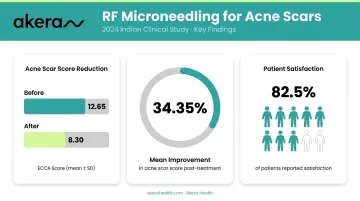
A 2024 Indian clinical study of patients with Fitzpatrick skin types III–V found that four RF microneedling sessions reduced the mean Goodman-Baron acne scar score from 12.65 to 8.3 — a 34.35% improvement — with 82.5% of patients rating their satisfaction as good to excellent.
Because the RF energy is deposited below the pigmented epidermis, the risk of post-inflammatory hyperpigmentation (PIH) is significantly lower than with ablative CO2 lasers.
A separate 2024 Indian retrospective study comparing RF microneedling and fractional CO2 found similar efficacy for atrophic scars, with lower downtime and fewer adverse effects on the RF microneedling side.
Combining RF Microneedling with PRP
RF microneedling can be combined with platelet-rich plasma (PRP) for enhanced outcomes. A 2026 randomised split-face trial found that RF microneedling plus PRP produced greater improvement in melasma than RF microneedling alone. Whether PRP adds benefit specifically for acne scar treatment remains an open research question, so discuss combination protocols with your dermatologist.
Are You a Good Candidate for RF Microneedling?
Who Benefits Most
The ideal candidate is someone in good general health with:
- Early-to-moderate acne scarring, fine lines, or skin laxity
- Enlarged pores or uneven skin texture
- Realistic expectations about gradual improvement
- Any skin tone — RF microneedling is appropriate across Fitzpatrick types I–V
Who Should Wait or Avoid the Procedure
Defer or avoid RF microneedling if you have:
- Active skin infections or open, inflamed lesions at the treatment site
- A history of keloids or poor wound healing
- Active implanted electrical devices (such as a pacemaker)
- Clotting disorders or current anticoagulant therapy
- Compromised immunity or relevant cancer history
- Pregnancy
The question of isotretinoin (Accutane) is more nuanced than often stated. A 2026 randomised study used low-dose isotretinoin concurrently with fractional RF sessions, though device-specific instructions vary. Your dermatologist will assess your individual history before making this call.
At Akera Health, every treatment begins with an in-depth consultation to review your medical history, skin type, lifestyle, and specific concerns — so the treatment plan reflects your unique needs.
What to Expect: The Procedure and Recovery Timeline
Before the Procedure
Your initial consultation will cover your medical history, current skin concerns, and pre-treatment instructions. Before your session:
- Avoid prolonged sun exposure in the weeks leading up to treatment
- Pause certain medications as directed by your dermatologist
- Take prophylactic antibiotics if you have a history of active acne or cold sores
- Book at least a month before any significant event to allow adequate healing time
During the Procedure
Here's what happens in the clinic:
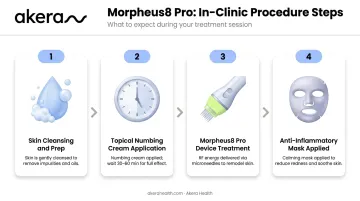
- Skin is cleansed and the treatment area is prepared
- Topical numbing cream is applied (typically 30–60 minutes, depending on the area and protocol)
- The Morpheus8 Pro device is passed over the treatment area, delivering needle penetration and RF energy simultaneously
- An anti-inflammatory mask is applied post-treatment to reduce redness and swelling
Session duration varies based on the area treated and number of passes required.
Recovery: Day by Day
| Timeframe | What to Expect |
|---|---|
| Immediately after | Redness, warmth, mild swelling — similar to a sunburn |
| Days 1–2 | Tightness, sensitivity; avoid makeup and heavy products |
| Days 3–5 | Possible light flaking or rough texture as skin renews |
| Week 1 | Most redness resolves; skin begins to appear smoother |
| Week 2 onwards | Collagen remodelling continues below the surface |
In the Indian clinical study, erythema occurred in 100% of patients and oedema in 30%, both resolving within 24 hours. Higher-energy treatments can occasionally leave grid marks lasting 1–2 weeks.
Post-Treatment Care
Protecting your skin at home is just as important as the treatment itself. Follow these guidelines:
- Apply broad-spectrum SPF 50+ daily — sun protection is essential on treated skin
- Use gentle, non-irritating cleansers only
- Avoid retinoids, AHAs, and BHAs for at least one week post-treatment
- Skip strenuous exercise, saunas, and direct sun for 24–48 hours
- Do not pick at peeling skin
Akera Health's Bask Sunscreen (SPF 50+) covers oily/combination, normal, and dry/sensitive skin types, making it a practical choice for post-treatment sun protection. Their Equi Cleanse, Soft Cleanse, and Dew Cleanse options are similarly formulated to keep treated skin calm while it heals.
Results: Effectiveness, Timeline, and Longevity
Does It Actually Work?
The evidence is solid. Multiple published studies and a 2025 systematic review confirm significant scar-grade improvement across RF microneedling monotherapy studies. For wrinkles, a Thai cohort study found that 82% of patients reported more than 25% improvement at six months, and 51% reported more than 50% improvement.
When Will You See Results?
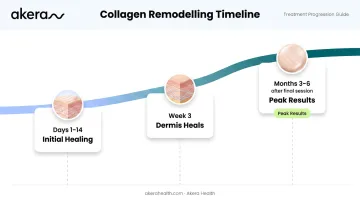
- First few days: Early changes may appear, with more visible improvement by weeks 2–4
- 3 weeks post-treatment: Full initial results become apparent as the dermis heals
- 3–6 months after final session: Optimal results, since collagen remodelling is a gradual process
How Many Sessions Are Needed?
Most patients require 3–4 sessions spaced approximately 4–6 weeks apart. Published protocols vary — the Indian acne-scar study used four sessions at three-week intervals, while other studies used two- to four-week spacings. At Akera Health, your dermatologist determines the right number of sessions based on your concerns and goals. Sessions start from ₹10,000.
How Long Do Results Last?
Most clinical studies followed patients for 3–6 months, with only a handful reaching 12 months. The claim that results routinely last 18–24 months isn't well-verified by current evidence. Results are long-lasting, particularly with consistent sun protection and skincare maintenance. Annual maintenance sessions are commonly recommended to preserve improvements.
Potential Side Effects and Safety Considerations
Common, Expected Reactions
These are normal signs of the healing process and typically resolve within days:
- Redness and warmth
- Mild swelling or edema
- Dryness and minor flaking
- Pinpoint bleeding or bruising at needle sites
- Occasional brief acne flare or cold sore breakout in those prone to them
In the 2021 body-laxity study, transient erythema occurred in 69% of patients and edema in 46% — all resolved without scarring or pigmentary change.
Rare but Serious Side Effects
Seek medical attention if you experience:
- Persistent redness or swelling beyond one week
- Signs of infection: increased warmth, pus, or fever
- Prolonged or unexplained bruising
- Any burn-like injury or significant skin change
The FDA has received reports of burns, scarring, fat loss, disfigurement, and nerve damage associated with RF microneedling devices — without published incidence rates. These outcomes are closely tied to provider training and incorrect device settings.
Why Provider Expertise Matters
Needle depth, RF intensity, pulse duration, and treatment spacing must all be calibrated to each patient's skin profile and anatomy. Excessive superficial energy increases epidermal injury risk and the likelihood of post-inflammatory hyperpigmentation (PIH) — a concern that is especially relevant for darker skin tones common across India.
Provider qualification directly shapes your risk profile. The same procedure carries very different outcomes depending on whether it's performed by a board-certified dermatologist using a properly calibrated device or by an untrained operator working with incorrect settings.
Frequently Asked Questions
Does microneedling with radiofrequency really work?
Yes. Multiple published studies and systematic reviews confirm measurable improvements in acne scars, wrinkles, enlarged pores, and skin laxity. The addition of radiofrequency energy to traditional microneedling delivers more skin tightening and deeper collagen remodelling than needling alone.
How long do results from microneedling with radiofrequency last?
Results are long-lasting with proper sun protection and maintenance. Most patients see continued improvement for 6–12 months, and annual touch-up sessions help preserve those gains over time.
What will my face look like after RF microneedling?
Expect redness, mild swelling, and warmth immediately after — similar to a moderate sunburn. This typically resolves within 24–48 hours. Light flaking or rough texture may follow in days 3–5, after which skin progressively appears smoother and firmer.
How many sessions of RF microneedling do I need?
Most patients need 3–4 sessions spaced 4–6 weeks apart. Deeper acne scars or more significant laxity may require additional sessions. At Akera Health, your dermatologist will determine the right number based on your individual concerns.
Is RF microneedling safe for darker or Indian skin tones?
Yes. Because RF energy is delivered below the pigmented epidermis rather than targeting surface melanin, the risk of post-inflammatory hyperpigmentation (PIH) is considerably lower than with ablative laser treatments. Studies on Indian skin tones (Fitzpatrick III–V) confirm effective results with side effects that are typically mild and short-lived.
What is the difference between regular microneedling and RF microneedling?
Traditional microneedling relies on needle-induced micro-injuries to stimulate collagen. RF microneedling adds controlled heat energy delivered directly into the dermis — producing deeper structural changes and longer-lasting skin tightening that needles alone cannot achieve.