The good news: dermal fillers are a well-established, minimally invasive treatment with a strong safety record and natural-looking results when performed by a qualified dermatologist. This guide covers how fillers work for nasolabial folds, what the treatment process looks like, how long results last, what risks to understand, and what other options exist.
Key Takeaways
- Nasolabial folds deepen due to collagen loss, descending fat pads, and gradual bone resorption — not surface wrinkling alone
- Hyaluronic acid (HA) fillers are the most commonly used and reversible first-line treatment
- Results typically last 6 to 18 months depending on filler type and individual factors
- The goal is softening the fold — not eliminating it completely
- A dermatologist consultation is essential before any treatment
What Are Nasolabial Folds and What Causes Them?
Nasolabial folds are the creases that run from the sides of the nose down to the corners of the mouth. Often called "smile lines" or "laugh lines," they're present in virtually everyone. What changes with age: these folds become visible even at rest — not just during expression. Understanding why requires a look at what's happening beneath the skin's surface.
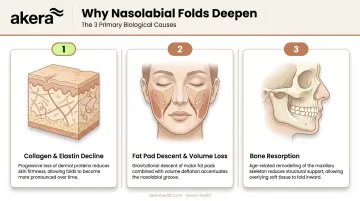
The Biology Behind the Fold
Research into facial aging anatomy identifies three primary structural contributors:
- Collagen and elastin decline — intrinsic aging reduces skin firmness; elastin production falls markedly around ages 40–50
- Fat pad changes — nasolabial fat can enlarge or descend while adjacent midface compartments lose volume, sharpening the boundary between cheek and upper lip
- Bone resorption — the maxillary and piriform regions recede with age, reducing structural support beneath the medial cheek and alar base
A 2025 cross-sectional study of 150 adults found that 36.7% of participants in their 20s already had a visible nasolabial fold at rest, with upper-fold changes accelerating through the 30s–50s and lower-fold changes through the 40s–60s.
Lifestyle and External Factors
Structural aging isn't the whole story. These external factors accelerate fold deepening:
- Smoking — a comparison study found significantly greater nasolabial fold surface area in smokers (p=0.031), linked to altered collagen and elastin turnover
- Chronic sun exposure — photoaging damages collagen architecture and produces solar elastosis
- Significant weight fluctuations — major weight loss causes facial fat devolumisation and increased skin laxity
- Habitual side-sleeping — repeated mechanical pressure on one side of the face can deepen the fold asymmetrically over time
- Genetics — family history determines how early and how deeply folds develop
How Do Nasolabial Fold Fillers Work?
Dermal fillers restore lost volume beneath the skin to structurally support tissue and reduce the shadow created by the fold. Rather than stopping the ageing process, they create a temporary scaffold that softens the crease while preserving natural facial movement.
Direct vs. Indirect Treatment
There are two distinct placement strategies, and experienced dermatologists often combine them:
| Approach | What It Does | Best For |
|---|---|---|
| Direct filling | Filler placed along the crease itself | Softening a visible, defined fold |
| Midface/cheek support | Volume placed in the cheek or piriform fossa region | Addressing underlying structural volume loss |
A 77-patient 3D imaging study found that cheek volumisation alone did not mechanically lift or move the nasolabial fold. Treating midface volume loss addresses a separate contributor, but direct fold treatment remains necessary for the crease itself. A 2025 assessment protocol recommends matching the approach to the identified cause — direct, indirect, or combined — rather than applying a one-size-fits-all method.
What the Dermatologist Assesses
Before any injection, the treating dermatologist evaluates:
- Fold depth and symmetry
- Skin thickness and quality
- Fat pad position and nasolabial fat compartment
- Bone support in the piriform and premaxillary region
- Overall facial anatomy and movement patterns
Overfilling is a recognised mistake. Excessive product in the nasolabial area creates an unnatural, doughy or pillowy appearance — and can lead to asymmetry, nodules, or product migration over time. The goal is always subtle correction, not maximum volume.
This is also why filler choice matters. Hyaluronic acid fillers are reversible using an enzyme called hyaluronidase, which makes them the preferred option for first-time patients and anyone who wants built-in flexibility.
Types of Fillers Used for Nasolabial Folds
No single filler suits every patient. The choice depends on fold depth, skin quality, tissue mobility, and treatment goals.
Hyaluronic Acid (HA) Fillers
HA fillers are the most widely used option. They blend naturally with tissue, provide immediate results, and are adjustable. G-prime (the filler's resistance to deformation) determines how each product performs:
- Lower G-prime (softer gels) — used for superficial fine lines
- Medium to higher G-prime — used for deeper structural NLF correction
Common HA products with FDA indications specifically for nasolabial folds include Juvéderm Vollure XC and Restylane Refyne and Defyne. Vollure data shows 93.2% of patients maintained at least one severity-grade improvement at 6 months, with 59.4% still showing improvement at 18 months.
At Akera Health, dermatologists select internationally approved hyaluronic acid fillers suited to each patient's skin type and fold severity — including patients with darker or more sensitive skin tones.
Alternative Filler Types
When HA fillers aren't the right fit — due to volume loss patterns or patient preference for longer-lasting stimulation — two alternatives are commonly considered:
- Calcium hydroxylapatite (e.g., Radiesse) — provides immediate volume and stimulates collagen production; one long-term follow-up found 40% of treated folds still improved after 30 months
- Poly-L-lactic acid (e.g., Sculptra) — a biostimulator that builds collagen gradually over multiple sessions; better suited to patients with generalised volume loss rather than isolated fold correction

What to Expect: Treatment Process and Recovery
The Consultation
A thorough assessment happens before any filler is selected. The dermatologist evaluates the face in an upright position — not lying down, where gravity changes fold appearance — and identifies fold cause, severity, and the appropriate injection approach.
At Akera Health, this includes an honest discussion of whether fillers alone are sufficient or whether complementary treatments like Morpheus8 RF Microneedling or chemical peels would yield better long-term results.
The Treatment Session
- Skin cleansing and topical numbing cream — applied before any injections begin
- Filler injection — using a fine needle or cannula; cannula technique has been shown in a double-blind randomized trial to produce less pain, bruising, and swelling than a needle, with comparable correction
- Immediate results visible — though final contour settles as swelling reduces
Recovery Timeline
| Timeframe | What to Expect |
|---|---|
| Days 0–2 | Mild redness, swelling, possible bruising — normal |
| Days 3–7 | Swelling subsides, contours begin to smooth |
| Week 2 | Filler settles fully; results stabilise |
In Restylane Refyne and Defyne trial diaries, swelling occurred in 60.1% of patients and bruising in 57.1%, with most swelling lasting 1–3 days and bruising resolving within 1–14 days.
Aftercare
- Avoid intense exercise, direct sun exposure, and extreme heat (saunas, steam rooms) for the first 24–48 hours
- Do not massage the treated area
- Sleep with the head slightly elevated on the first night
- Apply SPF daily — both to protect healing skin and to maintain results longer
Set realistic expectations: some fold will always remain — it is a structural feature of the face. Patients who expect complete elimination of the crease are likely to be disappointed, and overfilling to achieve that goal creates unnatural results.
Risks and Side Effects of Nasolabial Fold Fillers
Common Temporary Reactions
These are expected and resolve on their own:
- Bruising, swelling, redness at injection sites
- Mild tenderness or firmness
- Temporary lumps or bumps
Most reactions resolve within 7–14 days. Cannula technique reduces bruising risk at certain anatomical points near the facial artery.
Technique-Related Complications
These occur with inadequate experience or assessment:
- Overfilling — adds bulk instead of softening, making folds appear heavier
- Superficial placement — can cause visible lumps or a raised "shelf" effect at the fold margin, or a blue-grey Tyndall effect through the skin
- Uneven distribution — leads to asymmetry
Rare but Serious: Vascular Occlusion
The angular artery runs near the nasolabial fold — and its position varies. One anatomical study found it medial to the fold in 42.9% of specimens, lateral in 23.2%, and crossing it in 33.9%. Surface landmarks cannot guarantee vessel position.
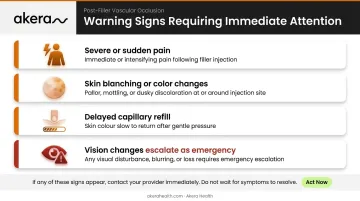
Beyond technique errors, the anatomy itself introduces a less common but more serious risk: vascular occlusion. This occurs when filler blocks blood supply to surrounding tissue. A Dutch prospective study estimated approximately 1 vascular event per 6,558 facial filler treatments overall — uncommon, but potentially severe. Warning signs requiring immediate attention:
- Severe or sudden pain during/after injection
- Skin blanching or colour changes
- Delayed capillary refill
- Any vision changes — escalate as emergency
A provider with verified anatomical training and emergency protocols — including on-hand hyaluronidase for HA fillers — is essential for managing this risk if it arises.
Who Is Not a Good Candidate
- Patients with significant skin laxity or advanced fat pad descent — surgical options may be more appropriate
- Active infection or inflammation near the treatment area
- History of severe allergic reactions or ingredient hypersensitivity
- Certain connective tissue disorders — requires individualised medical assessment
- Pregnant or breastfeeding women
Other Ways to Treat Nasolabial Folds
Fillers address volume. Other treatments address skin quality, laxity, or tissue position. They're often most effective when combined.
RF Microneedling (Morpheus8)
Radiofrequency microneedling stimulates collagen remodelling and improves skin laxity, targeting what fillers cannot: the quality of the skin surrounding the fold. Akera Health offers Morpheus8 Pro RF Microneedling, which complements filler treatment by tightening and remodelling the nasolabial region.
A 2025 observational paper reported softening of nasolabial folds with RF-assisted treatment and no major complications, though this was a single study without a controlled comparison.
Chemical Peels
Chemical peels refine skin texture and tone in the nasolabial area, targeting surface-level changes that fillers don't address. At Akera Health, plant-based peel formulations are customised to each patient's skin type. They work best for:
- Uneven skin tone and photoaging around the fold
- Pigmentation changes at the nasolabial crease
- Overall surface texture when combined with injectables
Other Non-Surgical Options
- PDO cog threads : mechanically reposition descending tissue; a 2026 study reported longer-lasting correction when combined with botulinum toxin than threads alone
- Laser resurfacing : ablative and non-ablative approaches stimulate collagen and improve skin quality; an Er:YAG pilot found intraoral SMOOTH-mode treatment effective for NLF rejuvenation
- Topical retinoids : slower-acting, useful for mild surface changes and long-term skin maintenance; a 2022 pilot showed modest NLF improvement after 6–11 weeks, though effects were smaller than HA or CaHA correction
What About Botox?
Botox relaxes muscles. Nasolabial folds result from volume loss and structural descent — not from muscle overactivity. Botox is not a substitute for fillers in this area. Small doses near the levator labii (the muscle contributing to gummy smile or upper-lip animation) may be used alongside fillers at the dermatologist's discretion, but this is an adjunct — not a standalone treatment for folds.
Frequently Asked Questions
Are fillers good for nasolabial folds?
Yes — dermal fillers are widely considered the first-line non-surgical treatment for nasolabial folds. They restore volume and structural support beneath the skin to soften the crease, with results that are visible immediately and reversible if needed.
How long will fillers last in nasolabial folds?
Most dermal fillers in the nasolabial area last between 6 and 18 months. Duration varies by filler type, the individual's metabolism, and how much the area moves with facial expression and talking.
Is 1ml of filler enough for nasolabial folds?
1ml is often a reasonable starting point for mild-to-moderate folds. Deeper folds or patients requiring midface support in addition to direct fold treatment may need more. The exact volume is determined during a dermatologist consultation based on individual facial anatomy and goals.
What are the risks of nasolabial fillers?
Common risks include bruising, swelling, and temporary tenderness, which resolve within 1–2 weeks. Rare but more serious risks include vascular occlusion — which is why treatment should only be performed by a medically qualified provider with strong anatomical knowledge and the ability to manage complications.
Can nasolabial fold fillers be reversed?
Hyaluronic acid fillers — the most commonly used type — can be dissolved using hyaluronidase, an enzyme injection that breaks down the filler, making them fully reversible if results are unsatisfactory or a complication arises.
What is the difference between fillers and Botox for nasolabial folds?
Fillers add volume to structurally lift and soften the fold; Botox relaxes muscles. Because nasolabial folds are driven by volume loss and tissue descent rather than muscle overactivity, fillers are the more effective treatment. Botox may complement filler in select cases but cannot replace it.
Ready to discuss your nasolabial fold treatment options with a qualified dermatologist? Book a consultation with the team at Akera Health in Bengaluru — HSR Layout or HRBR Layout — for a personalised facial assessment.