The honest answer is that hair restoration isn't a single procedure with a fixed price. It spans a wide spectrum — from non-surgical sessions that run a few thousand rupees to full surgical transplants that can exceed ₹1,50,000. The right cost depends entirely on your diagnosis, the stage of your hair loss, and where you get treated.
This guide breaks down realistic pricing for every major hair restoration option available in India, explains what drives costs up or down, and helps you figure out what budget actually makes sense for your situation.
Key Takeaways
- Non-surgical treatments like PRP and GFC typically start from ₹5,500 per session — best suited for early-to-moderate hair loss
- Surgical hair transplants at other clinics in Bengaluru typically range from ₹77,000 to ₹1,65,000 — non-surgical routes offer a significantly lower-cost alternative
- The degree of hair loss — not the treatment type — is the biggest driver of total cost
- Bengaluru sits at the higher end of metro pricing, with the highest average listed cost among major Indian cities
- Choosing by price alone — without a proper diagnosis — is the most expensive mistake you can make
How Much Does Hair Restoration Cost in India?
Hair restoration costs vary considerably based on three variables: the type of treatment, the extent of hair loss, and the clinic. Without clarity on all three, most people either underbudget or pursue treatments they don't actually need.
Two common mistakes worth avoiding:
- Jumping straight to surgery when non-surgical treatment would have worked for their stage of hair loss
- Choosing the cheapest option without evaluating clinic safety standards, leading to poor outcomes and corrective costs later
Non-Surgical Hair Restoration
Non-surgical treatments work by stimulating existing hair follicles. They're appropriate when follicles are still active but weakened — not yet lost.
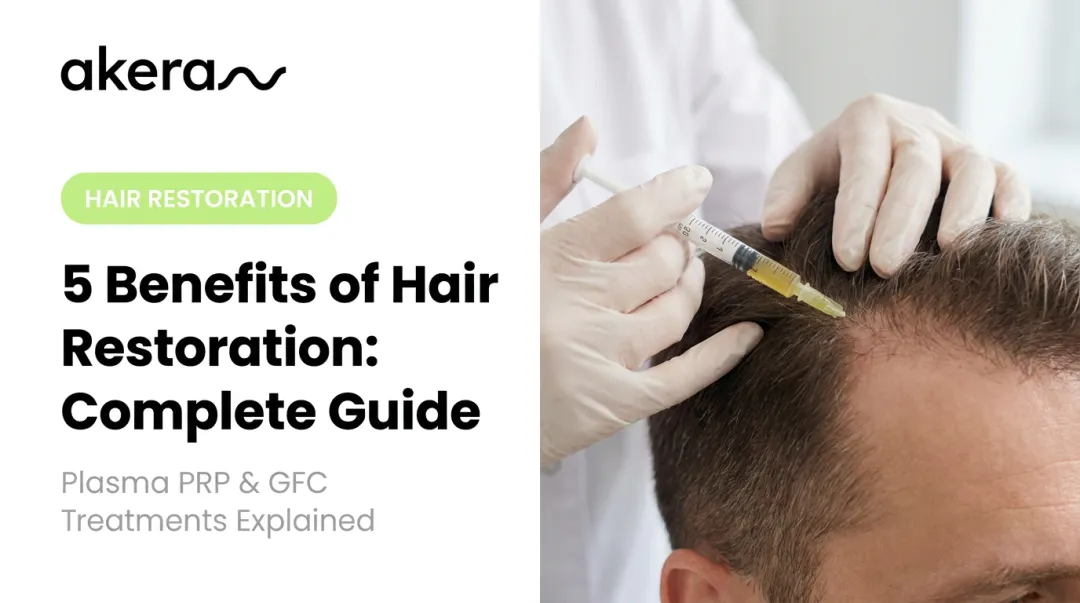
The most common options in India are PRP (Platelet-Rich Plasma) therapy and GFC (Growth Factor Concentrate). Both use the patient's own blood to deliver concentrated growth factors directly into the scalp.
At Akera Health in Bengaluru, non-surgical plasma hair restoration sessions start from ₹5,500, which places them in the mid-range of what clinics in the city typically charge for these treatments. Sessions include scalp assessment, blood draw, centrifuge processing, topical numbing, and the injection itself — all performed under dermatologist supervision. Medications or topical treatments (such as minoxidil) are not included in the session cost.
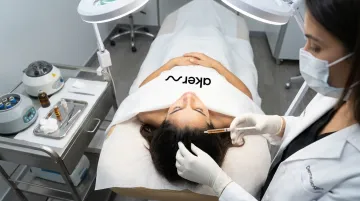
Treatment courses involve multiple sessions — published protocols commonly support three monthly induction sessions followed by maintenance every six months, though individual plans vary based on hair loss severity and response to treatment.
Best suited for:
- Early-to-moderate hair thinning in men and women
- Hormonal hair loss, including PCOS-related shedding
- Individuals looking to slow hair loss progression before considering surgical options
- Post-transplant support for preserving remaining natural hair
What About Surgical Hair Transplants?
For individuals with advanced follicle loss where stimulation alone cannot achieve regrowth, surgical transplant (FUE or FUT) may be the appropriate next step. This involves extracting and reimplanting donor follicles under local anaesthesia — a procedure performed by surgical specialists rather than dermatology clinics.
Akera Health focuses exclusively on non-surgical plasma hair restoration. If a consultation indicates that surgical evaluation is warranted, the team will communicate this clearly so you can seek the right specialist.
Key Factors That Affect Hair Restoration Cost
Hair restoration costs vary widely depending on your degree of hair loss, the treatment approach, your provider's credentials, and where the clinic is located.
Degree of Hair Loss and Treatment Extent
For any hair restoration treatment — surgical or non-surgical — the extent of hair loss is the primary cost driver. Treatment planning is based on the size of the affected area and the desired density, and it cannot be accurately estimated without a clinical scalp evaluation.
Two classification systems help assess hair loss severity:
- Norwood Scale (men): Stages I through VII, progressing from minimal recession to near-complete crown and frontal loss
- Ludwig Scale (women): Grades I through III, moving from mild central thinning to severe crown loss while typically preserving the frontal hairline
For non-surgical treatments like PRP and GFC, patients with more advanced loss (Norwood Stage IV+) typically require more sessions in the initial course and more frequent maintenance — directly increasing total cost. Earlier-stage intervention is almost always more cost-effective.
Treatment Approach: Non-Surgical vs. Surgical
| Factor | Non-Surgical (PRP/GFC) | Surgical Transplant |
|---|---|---|
| Cost | Lower per session; ongoing | Higher upfront; usually one-time |
| Scarring | None | Varies by technique |
| Recovery | No downtime | Several days to weeks |
| Sessions needed | Multiple (ongoing maintenance) | Usually one to two |
| Best for | Early to moderate loss | Moderate to advanced loss |
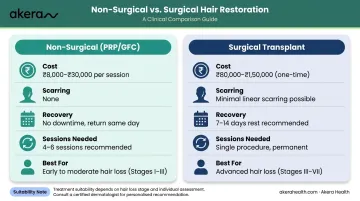
Non-surgical options like PRP and GFC are well-suited for patients in earlier stages of hair loss, those who want to avoid surgery, or those looking to maintain results after a transplant. For severe or advanced loss, surgical options may be discussed as a referral — Akera Health focuses exclusively on non-surgical plasma hair restoration.
Dermatologist Qualifications and Clinic Standards
Dermatologist-supervised clinics charge more than unregulated providers — and the difference in outcome quality justifies the gap. For non-surgical treatments like PRP and GFC, protocol precision matters: platelet concentration, injection depth, and session spacing all affect results.
Clinics cutting costs through unqualified staff or low-grade equipment often produce inconsistent outcomes that require corrective sessions, erasing any initial savings. When evaluating a clinic, check for:
- Dermatologist or trichologist oversight (not just technician-led sessions)
- Documented hygiene and sterilization protocols
- Transparent pricing with no hidden package fees
- Verified patient reviews and before/after documentation
City and Clinic Location
Bengaluru has the highest starting and average listed hair restoration price among India's major metros, based on listed clinic prices on Practo:
| City | Starting Price | Average | Upper Range |
|---|---|---|---|
| Bengaluru | ₹77,000 | ₹98,000 | ₹1,65,000 |
| Mumbai | ₹20,000 | ₹57,633 | ₹1,50,000 |
| Delhi | ₹25,000 | ₹34,491 | ₹1,25,000 |
| Hyderabad | ₹35,000 | ₹55,980 | ₹2,65,000 |
| Chennai | ₹35,000 | ₹48,771 | ₹2,65,000 |
Even within a city, clinics in premium locations charge more than those in outer areas due to higher operational costs.
Number of Sessions Required
- Non-surgical (PRP/GFC): An initial course of 3–6 sessions, followed by maintenance every 3–6 months; results typically last 6–18 months before top-up sessions are needed
- Advanced hair loss cases: More sessions in the initial course and shorter maintenance intervals — increasing annual cost compared to early-stage treatment
- Surgical transplants: Typically one to two sessions; ongoing non-surgical maintenance is often recommended post-transplant to preserve surrounding hair
Non-Surgical vs. Surgical Hair Restoration — A Cost Comparison
The most important cost question isn't which clinic is cheapest — it's which treatment category is right for your specific hair loss stage. Getting this wrong wastes money and delays results.
| Factor | PRP (Platelet-Rich Plasma) | GFC (Growth Factor Concentrate) |
|---|---|---|
| Upfront cost per session | Lower | Slightly higher |
| Sessions needed | Multiple (ongoing) | Multiple (ongoing) |
| Timeline to results | 3–6 months | 3–6 months |
| Longevity per course | 6–12 months | 6–18 months |
| Growth factor concentration | Standard | Higher (more targeted) |
| Best for | Early-stage loss, maintenance | Moderate loss, accelerated response |
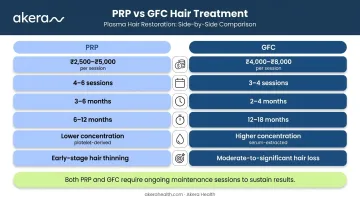
Both PRP and GFC require ongoing maintenance every few months, so annual costs accumulate over time. A four-session PRP course at ₹5,500 per session totals ₹22,000, with periodic top-up sessions adding to that each year. GFC sessions typically cost slightly more per visit but may extend the interval between maintenance courses.
The key clinical distinction is follicle viability. PRP and GFC can only stimulate follicles that are still alive and responsive. If follicles are permanently lost, non-surgical treatment will not restore them — that requires a separate surgical consultation with a hair transplant specialist. Starting non-surgical treatment earlier, while follicles are still active, consistently delivers better outcomes and costs far less than waiting until options narrow.
A dermatologist-supervised assessment — such as those conducted at Akera Health in Bengaluru — determines whether your follicles are still responsive to non-surgical treatment, and which protocol (PRP or GFC) suits your hair loss stage, scalp health, and genetics before you commit to any spend.
How to Estimate the Right Budget for Hair Restoration
Right-sizing your budget means looking beyond the quoted price of a single session. Consider these variables together:
Stage of hair loss:
- Early-stage thinning → non-surgical approach (PRP or GFC), lower total cost
- Moderate-to-advanced loss → more intensive PRP/GFC course with longer treatment duration and higher overall investment
Full course cost vs. per-session cost: A clinic offering ₹3,000 per session that requires 12 sessions costs more than one offering ₹5,500 per session for a structured 6-session course. Always ask for the full treatment plan cost, not just the per-session figure.
Post-treatment maintenance: Factor in maintenance sessions every 3–6 months for non-surgical treatments, or ongoing GFC/PRP support after completing an intensive course.
What's included in the quote: Ask specifically whether pre-treatment tests, medications, follow-up consultations, and post-session care are included or charged separately.
Once you have a treatment plan from a qualified dermatologist — covering session count, spacing, maintenance schedule, and itemised costs — you can budget with confidence rather than guessing from a single quoted figure.
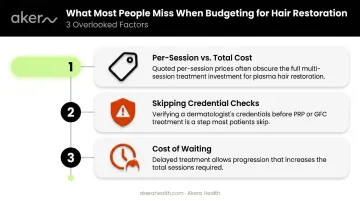
What Most People Miss When Budgeting for Hair Restoration
Per-session price isn't the same as total treatment cost. A low per-session rate spread across many sessions often adds up to more than a structured mid-range course. Stopping treatment mid-way because costs crept up means results are never fully achieved.
Choosing a clinic without checking credentials. Complications from poorly performed procedures — graft failure, unnatural results, scalp infections — cost substantially more to correct than the original treatment. A provider's hygiene standards, doctor qualifications, and track record matter as much as the quoted price.
Ignoring the cost of waiting. As hair loss progresses from early to advanced stages, treatment options narrow and costs rise. More grafts, more sessions, higher complexity — early intervention is almost always cheaper than late intervention.
Frequently Asked Questions
How much does it cost to restore hair in India?
Non-surgical treatments like PRP and GFC typically start from around ₹5,500 per session, with multiple sessions required per course. Surgical hair transplants in Bengaluru range from approximately ₹77,000 to ₹1,65,000 depending on graft count and technique. Total cost depends on the type and severity of hair loss.
How much does a 3,000-graft hair transplant cost in India?
Pricing varies by clinic and technique. Based on Bengaluru market data, a 2,000-graft FUE procedure typically runs ₹75,000–₹1,50,000; a 3,000-graft case generally falls at the higher end of that range or above. FUT for the same count is usually lower. Always request an itemised quote after a clinical assessment.
Is hair transplant 100% safe?
Hair transplants are generally safe when performed by qualified surgeons in well-equipped, hygienic clinics — infection rates in peer-reviewed studies run below 1% for qualified practitioners. Serious complications are rare but more likely in unregulated settings. Common temporary effects include swelling, shedding, and mild scalp sensitivity.
Which hair restoration treatment is best for early-stage hair loss?
Non-surgical treatments — PRP, GFC, or a combination — are typically first-line for early-stage thinning where follicles are still active. A dermatologist can evaluate the hair loss pattern and recommend the most effective approach before irreversible follicle loss occurs, avoiding unnecessary surgery.
How many PRP sessions are needed to see results?
Published protocols support three monthly induction sessions followed by maintenance at six-month intervals. Visible improvement in hair density is typically noticeable after three to four sessions, though results vary based on individual response and the degree of hair loss when treatment begins.