Platelet-rich plasma therapy — commonly nicknamed the "vampire facial" — uses your own blood to stimulate the skin's natural repair processes. The concept sounds dramatic, but the science behind it is genuinely interesting, and interest in non-surgical skin rejuvenation is growing fast. India's medical aesthetics market is projected to reach US$1,334.3 million by 2034, reflecting how seriously people are taking their skin.
This guide covers what PRP actually does, what the evidence says, what the procedure involves, and — critically — what realistic results look like. No overselling, just an honest breakdown.
Key Takeaways
- PRP uses your own platelet-derived growth factors to stimulate collagen and elastin production
- Strongest evidence supports PRP for fine lines, texture improvement, and atrophic acne scars
- Most patients need 3–6 sessions spaced 4–6 weeks apart for meaningful results
- Sterility and provider qualification matter enormously — unsafe handling carries serious infection risks
- Results are gradual and cumulative, not instant or facelift-equivalent
What Is PRP and How Does It Work?
PRP stands for platelet-rich plasma. To understand it, a quick anatomy note: blood is made up of red cells, white cells, and plasma — the liquid portion. Floating in that plasma are platelets, tiny cells best known for clotting wounds. What makes them useful for skin treatment is what they carry: concentrated growth factors.
When activated platelets are introduced into skin tissue, they release mediators including PDGF, TGF-beta, VEGF, and EGF. These stimulate fibroblast activity, collagen and elastin expression, and extracellular matrix remodelling — the biological processes that keep skin firm, smooth, and resilient.
How PRP Is Prepared
The process follows three core steps:
- Blood draw — A small amount of blood is collected from the arm (reviewed aesthetic studies used 10–34 mL, though protocols vary)
- Centrifugation — The blood is spun at high speed to separate platelets from red and white blood cells, concentrating the platelet-rich portion
- Application — The extracted PRP is delivered to the treatment area
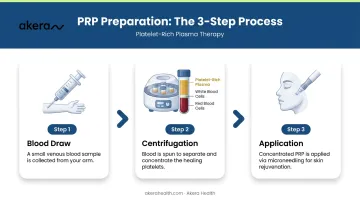
No universal centrifugation protocol exists — spin speeds, duration, and platelet concentration ratios differ across clinics and preparation systems.
Two Delivery Methods
| Method | How It Works |
|---|---|
| Microneedling + topical PRP | PRP is spread on the skin; fine needles create micro-channels that allow absorption |
| Direct injection | PRP is injected into targeted areas, similar to a filler technique |
Some clinics combine both approaches in a single session. The right method depends on the concern being addressed and the provider's assessment.
PRP's medical applications extend well beyond aesthetics — it's used in orthopaedics for joint repair, wound healing, and hair follicle restoration. This cross-specialty track record gives PRP a clinical foundation that most skincare treatments don't have.
What Can PRP Treat? Key Benefits for Your Skin
PRP works best for people dealing with gradual, diffuse skin quality concerns rather than specific structural changes. The clearest evidence supports its use for:
- Fine lines and wrinkles — Multiple studies report improved wrinkle scores and increased collagen density, particularly around the periorbital (eye) area
- Atrophic acne scars — A 2020 systematic review and meta-analysis found significantly better validated scar outcomes when PRP was added to microneedling or subcision compared to those procedures alone
- Skin texture and dullness — Fibroblast stimulation refines surface texture over time
- Mild skin laxity — Small studies report improved elasticity and tissue tension; robust tightening effects are not established
- Uneven skin tone — Some trials report changes in melanin indices and pigmentation homogeneity, though evidence here is limited
What PRP Cannot Do
The American Academy of Dermatology notes that some patients report less sagging and fewer wrinkles, but explicitly states that more research is needed and that PRP cannot restore a face to its younger state.
Results are gradual, building over weeks and multiple sessions. Anyone expecting dramatic transformation after a single session will be disappointed.
A 2024 appraisal rated 12 of 13 included systematic reviews on PRP as low or critically low quality — largely because preparation protocols, comparison treatments, and outcome measures differ so much between studies. This doesn't mean PRP doesn't work. It means the evidence for some claims (universal pore reduction, significant lifting) is thinner than marketing materials suggest.
Beyond skin, PRP is also used for hair follicle rejuvenation. Akera Health offers Plasma Hair Restoration using both PRP and GFC (Growth Factor Concentrate) — an extension of the same biology that makes PRP effective for skin repair.
What to Expect: The PRP Procedure, Step by Step
Consultation and Preparation
Before any blood is drawn, a dermatologist should evaluate your skin concerns, health history, current medications, and goals. This assessment determines whether PRP is appropriate and, if so, what delivery method and number of sessions makes sense for your situation.
General pre-procedure guidance from clinical literature includes:
- Avoid NSAIDs (ibuprofen, aspirin) before treatment — these affect platelet function
- Inform your provider about any blood thinners or anticoagulants you take
- Arrive with clean skin and no active infection in the treatment area
- A baseline blood count and infection screening may be recommended
The Procedure Itself
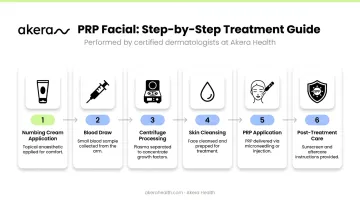
PRP is a 45–60 minute procedure from start to finish. Here's a typical sequence:
- Topical numbing cream is applied to the treatment area
- Blood is drawn from the arm
- Blood is placed in the centrifuge and processed
- The treatment area is cleansed
- PRP is applied via microneedling or injected directly with fine needles
- Post-treatment care is applied (often sunscreen)
Most patients find the discomfort very manageable. The numbing cream handles the bulk of it, and any residual tenderness after the session usually fades within a day or two.
PRP Safety: Risks and Side Effects to Know
PRP is derived from your own blood, which significantly reduces the risk of allergic reaction. But "natural" does not mean risk-free.
Common, expected side effects (usually resolve within days):
- Redness and warmth at the treatment site
- Swelling and mild bruising
- Pinpoint bleeding at injection points
- Temporary tenderness or tightness
Less common risks:
- Skin discoloration
- Infection (rare with proper sterile technique)
- Allergic reaction to numbing cream
- In procedures combining PRP with dermal filler — rare but serious risks including nodule formation or vascular occlusion
The sterility point cannot be overstated. In a documented case from the US, the CDC recorded three presumptive HIV transmissions linked to PRP microneedling facials at an unlicensed spa in New Mexico, where blood handling practices were unsafe. It's a clear argument for choosing a board-certified dermatologist working in a clinical setting with verified hygiene standards and single-use equipment.
At Akera Health, for example, all PRP procedures are performed by certified dermatologists under strict sterile protocols — the kind of clinical oversight that makes a meaningful difference in both safety outcomes and results.
Results, Recovery, and Aftercare
What the Timeline Looks Like
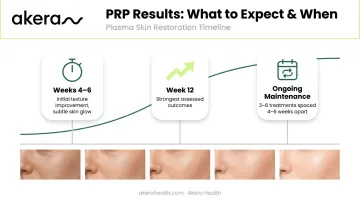
PRP results don't appear overnight. The biological process takes time:
- 4–6 weeks — Initial visible improvement in skin texture (based on clinical review data)
- Around 12 weeks — Many studies report their strongest assessed outcomes near this point
- Long-term durability — Still uncertain; the research explicitly calls longevity an open question. Treat claims of guaranteed 12–18 month results with scepticism — your dermatologist can better advise based on your individual response
Most patients need 3–6 sessions spaced 4–6 weeks apart to achieve meaningful results. The AAD confirms that many patients require three or more treatments.
How you care for your skin between and after sessions directly affects how well those results hold. Here's what the clinical guidance recommends:
Aftercare Guidelines
Post-treatment care supports healing and protects your results. Clinical guidance includes:
- Avoid NSAIDs for approximately two weeks after treatment (they can blunt the platelet response)
- Apply strict sun protection for at least two weeks — a broad-spectrum SPF 50+ is essential
- Use gentle, hydrating moisturisers during the recovery period
- Avoid vigorous rubbing or scrubbing of the treated area in the first 24 hours
- Hold off on intense exercise, heat exposure, and alcohol for 24–48 hours
Sun protection deserves special attention in the weeks after PRP. Akera's SPF 50+ sunscreen range — formulated for oily/combination, normal, and dry/sensitive skin — is well-suited to post-procedure care and available to order online.
Who Is (and Isn't) a Good Candidate for PRP?
Ideal Candidates
PRP suits people who:
- Have mild-to-moderate fine lines, skin laxity, or acne scarring
- Want a minimally invasive approach that uses the body's own biology
- Are comfortable with a multi-session, gradual improvement process
- Are looking to complement other treatments like microneedling or laser resurfacing
Medical Contraindications
PRP is not appropriate for everyone. Aesthetic PRP guidance identifies the following as reasons to avoid treatment:
- Platelet dysfunction disorders or critical thrombocytopenia
- Active local infection or sepsis in the treatment area
- Current use of anticoagulants (medication changes require the prescribing doctor's input)
- Active or haematologic cancers
- HIV, hepatitis C, or HBsAg — these require screening; aesthetic protocols advise avoiding treatment pending assessment
If you're in Bengaluru and considering PRP, a consultation at Akera Health's HSR Layout or HRBR Layout clinic gives you access to an honest, personalised evaluation. If PRP isn't the right fit, the dermatologist will walk you through alternatives — Morpheus8, laser toning, or chemical peels — based on what your skin actually needs.
Frequently Asked Questions
How many PRP face treatment sessions are needed?
Most patients require 3–6 sessions spaced 4–6 weeks apart to see meaningful results, with many providers recommending maintenance treatments every six months after that. The exact number depends on skin condition severity and individual response.
Does PRP face treatment really work?
Clinical studies show PRP can improve skin texture, reduce fine lines, and diminish atrophic acne scars — particularly when combined with microneedling. The AAD acknowledges promise but notes that research is still evolving and results vary significantly by individual, provider skill, and treatment protocol.
Is PRP face treatment better than Botox?
They target different concerns. Botox relaxes facial muscles to reduce expression-related lines; PRP stimulates collagen regeneration for overall skin quality improvement. They can complement each other well, and a dermatologist can advise which — or which combination — suits your goals.
What are the side effects of PRP face treatment?
Common side effects — redness, swelling, tenderness, and mild bruising — typically resolve within a few days. Rare risks like infection or skin discoloration are significantly reduced when treatment is performed by a qualified dermatologist using sterile, single-use equipment.
How long do PRP face treatment results last?
Long-term durability remains an open question in the clinical literature. Many patients report results lasting several months to over a year, though this varies widely. Regular maintenance sessions help sustain collagen stimulation over time.
Is PRP face treatment safe for all skin tones?
PRP uses your own blood, so allergy risk is low across skin tones — including darker Indian skin. That said, needling can trigger post-inflammatory hyperpigmentation in some individuals, making a dermatologist consultation essential before proceeding.