Introduction
Your neck tends to betray your age before your face does. The skin there is thinner, less supported by oil glands, and more exposed to daily movement — which is why patients in their 30s and 40s often notice a softening jawline, loose skin under the chin, or horizontal creases that no moisturiser can touch.
Morpheus8 addresses these concerns at a structural level. It combines microneedling with radiofrequency energy to remodel skin from the inside out, with no surgery, anaesthesia, or extended downtime required. Results look natural because they develop through your body's own healing process.
This article covers how Morpheus8 works on the neck and jawline, what it can realistically treat, and how to decide whether you're a good candidate — including what to expect at a clinic like Akera Health in Bengaluru.
Key Takeaways
- Morpheus8 delivers radiofrequency energy up to 4mm beneath the skin's surface, targeting neck laxity, jowls, and horizontal lines at a structural level
- Neck skin is thinner and collagen-poor, making it especially responsive to RF-based tissue remodelling
- Most patients need 3–4 sessions spaced 4 weeks apart, with noticeable tightening visible from 3 months onward
- Results last 1–3 years, with annual top-up sessions recommended
- Safe for all skin tones, including darker Indian skin types that carry higher pigmentation risks with laser-based treatments
Why Your Neck Ages Faster Than Your Face
Neck skin is structurally disadvantaged from the start. A 2020 comparative study on skin thickness found mean full-thickness measurements of 2.92mm at the anterior neck versus 4.42mm at the cheek — making neck skin roughly one-third thinner than facial skin. It also has fewer sebaceous glands, which means less natural lubrication and faster textural decline with age.
Structural breakdown becomes visible here earlier — and progresses faster than most patients expect.
The Five Signs Patients Notice First
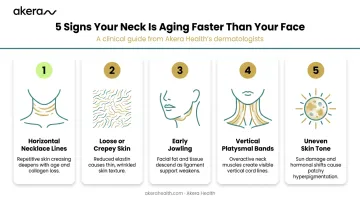
By the mid-30s, most patients begin recognising one or more of these:
- Horizontal necklace lines — deep creases from repetitive skin folding
- Loose or crepey skin — especially under the chin and along the jawline
- Early jowling — the lower face and neck begin to blur together as fat pads lose support
- Vertical platysmal bands — cords that appear down the front of the neck
- Uneven skin tone — sun-induced pigmentation that accumulates faster on thinner skin
The "Tech Neck" Factor
Constant downward head tilt from phones and laptops creates repetitive creasing along the neck — and Bengaluru's tech-driven environment means this affects patients in their late 20s who wouldn't otherwise be thinking about neck treatments. The repeated mechanical stress accelerates skin folding in the same areas, making tech neck a genuine issue for patients in their 20s and 30s, not just older adults.
Understanding what makes neck skin structurally vulnerable also explains why effective treatment needs to work below the surface — not just on it.
How Morpheus8 Works to Tighten and Contour the Neck
Morpheus8 combines two mechanisms in a single pass. Ultra-fine microneedles create controlled micro-channels in the skin while simultaneously delivering radiofrequency energy into the deeper tissue layers beneath. The microneedling triggers surface renewal; the RF energy drives thermal remodelling deeper down.
Depth and Tissue Targeting
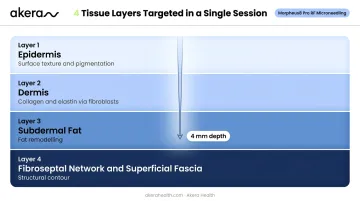
This depth is what sets Morpheus8 apart from surface treatments. According to a 2025 peer-reviewed neck and jawline protocol study, the treatment was applied at up to 4mm in the jowl and submental regions, with the neck proper treated at 1–2mm to account for its thinner tissue. Four tissue layers are targeted in a single session:
- Epidermis: surface texture and pigmentation
- Dermis: collagen and elastin production via fibroblast activation
- Subdermal fat layer: fat remodelling and volume redistribution
- Fibroseptal network and superficial fascia: the structural layer governing neck contour
Standard microneedling and surface lasers stop short of the fibroseptal network — which is why they improve texture but rarely improve contour.
How the Body Rebuilds Collagen
The RF energy creates controlled thermal injury in the tissue. The body responds by activating fibroblasts — the cells that produce new collagen and elastin. Research from Varani et al. found type I procollagen production to be 68% lower in adults over 80 compared to those aged 18–29, showing how sharply collagen output falls with age. Morpheus8's heat stimulus reactivates this process, gradually restoring the structural support the neck loses over time.
Why It's Safe for Indian Skin
Morpheus8 delivers energy via radiofrequency — not light. Unlike laser treatments that target pigment and carry meaningful hyperpigmentation risk for darker skin tones, RF energy is not absorbed by melanin. This makes it appropriate for Fitzpatrick IV–VI skin types. At Akera Health, all Morpheus8 Pro treatments are performed by a board-certified dermatologist, with treatment parameters personalised to the patient's skin type and tone.
What Morpheus8 Can Treat on the Neck and Jawline
Skin Laxity and Loose Neck Skin
Sagging neck skin results from the breakdown of collagen, elastin, and the fat scaffold beneath. Morpheus8's subdermal RF energy triggers tissue contraction and collagen rebuilding, creating a firmer, more lifted neck profile without surgical incisions. The 2025 Stein et al. series, which followed 233 women aged 32–78, reported improved soft-tissue contraction, better cervicomental angle definition, and enhanced skin quality across non-surgical neck cases.
Jawline Contouring and Jowls
Jowls form as the SMAS (the structural muscle-fascia layer) and supporting fat pads lose tone, causing the lower face and neck to merge. Morpheus8 addresses this by remodelling underlying fat deposits and stimulating dermal tightening along the jawline, improving definition without the sharp, operated look of surgical correction. Double chin and jawline contouring are among the most common concerns patients bring to consultation — a pattern we see consistently at Akera Health.
Horizontal Necklace Lines and Crepey Skin
Deep horizontal creases result from years of repetitive skin folding combined with progressive thinning of the dermis. As Morpheus8 stimulates new collagen production, it gradually softens these lines and improves crepey skin texture. Topical moisturisers can't reach the structural level where the thinning originates — Morpheus8 works precisely there.
Tech Neck Lines in Younger Patients
Morpheus8 is increasingly sought by patients in their late 20s and 30s as an early-intervention treatment for device-related neck creasing. By reinforcing the skin's structural integrity before significant laxity develops, the treatment helps the neck better withstand the repeated folding stress of daily phone and laptop use.
What to Expect: The Morpheus8 Neck Treatment Process
Consultation and Customised Planning
The first step is a dermatologist-led skin analysis. At Akera Health, the consultation evaluates:
- Degree of skin laxity and primary concern (jowling, crepey texture, horizontal lines, or a combination)
- Concern severity — mild, moderate, or severe — which patients self-identify during booking
- Individual skin type, age, and lifestyle to calibrate needle depth and RF energy levels
Treatment parameters are tailored to each patient's profile. Morpheus8 Pro sessions at Akera Health start from ₹10,000.
On the Day of Treatment
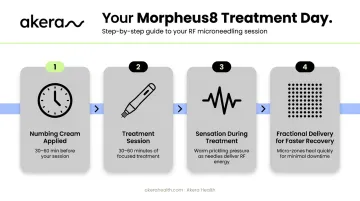
- Topical numbing cream is applied 30–60 minutes before the session begins
- The treatment itself takes approximately 30–60 minutes for the neck and jawline area
- Sensation — most patients describe warm prickling pressure, well-tolerated with numbing
- Fractional delivery — only portions of the skin surface are treated per pass, enabling faster recovery
Recovery and Aftercare
Here's what to expect in the days after treatment:
- Mild redness, swelling, and small grid-patterned micro-scabs are normal
- These typically resolve within 3–5 days
- Most patients return to routine activities within 1–2 days
Key aftercare steps:
- Keep the area moisturised to support skin barrier recovery
- Apply SPF 50+ sunscreen daily — Akera Health's Bask Sunscreen range (₹1,299) is available in variants for oily/combination, normal, and dry/sensitive skin
- Avoid direct sun exposure during the healing period
- Skip active skincare ingredients (retinoids, AHAs, BHAs) for at least one week post-session
Number of Sessions
Most patients follow a course of 3–4 sessions spaced 4 weeks apart. At Akera Health, the exact number is determined by a dermatologist based on the severity of concerns:
- Mild early laxity or tech neck lines — fewer sessions may suffice
- **Moderate laxity with horizontal lines** — typically 3 sessions
- More pronounced jowling or submental sagging — 3–4 sessions recommended
Results Timeline: When Will You See the Difference?
Results from Morpheus8 develop progressively — not overnight. Here's a realistic timeline:
| Timeframe | What to Expect |
|---|---|
| Weeks 1–2 | Initial firmness as swelling subsides; skin texture begins to improve |
| Weeks 4–6 | Visible contouring changes as collagen remodelling accelerates |
| 3 months post-final session | Most significant improvement in laxity, definition, and texture |
| Up to 6 months | Continued improvement as newly formed collagen matures |
Longevity: Results typically last 1–3 years. Factors that influence duration include age, sun exposure, smoking, and whether annual maintenance sessions are used to keep collagen activity sustained.
Because improvements develop through the body's own healing response, results look natural. That sets Morpheus8 apart from surgical neck lift outcomes, which can appear more dramatic or, if overdone, obviously "worked on."
Are You a Good Candidate for Morpheus8 on the Neck?
Ideal Candidates
- Adults with **mild to moderate skin laxity**, early jowling, horizontal neck lines, or crepey texture
- Those in good general health with realistic expectations
- Patients not ready for — or preferring to avoid — surgical intervention
- Younger patients seeking preventive treatment for tech neck
Who Should Avoid the Treatment
Per the InMode operator guidelines, contraindications include:
- Active skin infection or open wounds in the treatment area
- History of keloid scarring or abnormal wound healing
- Pregnancy or breastfeeding
- Implanted electronic devices (pacemakers, defibrillators)
- Isotretinoin use within the past 6 months
- Current skin cancer or premalignant lesions
Severe laxity is not a contraindication but an efficacy limitation — excisional surgery remains the gold standard for moderate-to-severe skin sagging where non-surgical treatments cannot deliver meaningful structural correction.
Morpheus8 vs. Surgical Neck Lift
| Morpheus8 | Surgical Neck Lift | |
|---|---|---|
| Laxity level suited | Mild to moderate | Moderate to severe |
| Anaesthesia | Topical numbing | General or local |
| Downtime | 3–5 days | 2–4 weeks |
| Results appearance | Gradual, natural | More dramatic |
| Cost | ₹2,500–₹10,000/session | Significantly higher |
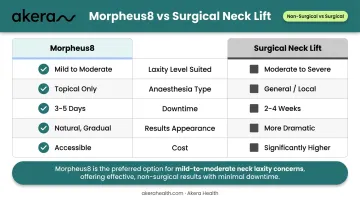
For patients with mild-to-moderate concerns, Morpheus8 delivers visible improvement without the recovery time or surgical risk — making it a practical first step before considering more invasive options.
Frequently Asked Questions
Is Morpheus8 good for the neck?
Yes — its ability to deliver RF energy up to 4mm deep makes it one of the most capable non-surgical treatments for neck laxity, jowling, and horizontal lines. It addresses skin at a structural level that surface treatments and topical products simply cannot reach.
How long does Morpheus8 last on the neck?
Results typically last 1–3 years. Longevity depends on age, sun exposure, smoking habits, and whether annual maintenance sessions are used to sustain collagen production over time.
What is the best skin tightening for the neck?
Morpheus8 is a leading non-surgical option for mild-to-moderate laxity due to its multi-level tissue remodelling. The right choice depends on severity — patients with pronounced sagging may need a surgical consultation to achieve the correction they're looking for.
How many sessions of Morpheus8 are needed for the neck?
Most patients need 3–4 sessions spaced 4 weeks apart. The exact number depends on the severity of the concern and individual skin response, which a dermatologist consultation will help clarify.
Is Morpheus8 painful on the neck?
Topical numbing cream is applied before the session, making the procedure well-tolerated for most patients. The typical sensation is warm prickling pressure; some patients find it mildly uncomfortable, but few report sharp or severe pain.
Is Morpheus8 safe for Indian skin tones?
Yes. Morpheus8 uses radiofrequency energy, which is not absorbed by melanin — making it safe for all Fitzpatrick skin types, including deeper Indian skin tones. This is an important distinction from certain laser treatments, which carry a higher pigmentation risk for melanin-rich skin.
Interested in Morpheus8 for your neck or jawline? Book a consultation with Akera Health's board-certified dermatologists at akerahealth.com/pages/contact. The clinic operates from HSR Layout and HRBR Layout, Bengaluru.