Key Takeaways
- 1ml is a conservative, starter amount — it delivers subtle volume restoration and a light lift, not a dramatic transformation
- Don't judge results immediately — swelling is normal for 1–3 days; final results settle over 2–4 weeks
- Outcome depends on your anatomy — face shape, skin laxity, and existing volume loss all shape what 1ml can do
- Results are buildable — hyaluronic acid fillers typically last 9–18 months, with top-up sessions added over time
You've been staring at your face in the mirror, noticing your cheeks look a little flatter than they used to. Not dramatically so — just a subtle tiredness that wasn't there a few years ago. You've been researching cheek filler, but one question keeps stopping you: will 1ml actually do anything, or will it look overdone?
Both fears are valid — and this guide addresses them directly.
It walks you through exactly what 1ml of cheek filler looks like before and after treatment — stage by stage — who it suits, what side effects to expect, and how to care for your results.
What Is 1ml Cheek Filler and What Does It Actually Do?
To understand what 1ml can realistically achieve, start with the physical reality: according to NIST measurement standards, 5ml equals one teaspoon, making 1ml just one-fifth of a teaspoon. It is a small, precise quantity suited to focal correction rather than full-face volumisation.
How It Works
The active ingredient in most cheek fillers is hyaluronic acid (HA) — a naturally occurring polysaccharide already present in your skin. When injected, it does two things:
- Provides immediate lift through gel placement in targeted fat compartments
- Attracts water molecules, adding soft hydration and volume from within
The FDA notes that HA combines with water and swells in gel form, creating a smoothing and filling effect. Cross-linking in the gel structure slows its breakdown, though how much the filler swells varies by formulation.
What 1ml Can and Cannot Address
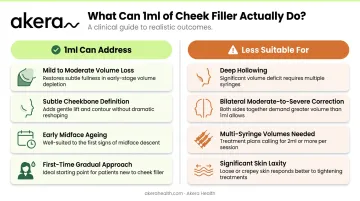
| Can address | Less suitable for |
|---|---|
| Mild to moderate volume loss | Deep hollowing or significant structural deficit |
| Subtle cheekbone definition | Patients needing bilateral moderate-to-severe correction |
| Early signs of midface ageing | Situations where larger multi-syringe volumes are needed |
| First-time filler, gradual approach | Significant skin laxity requiring multilayer treatment |
Clinical trials studying cheek filler outcomes — including pivotal VOLUMA studies — used a median of 6.6ml total bilateral volume for moderate-to-severe age-related volume deficit. That places 1ml firmly in the conservative, focal correction category.
1ml Cheek Filler Before and After: A Stage-by-Stage Guide
Before-and-after results aren't a single moment. They're a process with three distinct phases, and understanding each one prevents unnecessary worry — or premature disappointment.
Before Treatment: What Brings Someone In
Most people considering 1ml cheek filler describe their concerns in similar terms:
- Cheeks that look slightly flat or less defined than before
- A mild hollowness under the eye area creating a tired appearance
- Loss of the subtle roundness or "lift" the mid-face used to have
- No interest in surgery — just a quiet refresh
These are exactly the kinds of concerns that 1ml is designed to address.
Immediately After Treatment: Swelling Comes First
Right after the procedure, your cheeks will likely look fuller than you expected. This is not your final result — it's acute swelling from the injection itself, and it's completely normal.
What to expect in the first 24–72 hours:
- Visible fullness (more than the intended outcome)
- Possible redness or tenderness at injection sites
- Minor bruising in some cases
- Asymmetry that resolves as swelling settles
Do not evaluate your results during this phase. The swelling distorts everything. Give it time.
Full Results at 2–4 Weeks: The True Before and After
Once swelling has resolved — typically within 2–4 weeks — the filler settles into the tissue and blends naturally with the surrounding tissue. That's when a fair comparison becomes possible.
What settled results typically look like with 1ml:
- A gentle lift in the mid-face
- Smoother transition between the cheek and under-eye area
- Softly more defined cheekbones
- Volume that blends with your existing features rather than sitting on top of them
The goal with 1ml is a refreshed version of you. When volume is placed correctly, the people around you won't clock it as filler — they'll simply think you look well-rested.
How to Read Before and After Photos Accurately
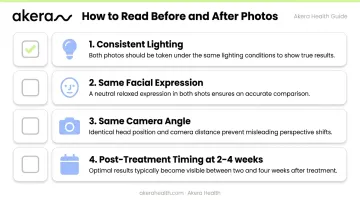
Understanding what settled results look like makes it easier to evaluate before-and-after photos accurately — because the images circulating online vary enormously in reliability. When reviewing them, check for:
- Consistent lighting — different lighting alone can fake dramatic results
- Same facial expression — a smile versus a neutral face changes cheek volume visibly
- Same camera angle — even a slight tilt alters perceived contour
- Post-treatment timing — photos taken in the first week often show swelling, not settled results; look for images taken at least 2–4 weeks post-treatment
Swollen post-treatment photos shared within days of the procedure are among the most misleading images you'll encounter online. They make 1ml look far more dramatic than the actual settled result — which is precisely why timing matters when reading any before-and-after comparison.
Will 1ml Make a Noticeable Difference? Volume and Candidacy
Yes — but how noticeable that difference looks depends heavily on your starting point.
1ml refines and restores more than it transforms. It's often called a "starter amount" because it delivers visible improvement while keeping the risk of overfilling low. But the degree of that improvement varies by individual.
Who 1ml Tends to Suit Best
- First-time filler patients who want to test how their face responds before committing to more
- Younger patients in their 20s–30s with mild, early volume loss
- Anyone prioritising a natural appearance over dramatic contouring
- Patients interested in gradual, buildable results across multiple sessions over time
When 1ml May Not Be Enough
Some presentations simply require more product to achieve a meaningful result:
- Deep hollow cheeks with significant volume loss
- More advanced age-related fat and collagen changes — often seen in the 40s and 50s — where midface structure has shifted substantially
- Patients seeking prominent structural definition rather than subtle enhancement
In these cases, a practitioner may recommend a higher volume or a staged plan across multiple sessions. No fixed dose applies to every face. Facial anatomy, not a standard syringe amount, should guide the decision.
At Akera Health, every cheek filler treatment starts with a personalised consultation where a dermatologist evaluates facial anatomy, skin quality, and treatment goals before recommending the appropriate volume — so the plan reflects each patient's face, not a default amount.
Is 1ml Cheek Filler Safe? Side Effects and Recovery
Hyaluronic acid cheek fillers have a strong safety profile when administered by a qualified medical professional. Side effects are common, and knowing what's normal versus what warrants concern makes the experience far less stressful.
Common, Expected Side Effects
In clinical studies of cheek fillers, the most frequently recorded post-treatment responses included tenderness, swelling, and bruising — typically mild to moderate and resolving within days. Most patients can return to normal activities the following day.
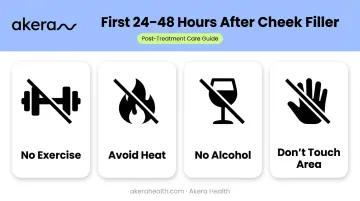
Standard post-treatment restrictions for the first 24–48 hours:
- Avoid strenuous exercise
- Skip excessive heat exposure (saunas, hot showers, direct sun)
- Avoid alcohol, which can increase bruising
- Don't touch or massage the treated area
When to Seek Immediate Medical Attention
Rare but serious complications do exist. Seek immediate medical attention if you experience any of the following:
- Unusual or escalating pain after the initial days
- Vision changes of any kind
- White, grey, or blue skin discolouration near the injection site
- Stroke-like symptoms: facial weakness, speech difficulty, or severe headache
These signs can indicate a vascular event requiring urgent treatment. Hyaluronidase (an enzyme that breaks down HA) is the standard emergency intervention, but it works best when administered quickly. Don't wait to contact your injector if something feels wrong.
Persistent swelling beyond two weeks, or signs of infection, also warrant prompt clinical review.
Aftercare Tips to Maximise Your Results
First 24–48 Hours
- Apply a cold compress intermittently to manage swelling — avoid direct ice contact
- Sleep with your head slightly elevated to reduce fluid pooling
- Don't touch or massage the treated area
- Skip the gym, sauna, and hot showers for at least 24 hours
Medium-Term Care (Weeks 1–4)
- Avoid aggressive facial treatments — chemical peels, microneedling, or deep massage — for at least two weeks
- Apply SPF daily; UV exposure can degrade filler over time
- Stay well-hydrated to support the hyaluronic acid's water-binding function
- Avoid smoking during the recovery period
Longevity
How well you follow aftercare directly influences how long your results hold. Hyaluronic acid cheek fillers don't last indefinitely — duration depends on the product used, your metabolism, and lifestyle factors. Clinical evidence from VOLUMA pivotal trials showed responder rates of 85.6% at 6 months and 67.1% at 24 months. Those figures reflect larger multi-syringe treatment volumes, so they can't be applied directly to a 1ml result.
A realistic planning window is several months to over a year, depending on your individual response. A follow-up assessment at Akera Health lets our team evaluate your results and schedule any touch-up sessions needed to keep the outcome on track.
Frequently Asked Questions
Will 1ml cheek filler make a noticeable difference?
Yes — but expect a subtle, restorative change rather than a dramatic transformation. It works best for mild volume loss or first-time patients. If you have significant hollowing, a consultation will clarify whether 1ml is sufficient for your face.
How long does 1ml of cheek filler last?
Results typically last several months to over a year, depending on the specific hyaluronic acid formulation, your individual metabolism, and aftercare habits. Your practitioner can give a more precise estimate based on the product used.
How long after cheek fillers will I see results?
Some change is visible immediately after treatment, though some of this is initial swelling. Final results are best assessed 2–4 weeks post-treatment, once the filler has settled and swelling has fully resolved.
Do cheek fillers look natural?
When the correct volume is chosen and placed by a skilled practitioner, 1ml typically looks entirely natural — enhancing your existing features without creating an obviously different appearance.
Is getting cheek filler a painful procedure?
Discomfort is minimal. At Akera Health, a topical numbing cream is applied before the procedure. Most patients feel only mild pressure or a brief pinching sensation during the injection itself.
What should I avoid after getting cheek filler?
Follow these aftercare steps to protect your results:
- First 24–48 hours: avoid strenuous exercise, excessive heat, alcohol, and touching the treated area
- First two weeks: skip facial massages, microneedling, and chemical skin treatments until the filler has fully settled
Ready to find out whether 1ml is right for your face? Book a consultation with the dermatology team at Akera Health for a personalised assessment in Bengaluru.