This article breaks down exactly what HydraFacial is, how the three-step process works, what the clinical evidence actually says about its benefits, who it suits (and who should skip it), and what to expect before and after your session.
Key Takeaways
- HydraFacial is a non-invasive, 3-step treatment combining cleansing, extraction, and serum infusion in one session
- Targets acne, enlarged pores, dullness, uneven skin tone, and early fine lines
- Most people resume normal activities immediately — no peeling, no significant redness
- Clinical evidence is preliminary but promising, especially for acne, hydration, and visible texture improvements
- Consult a dermatologist before your first session to confirm suitability and get the right serum protocol
How Does a HydraFacial Work?
HydraFacial uses a patented device with a vortex-tipped handpiece that does something traditional facials and manual extractions can't: it simultaneously removes debris from pores while infusing active serums into them. This dual-channel approach sets it apart from basic exfoliation or microdermabrasion, both of which work only on the skin's surface.
The full procedure takes 30–60 minutes with no recovery time. Here's what happens at each step.
Step 1: Cleanse and Exfoliate
The treatment opens with a vortex-tipped head that gently dislodges dead skin cells and surface impurities. A mild acid blend — typically containing glycolic and salicylic acids — is applied to loosen congestion within pores and prep the skin for extraction. The exfoliation is controlled and even, unlike physical scrubs that can cause micro-tears.
Step 2: Extract
Once pores are loosened, the device switches to a gentle vacuum suction mode. It draws out blackheads, excess sebum, and debris without the pinching or pain that comes with manual extractions. Patients with sensitive skin who've always avoided extractions often find this step surprisingly comfortable.
Step 3: Hydrate and Infuse
This is where HydraFacial earns its edge over standard facials. Customised serums — typically containing antioxidants, peptides, and hyaluronic acid — are infused directly into the freshly cleared pores. With pores already cleared, active ingredients penetrate far more effectively than they would on unprepared skin.
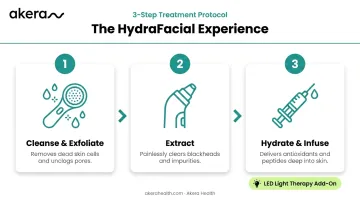
Optional add-ons like LED light therapy can be combined with the base treatment to target specific concerns such as acne or redness. These are clinic-dependent enhancements, not core steps of the protocol.
Benefits of HydraFacial for Your Skin
Immediate Radiance — and Why That Matters
Most people notice a visible glow immediately after a single session. Skin looks more hydrated, brighter, and refined — without redness or peeling. This is why HydraFacial is popular as a pre-event treatment: it delivers results the same day with no visible recovery.
Clients at Akera Health's Bengaluru clinics have echoed this. Per clinic reviews, one patient described her skin as having "an instant glow" with deep hydration, while another noted visible clearing of congestion and a noticeably smoother complexion — both after a single session.
What Clinical Research Shows
Two peer-reviewed studies provide the strongest available evidence:
- A 2022 acne study published in the Journal of Clinical and Aesthetic Dermatology followed 20 adults with mild-to-moderate acne through six HydraFacial sessions over 12 weeks. Investigator-rated clear or almost-clear skin improved from 20% to 65% (p=0.0027). The study was uncontrolled and small, so these figures reflect preliminary — not definitive — outcomes.
- A 2024 imaging study published in Skin Research and Technology used microscopic imaging to track skin changes in 8 volunteers after a single session. Stratum corneum thickness decreased from 9.42 to 6.67 micrometres immediately post-treatment, confirming measurable exfoliation. Notably, no visible improvement in collagen quality was found at two weeks — suggesting this is not a durable anti-ageing treatment based on current evidence.
Beyond these measurable effects, HydraFacial also offers several practical advantages that make it a versatile option across different skin profiles.
Other Benefits Worth Knowing
- Improved skincare absorption — thorough pore cleansing removes the dead-skin barrier that blocks serums and moisturisers applied at home
- Targets your specific concerns — boosters for acne, pigmentation, anti-ageing, or dullness can be selected per session, making one treatment format adaptable to different skin profiles
- Zero downtime — unlike chemical peels or laser resurfacing that require days of recovery, you can apply makeup and return to normal activities on the same day
Who Is HydraFacial Right For — and Who Should Skip It
Good Candidates
HydraFacial is broadly inclusive. It works across oily, dry, and combination skin types, and is adjustable enough that a skilled provider can tailor it to very different skin profiles. It's particularly well-suited for:
- Enlarged pores and congested skin
- Mild to moderate acne and blackheads
- Dull or dehydrated skin
- Uneven skin tone and surface pigmentation
- Early fine lines (for short-term improvement)
- Anyone who needs results with zero recovery time
Suitability for Indian and South Asian Skin Tones
The 2024 imaging study included Fitzpatrick types II–V, and no post-inflammatory hyperpigmentation (PIH) was reported — but with only 8 participants, that sample is far too small to estimate PIH incidence reliably. No peer-reviewed HydraFacial study has specifically examined Indian, South Asian, or Fitzpatrick VI skin outcomes.
Separate literature on ablative CO2 lasers does document PIH risk in darker phototypes. HydraFacial is a non-ablative, non-thermal treatment — a lower-risk option by comparison — but no direct study confirms a measurable PIH advantage. Consulting a dermatologist before proceeding is the only reliable way to assess suitability for your specific skin tone.
At clinics like Akera Health, each patient undergoes a thorough skin assessment before any treatment to confirm whether HydraFacial is appropriate and which serums are best matched to their skin type and concerns.
Who Should Avoid or Delay HydraFacial
Do not proceed if you have:
- Active sunburn or open skin wounds
- Active skin infections or rashes
- Moderate to severe rosacea flare-ups
- Severe cystic or inflammatory acne
- Active eczema flare-ups
Pregnant women should consult a doctor first. While ACOG permits OTC topical salicylic acid during pregnancy, the HydraFacial device's own instructions state it has not been evaluated for use in pregnant or lactating individuals. The professional-grade exposure in a clinic setting is a different context from over-the-counter use.
Risks and Side Effects of HydraFacial
HydraFacial is generally well-tolerated, but it's not entirely without side effects.
Common, temporary reactions:
- Mild redness, itching, or stinging during or after the session
- Temporary flushing or slight swelling
In the 2022 acne study, participants reported stinging and itching that was mostly mild to moderate. One severe tingling episode occurred after the first treatment but resolved before the second visit. The 2024 imaging study noted erythema and bruising lasting 2–5 days in more intensively treated cases — a finding that contradicts the common claim of zero downtime for every patient.
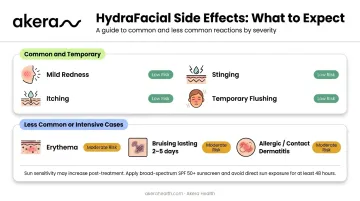
Allergic reactions are possible. Since clinics use different serum formulations, contact dermatitis is a real risk — particularly for people with sensitive or reactive skin. Ask your provider exactly which products will be applied, and request a patch test if you have a history of skin reactivity.
Sun sensitivity post-treatment. Exfoliation increases UV vulnerability. Dermatological guidelines consistently recommend applying broad-spectrum SPF 50+ sunscreen and limiting direct sun exposure during use and for at least a week after any exfoliating treatment. Reach for a lightweight, non-comedogenic sunscreen — Akera Health's SPF 50+ range is formulated for post-treatment skin across different skin types — and reapply every two to three hours if you're outdoors.
How to Prepare and What to Expect After
Before Your Session
- Arrive with a clean, makeup-free face and remove facial jewellery
- Avoid retinol, prescription topicals, and aggressive exfoliants for a few days before your appointment
- Inform your provider about active skin conditions, allergies, known sensitivities, and any medications
Your provider may give you additional instructions based on your skin profile — these are starting points, not a complete checklist.
During and After the Session
The treatment is typically painless. Most people describe it as a gentle suction or soft pressure, and many find it relaxing.
What to expect immediately after:
- Skin usually looks dewy, brighter, and more refined
- Mild redness, if any, resolves within a few hours
- In some cases, redness may persist for a day or two
How Often Should You Get a HydraFacial?
Akera Health recommends sessions every 3–4 weeks, with a minimum gap of at least 2 weeks between treatments. The right cadence depends on your skin goals:
- Acne or active congestion: Closer to every 3 weeks, initially
- General maintenance and glow: Monthly sessions
- Pigmentation or texture improvement: A series of sessions is typically needed before visible, lasting improvement

Clinical studies have used anywhere from three to six sessions spaced 2–4 weeks apart. Your dermatologist's recommendation will depend on your specific skin concerns and how it responds over time.
Frequently Asked Questions
What does a HydraFacial cost?
HydraFacial pricing varies by city, clinic, and whether boosters are added. Commonly cited ranges in Bengaluru run approximately ₹3,500–₹8,000 per session — contact your clinic directly for current, confirmed pricing.
What exactly does a HydraFacial do?
It cleanses, exfoliates, extracts pore impurities via gentle suction, and simultaneously infuses antioxidant- and peptide-rich serums into cleared pores — improving skin tone, texture, and radiance in a single session.
Does a HydraFacial do lymphatic drainage?
Standard HydraFacial does not include lymphatic drainage as a core step. Some clinics may offer it as an optional add-on enhancement.
How long do HydraFacial results last?
The immediate glow and improved hydration typically last around 5–7 days. Lasting improvements in texture, pore size, and pigmentation require a consistent series of sessions over time.
Is HydraFacial safe for Indian or darker skin tones?
HydraFacial carries lower risk for darker skin tones than ablative laser procedures, though peer-reviewed evidence specific to Indian or Fitzpatrick VI skin remains limited. A dermatologist consultation before your first session is the most reliable way to confirm suitability.