Introduction
Picture this: you catch your reflection mid-conversation and notice a stern, downturned expression staring back — even though you feel perfectly fine. Those vertical creases running from the corners of your mouth toward your chin are marionette lines, one of the most recognisable signs of lower-face ageing.
They earn their name from marionette puppets, which have a visible hinge at the same location. That structural pull is what gives the face a downturned look — making you appear sad, tired, or older than you feel.
Dermal fillers are among the most effective non-surgical options for addressing this concern. This guide covers what marionette lines are, how fillers work, what realistic before and after results look like, and what the full treatment experience involves.
With the right approach and a qualified dermatologist, results look refreshed and natural — not overdone.
Key Takeaways:
- Marionette lines result from fat loss, bone resorption, reduced collagen, and gravity acting together
- Hyaluronic acid fillers are the most common and reversible option, typically 0.5–1.0 mL per side
- Effective treatment usually targets supporting areas around the fold, not just the crease directly
- Mild lines may resolve in one session; moderate to deep lines may need two sessions
- Botox and fillers target different components and are frequently combined for best results
What Are Marionette Lines and What Causes Them?
Marionette lines — also called melomental folds or labiomandibular folds — are vertical creases that descend from the outer corners of the mouth downward toward the chin or jawline. They range from subtle and barely visible to deep grooves that cast a noticeable shadow at rest.
Why They Form
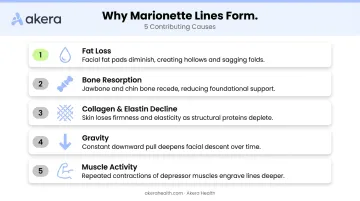
Their development is driven by several overlapping changes in facial anatomy:
- Fat loss — Deep fat below the depressor anguli oris (DAO) muscle diminishes, and buccal fat descends
- Bone resorption — Mandibular recession and maxillary resorption reduce the structural scaffolding beneath the skin
- Collagen and elastin decline — Elastin biosynthesis drops markedly around ages 40–50, reducing skin resilience
- Gravity — Facial tissues gradually displace downward over decades
- Muscle activity — The DAO and platysma muscles pull the mouth corners downward, accentuating the fold
Genetics, sun exposure, smoking, and repetitive facial movements can accelerate all of the above. A facial ageing review places the noticeable onset of labiomandibular folds broadly in the 40s, though individual timelines vary based on genetics and lifestyle.
Marionette Lines vs. Nasolabial Folds
These two concerns are often confused, but they occupy entirely different anatomical zones:
| Feature | Marionette Lines | Nasolabial Folds |
|---|---|---|
| Start point | Corner of the mouth | Side of the nose / alar region |
| End point | Chin or jawline | Corner of the mouth |
| Expression | Downturned mouth, sad look | Deepened smile lines |
| Treatment zone | Lower face / pre-jowl | Mid-face / cheek junction |
Many patients have both at the same time. Each responds well to fillers, but the injection techniques and placement depths differ significantly between zones — which is why a dermatologist's assessment matters before any treatment begins.
How Do Dermal Fillers Work for Marionette Lines?
Dermal fillers don't freeze muscles. They physically restore the volume that has been lost beneath the skin, lifting the fold from below and creating a smoother transition between the lower cheek and chin.
When injected along the labiomandibular sulcus, a well-placed filler:
- Lifts the skin upward to reduce the depth of the crease
- Supports the oral commissure (corner of the mouth)
- Softens the shadow created by the step-off between cheek and lower jaw
The Whole-Face Principle
Filling the marionette line in isolation often isn't enough — and can actually worsen the result. Peer-reviewed consensus recommends evaluating and addressing skeletal and regional volume loss before directly filling the fold.
This typically means assessing the:
- Mid-face and cheeks — Restoring volume higher up reduces downward pull on the lower face
- Pre-jowl sulcus — A structural area directly adjacent to the marionette fold
- Chin — Improves overall lower-face projection and balance
A skilled injector looks at the whole face in motion, not just the crease at rest.
Types of Fillers Used
Two filler types are used most often for marionette lines, each with distinct properties:
| Hyaluronic Acid (HA) | Calcium Hydroxylapatite (CaHA) | |
|---|---|---|
| Example brands | Juvederm, Restylane | Radiesse |
| How it works | Restores volume immediately; integrates with surrounding tissue | Immediate volume + stimulates collagen over time |
| Best for | Mild to moderate lines; layered placement (deep structural + superficial) | Moderate to deep lines requiring longer-lasting lift |
| Reversible? | Yes — hyaluronidase can dissolve HA if needed | No — hyaluronidase cannot reverse CaHA |
Because CaHA fillers are permanent in effect, provider skill and selection matter significantly more with this option.
At Akera Health, treatments use CDSCO-approved hyaluronic acid fillers selected based on each patient's anatomy and the severity of their lines — with the specific product recommended during your personal consultation.
To give you a realistic sense of what treatment involves: published consensus suggests 0.5–1.0 mL per side, varying by severity. A prospective clinical study using VYC-17.5L reported a mean initial volume of 0.73 mL per line, with a touch-up volume of 0.35 mL among those who required one.
Marionette Line Filler Before & After: What to Realistically Expect
Before Treatment: What Patients Typically Present With
- Corners of the mouth appear turned downward at rest
- A shadow or visible "step" between the cheek and lower mouth
- A stern or fatigued resting expression — despite feeling fine
- Reduced chin projection or a less defined jawline
These changes accumulate gradually, which is why many patients are surprised by how significant the difference can be once volume is restored.
Immediately After Treatment
Results are visible right away. The fold softens, the mouth corners lift, and the step-off between cheek and chin smooths out. Initial swelling is normal and can make results look slightly more pronounced for the first few days. Most injection-site reactions — including tenderness, redness, and swelling — resolve within approximately 8 days, based on clinical study data.
The goal is never to erase every line completely. A well-executed treatment leaves the face looking rested and natural — not puffed or altered.
Results by Severity
Mild marionette lines (subtle, mainly visible in certain lighting or when animated):
- Respond well to a small volume of softer, superficially placed filler
- Often addressed in a single session
- Before and after difference: a smoother, more rested appearance
Moderate to deep marionette lines (visible at rest, casting a noticeable shadow, with a clearly downturned mouth):
- Require a layered approach — firmer filler placed deeper for structural support, then softer filler in the subcutaneous layer
- Often benefit from two sessions spaced 4–6 weeks apart for the most natural-looking progression
- Results are more significant but need to be built gradually
At Akera Health, Dr. Lavina Mittal (MBBS, MD) begins every treatment with an honest assessment of severity and achievable outcomes — ensuring patients understand what their specific anatomy can realistically achieve before any product is used.
What Happens During a Marionette Line Filler Treatment?
The Consultation
Your dermatologist will examine your facial anatomy, assess the severity of the marionette lines, and discuss your goals. Expect:
- Photographs of the treatment area
- A discussion of which filler type and approximate volume is appropriate
- An honest overview of expected results and any limitations
Come prepared to share your medication list, supplements, and relevant medical history — your provider needs this before recommending a treatment plan.
Before Your Appointment: Pre-Treatment Precautions
To minimize bruising risk, your provider will typically advise:
- Avoiding blood-thinning medications and supplements (such as aspirin, ibuprofen, fish oil, and vitamin E) for a set period beforehand — your provider will confirm the exact timeframe
- Avoiding alcohol for at least 24 hours before your appointment
- Arriving without active skin infections or inflammation in the treatment area
The Procedure
- Cleanse and numb — The treatment area is cleaned and a topical numbing cream is applied; most HA fillers also contain lidocaine for added comfort
- Inject — Filler is placed using a fine needle or cannula, depending on the depth and anatomy
- Assess and refine — The injector checks symmetry and adjusts as needed

The entire procedure typically takes 20–30 minutes. Most patients return to their normal activities the same day.
Recovery, Side Effects, and Aftercare
What to Expect After Treatment
The lower face is relatively sensitive, but downtime is minimal. Common side effects include:
- Mild swelling and puffiness (most noticeable in the first 48 hours)
- Bruising at injection sites
- Tenderness or soreness when touching the area
Most of these resolve within a few days to a week.
Post-Treatment Care Guidelines
- Avoid strenuous exercise for 24–48 hours — increased blood flow can worsen swelling
- Skip extreme heat (saunas, hot showers, sun exposure) for the first 24 hours
- Don't massage the treated area for at least a week unless directed by your provider
- Hold off on makeup directly over injection sites for 12–24 hours
- Sleep with your head slightly elevated for the first night to reduce swelling
Contact your provider promptly if you notice unusual or increasing pain, prolonged swelling, or any changes in skin colour — particularly white or bluish discolouration.
Rare but Serious Risks
The most significant risk with any filler injection is vascular occlusion — where filler accidentally enters or compresses a blood vessel. A large retrospective survey of dermatologists reported HA vascular occlusion rates in the marionette area at 0.0004% with needles and 0% with cannulas. It's worth noting this figure reflects clinical recall data, not a precise prediction of individual risk.
This is why provider selection matters as much as the procedure itself. Always confirm your injector is a qualified medical professional trained in recognising and managing vascular complications — and don't hesitate to ask about their protocols before you book.
Botox vs. Fillers for Marionette Lines: Which Is Right for You?
Botox and dermal fillers both target marionette lines, but they work through entirely different mechanisms — and choosing between them comes down to what's actually causing your lines.
| Botox (DAO Injection) | Dermal Fillers | |
|---|---|---|
| Mechanism | Relaxes the DAO muscle that pulls the mouth corner down | Restores lost volume beneath the skin |
| Best for | Dynamic downturned mouth corners driven by muscle activity | Static fold caused by volume loss and structural deficit |
| Reversal | Temporary — wears off naturally | HA fillers reversible with hyaluronidase |
| Limitation | Doesn't address volume loss | Doesn't reduce muscle pull |

When to Use Each
- Botox alone may suit very early or mild cases where the downward pull is primarily muscular
- Fillers alone are more appropriate when volume loss is the dominant cause
- Both combined often produce the most complete result for moderate to deep lines — DAO toxin reduces muscular distortion of the fold while filler addresses the underlying structural deficit
The right approach depends on your anatomy, muscle activity, and severity. At Akera Health, this is assessed during your consultation so treatment is matched to your specific anatomy. Book a consultation to get a personalised recommendation from a certified dermatologist.
Frequently Asked Questions
How long do dermal fillers for marionette lines last?
Clinical evidence for HA fillers in the marionette area demonstrates measurable benefit through 12 months, with response rates declining over time. Duration varies by filler formulation, individual metabolism, and how much movement the area experiences. Maintenance sessions are typically recommended to sustain results.
Can dermal fillers get rid of marionette lines completely?
Fillers can significantly soften and reduce marionette lines, but they don't offer a permanent correction. They restore lost volume and lift the skin to minimise the crease, though results require ongoing maintenance to sustain.
What is better for marionette lines — Botox or fillers?
Fillers are generally more effective when volume loss is the primary driver. Botox targets the DAO muscle and helps with the downward pull component. The two are frequently combined for more comprehensive results — particularly for moderate to deep lines where both muscle and volume are contributing factors.
What are the side effects or risks of marionette line fillers?
Common temporary effects include swelling, bruising, and tenderness — most resolve within a week. Rare serious risks include vascular occlusion and infection. Selecting a trained medical professional reduces complication risk, and HA fillers carry the added safety net of being reversible with hyaluronidase.
How many sessions of filler are needed for marionette lines?
Mild lines often respond well to a single session. Moderate to deep lines may benefit from two sessions spaced approximately 4–6 weeks apart, allowing the first round to settle before adding more product. This staged approach tends to produce more natural-looking results.
Can marionette line filler be combined with other treatments?
Yes. Fillers pair well with Botox, nasolabial fold treatment, cheek filler, and chin filler for lower-face rejuvenation. A dermatologist can design a layered treatment plan based on your full facial assessment, targeting structural causes alongside the visible crease.