But "subtle" cuts both ways. The results are understated enough that many people wonder whether they've noticed a change at all — at least in the first week. Understanding what actually happens, day by day, is what separates realistic expectations from disappointment.
This guide covers exactly how a lip flip works, what to expect from day one through week six, how it compares to lip fillers, who's a good candidate, and what side effects are normal versus worth a call to your provider.
Key Takeaways
- A lip flip uses 4–6 units of neurotoxin to relax the upper lip muscle, creating the illusion of fullness without adding volume
- Results appear gradually, with visible change by day 5–7 and best assessment at 10–14 days
- Results typically last 8–12 weeks, with some patients seeing effects persist up to 4–5 months
- The lip flip suits subtle enhancement and gummy smile correction; fillers are better for significant volume
- Provider expertise is critical: the orbicularis oris is one of the most technically demanding muscles to inject
What Is a Botox Lip Flip and How Does It Work?
The lip flip is a non-surgical procedure where a small amount of botulinum toxin is injected into the superior orbicularis oris — the circular muscle running around your mouth. When that muscle relaxes, its inward pull on the upper lip weakens, and the lip gently rolls outward (everts), exposing more of the vermillion border — the pink surface of your lip.
That outward roll creates the appearance of a fuller upper lip — no filler, no added tissue required.
What the Injection Involves
According to a 2025 systematic review of botulinum toxin lip augmentation, a typical lip flip uses 4–6 total units of onabotulinumtoxinA (Botox), delivered at 2–6 points along the upper vermillion border, Cupid's bow, and toward the oral commissures. The procedure takes roughly 10–20 minutes.
A few things to keep in mind before booking:
- The lip flip does not add volume — it changes the lip's resting position
- It has no effect on the lower lip unless specifically targeted
- Results are temporary; nothing about your lip structure changes long-term
A Note on Neurotoxin Brands
The term "Botox lip flip" is widely used as a generic label. Other neurotoxins are also used for this procedure by qualified practitioners:
- Dysport (abobotulinumtoxinA)
- Xeomin (incobotulinumtoxinA)
The FDA notes that potency units cannot be converted across brands, so dosing is brand-specific and determined by your treating dermatologist.
Why Results Don't Last as Long Here
The lip muscles are in near-constant use — speaking, eating, smiling. Practitioners commonly observe that this sustained activity causes lip flip results to fade faster than forehead or glabellar treatments, though direct mechanistic proof in the literature remains limited. Treat this as clinical observation, not established fact.
Botox Lip Flip Before and After: What to Expect Week by Week
Results unfold gradually — here's a realistic, week-by-week breakdown of what to expect.
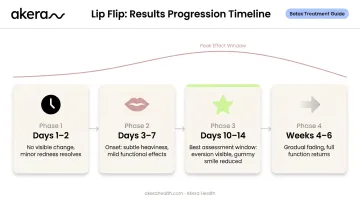
Days 1–2: Nothing Visible Yet
Immediately after injection, you may notice minor redness or swelling at the injection sites. Both resolve within a few hours. Your lip will look identical to before, which is completely normal at this stage.
Days 3–7: The Onset Phase
A 2023 perioral cosmetic treatment review reports that neurotoxin effects typically begin within 2–3 days. During this window, you may notice:
- A subtle heaviness in the upper lip
- Mild difficulty puckering or using a straw
- Slight changes in pronouncing "P" and "B" sounds
These are onset signs, not complications. They indicate the muscle is responding to treatment.
Days 10–14: Best Time to Assess Results
By the second week, the eversion is visible. Your upper lip rolls slightly outward, more of the lip surface becomes visible, and if you had a gummy smile, it's typically reduced. This is the optimal window to photograph your results and evaluate whether a touch-up is needed.
Practical tip most guides skip: Photograph your lips in natural light, at rest and while smiling, before the procedure — then again at Day 10 and Week 6. This gives you a reliable comparison across the full result timeline.
Weeks 4–6: Gradual Fading
The muscle gradually regains function. Straw use returns to normal, speech returns to normal, and the eversion becomes less pronounced. According to a 2025 review published in the Journal of Cosmetic Dermatology, results last 8–12 weeks as a conservative benchmark, with some sources citing a range extending to 2–5 months depending on individual metabolism and muscle activity.
Botox Lip Flip vs. Lip Fillers: Which One Is Right for You?
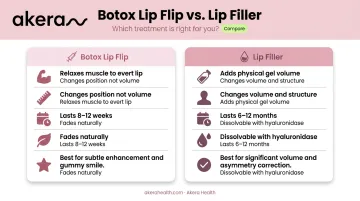
These two procedures solve different problems, and choosing between them comes down to what you actually want to change.
| Factor | Botox Lip Flip | Hyaluronic Acid Lip Filler |
|---|---|---|
| Mechanism | Relaxes muscle to evert the upper lip | Adds physical gel volume to lip tissue |
| What it changes | Lip position and shape | Lip volume and structure |
| Duration | 8–12 weeks (conservative); up to 2–5 months | Typically 6–12 months |
| Reversibility | Fades naturally; no antidote | Can be dissolved with hyaluronidase |
| Downtime | Minimal visible downtime; temporary functional effects | Swelling and bruising common short-term |
| Best for | Subtle enhancement, gummy smile, first-time patients | Significant volume, asymmetry, longer-lasting results |
Who Should Consider Each Option
Lip flip candidates:
- Upper lip that curls inward or disappears when smiling
- Mild gummy smile
- First-time injectable patients wanting a low-commitment starting point
- Those wanting subtle, natural-looking definition
Lip filler candidates:
- Noticeably thin lips needing volume
- Lip asymmetry
- Patients who want longer-lasting, more pronounced results
Can You Do Both?
For some patients, combining both delivers the most balanced outcome. A lip flip refines the border and shape; a small amount of filler adds targeted volume where it's needed. A dermatologist who offers both treatments — like the team at Akera Health — can assess your lip anatomy and recommend what genuinely serves your goals, rather than applying a one-size-fits-all approach.
Who Is a Good Candidate for a Botox Lip Flip?
Ideal Candidates
- Adults in good general health seeking subtle upper lip enhancement
- Those bothered by a gummy smile (excessive gingival display when smiling)
- People whose upper lip thins significantly or curls inward when they smile
- Patients new to cosmetic injectables who want a low-commitment introduction
Who Should Wait or Avoid It
The following situations warrant a conversation with your provider before proceeding:
- Active oral infection or cold sore at or near the injection site — this is a formal FDA contraindication for botulinum toxin
- Neuromuscular conditions such as myasthenia gravis, Lambert-Eaton syndrome, or ALS — the FDA flags these as increased-risk situations
- Pregnancy and breastfeeding — insufficient safety data exists for elective use; conservative assessment required
- Unrealistic expectations of dramatic volume change — if you want significantly fuller lips, fillers are the more appropriate starting point
If you're unsure which category applies to you, that's exactly what a consultation is for. At Akera Health in Bengaluru, Dr. Lavina Mittal conducts a personalised assessment before recommending any injectable treatment — evaluating lip anatomy, aesthetic goals, and overall health to determine whether a lip flip is genuinely the right fit.
Side Effects: What's Normal and What's Not
Temporary and Expected Side Effects
Most patients experience some combination of the following in the first 1–2 weeks:
- Mild swelling or tenderness at injection sites (resolves within hours)
- A feeling of heaviness in the upper lip (days 3–7)
- Temporary difficulty using a straw or whistling
- Slight changes in pronouncing plosive sounds ("P," "B")
- Minor bruising
These effects resolve as the lip muscles adjust to the neurotoxin. They don't require treatment.
Signs of Overtreatment
The orbicularis oris is a complex muscle. Too much toxin, or incorrect placement, can cause functional problems that go beyond the expected onset effects:
- Persistent inability to keep food or drink in the mouth beyond 10 days
- Significant drooling
- Noticeable facial asymmetry
- Prolonged oral incompetence (poor lip seal)
These signs indicate the muscle has been overtreated. They will resolve as the Botox wears off, but they do require a follow-up with your injector. If you experience any of these, contact your provider rather than waiting.
That's why provider selection carries more weight here than in most Botox applications. The perioral area controls speech, eating, and expression — small placement errors have immediate, noticeable consequences. Choose your injector based on qualifications and experience with lip anatomy, not cost.
How to Prepare and Care for Your Lips After a Lip Flip
Before the Procedure
- Avoid aspirin, NSAIDs, and non-essential supplements that affect clotting (fish oil, vitamin E) for at least a week beforehand — this reduces bruising risk, though your prescribing physician should be consulted before stopping any prescribed medications
- Avoid alcohol for several days before treatment
- Disclose your full medication list, allergy history, and any history of cold sores or neuromuscular conditions
- Postpone the appointment if you have an active cold sore at or near the lip
After the Procedure
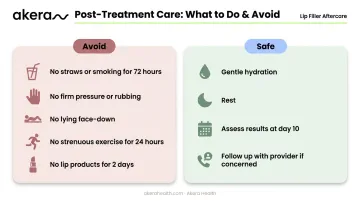
For the first 72 hours, avoid straws and smoking — puckering the lips contracts the treated muscle and can displace the Botox before it sets, per Cleveland Clinic guidance. Beyond that:
- No firm pressure or rubbing on the lip area
- Avoid lying face-down during the early settling period
- Skip strenuous exercise for approximately 24 hours
- Hold off on lip products for the first couple of days
When to Follow Up
Two weeks is the right time to assess results — the Botox has fully settled by then, and you can decide about a touch-up with an accurate picture of what was achieved. If results aren't visible at that point, or if functional side effects haven't improved, reach out to your provider rather than waiting.
Frequently Asked Questions
How long does lip Botox last?
Results typically last 8–12 weeks, with some patients seeing effects up to 4–5 months. The lip muscles are highly active, so neurotoxin breaks down faster here than in less mobile areas. Regular maintenance treatments are needed to sustain the effect.
Is lip Botox safe?
A lip flip carries a low complication rate when performed by a qualified dermatologist — most side effects are mild and temporary. Serious adverse events are rare and are typically linked to incorrect placement or overtreatment.
Which is better for lips: Botox or fillers?
Neither is universally better. A lip flip suits patients wanting subtle shape changes or gummy smile reduction. Fillers are more appropriate for adding significant volume or correcting asymmetry. A dermatologist can assess your lip anatomy and recommend the right approach — or a combination of both.
What does lip Botox do to your lips?
It relaxes the orbicularis oris (the muscle that circles the upper lip), reducing its inward pull. The lip gently rolls outward (everts), revealing more of the lip surface. This creates the appearance of fullness without adding any physical volume to the tissue.
How many units of Botox are used in a lip flip?
A lip flip typically requires 4–6 units of onabotulinumtoxinA — significantly fewer than most other Botox treatment areas. The exact number depends on your lip anatomy and is determined by your injector at the time of assessment.
Can a lip flip and lip fillers be done together?
Yes. The two treatments can be combined — the flip defines the upper lip border and shape, while filler adds targeted volume. A qualified dermatologist can design a complementary plan that delivers natural-looking results without one treatment working against the other.
Interested in whether a lip flip is right for your lip anatomy and goals? Book a consultation with Dr. Lavina Mittal at Akera Health's HSR Layout or HRBR Layout clinics in Bengaluru. Call +91 72044 88355 or visit akerahealth.com to get started.