
Introduction
As skin ages, it loses collagen and volume — processes that begin gradually but become more visible over time. Research on sun-protected skin shows that collagen production in adults aged 80+ is approximately 75% lower than in adults aged 18–29, which explains why faces change shape, not just texture, with age.
Dermal fillers have become one of the most popular minimally invasive responses to age-related volume loss. The global market was valued at USD 3.74 billion in 2024, with ISAPS recording 6.3 million HA filler procedures worldwide in 2024 alone.
Fillers are not interchangeable, though. Different substances, textures, and injection depths suit different concerns entirely.
This guide breaks down the four main filler types, how to choose between them, and what to evaluate before booking a treatment.
Key Takeaways
- Dermal fillers are injectable gel-like substances that restore volume, smooth wrinkles, and enhance facial contours — without surgery
- The four main types are HA, CaHA, PLLA, and PMMA — each with distinct longevity, mechanism, and ideal use cases
- HA fillers are the most widely used and the only type reversible with an enzyme
- PMMA is permanent; PLLA builds results gradually through collagen stimulation over several sessions
- Results and safety depend on dermatologist selection, technique, and using approved, genuine filler products
What Are Dermal Fillers and Why Do People Choose Them?
Dermal fillers are gel-like substances injected beneath the skin to restore lost volume, smooth folds, and enhance facial features. In India, they are classified as Class C medical devices under the Medical Devices Rules framework, meaning only licensed practitioners can legally administer them.
With age, the body produces less collagen and hyaluronic acid — both essential for skin firmness and hydration. Fillers make up for this loss without the recovery time of surgical procedures.
What Fillers Can Address
The range of treatable concerns goes well beyond wrinkles:
- Nasolabial folds (smile lines)
- Hollow or flat cheeks
- Under-eye troughs (tear troughs)
- Thinning lips
- Jawline and chin definition
- Acne scars
- Temple hollowing
Fillers vs. Botox: A Common Confusion
These are frequently mentioned together but work in completely different ways.
| Treatment | How It Works | Best For |
|---|---|---|
| Dermal fillers | Physically adds volume to restore structure | Volume loss, deep folds, contouring |
| Botox | Temporarily relaxes muscles | Dynamic expression lines (forehead, crow's feet) |
Neither replaces the other. Many patients use both in different areas. A dermatologist can assess which approach — or which combination — suits your specific concerns.
Types of Dermal Fillers
Fillers are categorised by their base substance, which determines how they work, how long they last, and which concerns they suit best. Knowing the differences helps you ask the right questions before committing to a treatment.
Hyaluronic Acid (HA) Fillers
HA is a sugar molecule naturally present in connective tissue that binds water and keeps skin plump. HA fillers come in varying particle sizes — finer particles target superficial lines, while larger particles provide deeper volumisation.
What makes HA distinct: it's the only filler type reversible with an enzyme called hyaluronidase. This makes it the lowest-risk starting point for first-time patients. Note that hyaluronidase use for filler reversal is off-label in some jurisdictions, but it is a well-established clinical tool for managing HA complications.
Best suited for: lips, nasolabial folds, under-eye hollows, cheek volume
Longevity: approximately 6–12 months (FDA general benchmark), though individual products and placement areas vary
Key limitation: breaks down faster than other filler types; requires more frequent maintenance. HA currently holds 78.4% of the global dermal filler market, reflecting both its versatility and patient preference for reversibility.
Calcium Hydroxylapatite (CaHA) Fillers
CaHA is a mineral compound naturally found in bones. In filler form, microscopic calcium particles are suspended in a smooth aqueous gel. The gel provides immediate correction; as it dissipates, the CaHA microspheres remain and stimulate the body's own collagen production.
What makes CaHA distinct: thicker consistency than HA means it sits deeper, providing structural support rather than surface-level filling. It is not reversible — there is no CaHA equivalent of hyaluronidase.
Best suited for: deeper wrinkles, jawline contouring, cheek structure, hands
Longevity: approximately 18 months (FDA general benchmark)
Key limitations: too thick for lips or fine lines; requires an experienced injector to avoid irregularities; placement is typically subdermal, at the border between dermis and subcutis
Poly-L-Lactic Acid (PLLA) Fillers
PLLA is a biocompatible, biodegradable synthetic material originally used in absorbable medical sutures. It works differently from other fillers — it is technically a collagen biostimulator, not a volumiser in the traditional sense.
The substance dissolves within days of injection but triggers a gradual collagen-building response in the surrounding tissue. Results appear slowly over weeks to months.
What makes PLLA distinct: results are not immediate. A typical protocol involves approximately three sessions spaced several weeks apart, so patients should expect a gradual transformation over months rather than visible change after a single visit.
Best suited for: significant volume loss, deep facial wasting, patients seeking durable anti-ageing results
Longevity: up to 2 years (FDA general benchmark), with correction sustained through 25 months in clinical studies
Key limitations: requires patience and a committed multi-session schedule; not suitable for patients expecting visible results immediately after treatment
Polymethylmethacrylate (PMMA) Fillers
PMMA consists of smooth, non-absorbable microspheres suspended in a collagen-based gel carrier. The gel provides initial correction; the microspheres remain permanently beneath the skin.
What makes PMMA distinct: it is the only filler the body does not absorb. The microspheres cannot be dissolved enzymatically and may be difficult or impossible to remove if complications arise.
Best suited for: deep nasolabial folds, moderate-to-severe atrophic acne scars, patients with clear long-term correction goals (FDA-approved for patients aged 21+)
Longevity: permanent
Critical limitations:
- Cannot be reversed — placement precision is non-negotiable
- Granulomas (inflammatory nodules) can develop months or years after injection
- A 2020 literature review reported a 4.9% overall PMMA-related complication rate and approximately 1.9% granuloma formation
- Best reserved for patients with prior filler experience who understand the permanence fully
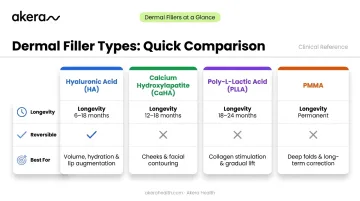
At a Glance: Filler Type Comparison
| Filler Type | Longevity | Reversible | Best For |
|---|---|---|---|
| Hyaluronic Acid (HA) | 6–12 months | Yes (hyaluronidase) | Lips, folds, under-eye, cheeks |
| Calcium Hydroxylapatite (CaHA) | ~18 months | No | Jawline, cheeks, hands, deep wrinkles |
| Poly-L-Lactic Acid (PLLA) | Up to 2 years | No | Volume loss, facial wasting |
| PMMA | Permanent | No | Deep folds, acne scars |
How to Choose the Right Dermal Filler for You
The right filler is not the most popular one, the most expensive, or the longest-lasting. It is the one that matches your specific concern, anatomy, and expectations.
Key Factors to Evaluate
| Factor | What to Consider |
|---|---|
| Area and depth | Fine lines need lighter fillers; deep folds or volume loss need denser ones |
| Desired longevity | Willing to return every 12 months, or prefer a longer interval? |
| Reversibility | First-timers often benefit from starting with HA |
| Treatment series | PLLA requires multiple sessions — can you commit to that? |
| Budget | Factor in initial cost plus maintenance over 2–3 years |
South Asian Skin Considerations
Skin tone and individual healing responses affect filler outcomes. For South Asian and Indian skin types (Fitzpatrick IV–VI), post-inflammatory hyperpigmentation (PIH) is a documented risk following any injection or inflammatory procedure. A qualified dermatologist should factor this into technique selection and aftercare guidance — a clinical detail that informs technique, not a barrier to treatment.
What a Pre-Treatment Consultation Should Cover
These individual skin factors are exactly why a thorough consultation matters — and why it goes well beyond simply picking a filler type.
At Akera Health in Bengaluru, consultations are structured around each patient's facial anatomy, aesthetic goals, genetics, and lifestyle. The same filler placed differently on two people can produce very different results.
A proper consultation covers:
- Facial analysis: identifying treatment areas, appropriate filler type, and injection depth
- Goals alignment: setting realistic expectations based on what is clinically achievable
- Medical history review: screening for contraindications — bleeding disorders, known allergies, blood thinners, NSAIDs
- Personalised treatment plan: filler type, volume, and number of sessions if a series is needed

To book a consultation with Akera Health's dermatologist team, visit akerahealth.com/pages/contact.
What to Watch Out for When Choosing a Dermal Filler
Don't Start with Permanent
If you're new to fillers, starting with a permanent option like PMMA is a significant risk. Hyaluronic acid fillers let you see how your face responds, adjust your aesthetic expectations, and build enough experience to pursue longer-lasting options with confidence.
Provider Qualifications Are Non-Negotiable
A survey-based JAMA Dermatology study found one vascular occlusion per 6,410 needle injections — a serious complication where filler enters a blood vessel, potentially causing tissue necrosis, vision loss, or stroke. The FDA identifies these as known risks of intravascular injection across all filler types.
An unqualified injector significantly raises the likelihood of these complications. Before booking, verify that your provider:
- Holds a medical licence and formal training in injectable techniques
- Has demonstrable knowledge of facial anatomy and vascular risk zones
- Is trained in complication recognition and management
Avoid Unregulated Products
Fillers purchased online or from unlicensed sources may be counterfeit, contaminated, or unapproved for use. Legitimate products come in sealed, properly labelled vials and are dispensed only through licensed healthcare providers.
Before proceeding, confirm:
- The exact product name and its regulatory approval status
- That the vial is unopened and comes from a verified supplier
If a clinic is vague about either point, treat it as a reason to walk away.
Conclusion
Dermal fillers offer a clinically proven, minimally invasive route to addressing volume loss, wrinkles, and facial definition concerns. But the range of options — from reversible HA to permanent PMMA — means the decision deserves the same care as any medical choice.
The best outcomes come from matching the right filler to the right concern, administered by a dermatologist who understands your anatomy and long-term goals. If you are considering fillers for the first time or exploring your options, book a consultation at Akera Health in Bengaluru, where Dr. Lavina Mittal and the clinical team can build a personalised plan around your skin, tailored to your anatomy, concerns, and goals.
Frequently Asked Questions
What are dermal fillers?
Dermal fillers are injectable gel-like substances placed under the skin to restore lost volume, smooth wrinkles, and enhance facial contours. They are minimally invasive, regulated as medical devices, and must be administered by a licensed medical professional.
How much do dermal fillers cost?
Costs in India vary based on the filler type, the area treated, volume used, and the clinic's expertise. Unusually low-priced offerings often indicate the use of unregulated or counterfeit products, so approach them with care. Book a consultation for an accurate, personalised quote.
How long do dermal fillers last?
Longevity depends on the filler type: HA fillers last around 6–12 months, CaHA around 18 months, PLLA up to 2 years, and PMMA is considered permanent. The treatment area and your individual metabolism also affect how long results hold.
Are dermal fillers better than Botox?
They address different concerns and are not directly comparable. Fillers restore volume and physically fill areas; Botox relaxes muscles to reduce dynamic expression lines. Many patients benefit from both, used in separate areas, based on a dermatologist's assessment.
Are dermal fillers safe?
Clinically validated fillers administered by a trained medical professional are considered safe. Most side effects — swelling, bruising, redness — are mild and temporary. Serious complications are rare but possible, particularly when fillers are used by unqualified injectors or sourced outside regulated channels.
What areas of the face can dermal fillers treat?
Common treatment areas include lips, cheeks, nasolabial folds, under-eye hollows, jawline, chin, temples, and the back of the hands. The appropriate filler type and technique varies by area, which is why a personalised consultation matters before any treatment.