Introduction
Collagen production peaks somewhere between your mid-twenties and early thirties — then begins a slow, steady decline of roughly 1–1.5% per year. Over time, that loss shows up as looser skin, softer jawlines, and fine lines that weren't there before. RF skin tightening was developed specifically to address this — the first FDA clearance for RF-based wrinkle treatment came in 2002, and the technology has been refined considerably since.
Even so, many patients don't fully understand what RF actually does inside the skin — which leads to mismatched expectations: hoping for surgical-level lifts from a non-invasive treatment, or being surprised when results take months to develop.
This guide explains RF skin tightening plainly — what it is, how it triggers collagen production, what it can and can't do — so you can make an informed decision about whether it's right for you.
Key Takeaways
- RF energy heats the deep skin layer (dermis) to trigger the body's natural collagen and elastin repair process
- Non-surgical with minimal downtime: most patients resume normal activities the same day
- Results develop gradually over 1–6 months as new collagen forms, and multiple sessions are often needed
- Safe for most skin types, including darker Indian skin tones
- Delivery formats include monopolar, bipolar, and fractional RF microneedling, each suited to different depths and concerns
What Is RF Skin Tightening?
RF skin tightening is a non-surgical cosmetic treatment that uses controlled radiofrequency energy to heat the dermis — the skin's deeper structural layer — and stimulate the body's own repair process, specifically collagen and elastin production.
It exists to fill a specific biological gap. As collagen degrades with age, skin loses its structural scaffolding: jowls soften, the neck loosens, and fine lines deepen. RF was designed to trigger the body's healing response without incisions, anaesthesia, or weeks of recovery.
What RF Is Not
RF is frequently confused with other treatments:
- Not a laser — lasers target pigment or the skin's surface; RF works below it
- Not a filler — fillers add volume; RF rebuilds the skin's structural fibres
- Not a surgical facelift — RF cannot replicate the degree of correction surgery achieves
The Three Main RF Delivery Formats
| Format | How It Works | Depth | Best For |
|---|---|---|---|
| Monopolar RF | Current travels from one electrode through tissue to a grounding pad | Up to ~20 mm (device-dependent) | Broad volumetric heating, laxity, wrinkles |
| Bipolar RF | Current passes between two electrodes on the handpiece | ~1–4 mm | Mild-moderate laxity, texture, localised areas |
| Fractional RF Microneedling | Fine needles deliver RF energy at selected dermal depths | 0.5–8 mm depending on device | Laxity, acne scars, texture, pores |
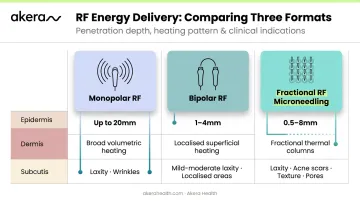
At Akera Health, the RF skin tightening treatment is Morpheus8 Pro, a fractional RF microneedling device that uses a matrix of fine needles to place RF energy precisely within the dermis, enabling deeper remodelling with additional benefits for acne scars and skin texture.
How Does RF Skin Tightening Work?
Understanding RF skin tightening starts with what happens beneath the surface. Controlled heat delivered to the dermis triggers a wound-healing response — your skin gradually produces new collagen over weeks and months, resulting in firmer, tighter skin.
Heating the Dermis
Radiofrequency energy is non-ionising electromagnetic radiation, the same broad category as radio waves. Unlike ionising radiation, it doesn't damage DNA; instead, it generates heat as it passes through tissue resistance.
In a treatment session, the device passes RF waves through the outer skin layer and concentrates heat in the dermis beneath. The epidermis (the top layer) is typically cooled throughout, protecting the skin surface while directing thermal energy deeper. This is what allows RF to produce internal changes without visibly damaging the outer skin.
A 2025 peer-reviewed review notes that collagen denaturation begins around 40–48°C, with coagulation effects at higher temperatures — the relationship between temperature and exposure time is central to achieving safe, effective dermal remodelling.
Triggering Collagen Remodelling
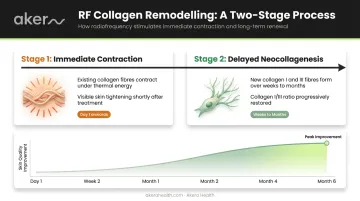
Once the dermis reaches the therapeutic temperature threshold, two things happen:
- Immediate contraction — existing collagen fibres contract in response to heat, producing some visible tightening shortly after treatment
- Delayed neocollagenesis — over the following weeks and months, new collagen and elastin fibres form as part of the tissue repair process
The mechanism involves heat-shock proteins. A 2025 preclinical RF study found increased HSP70 signalling, reduced collagen-degrading pathways, and restoration of the collagen I/III ratio — suggesting RF heat activates the body's collagen regulation system directly.
A histological study by El-Domyati et al. found increased collagen types I and III at three months post-treatment — confirming the separation between the early contraction effect and the slower remodelling benefit.
Benefits of RF Skin Tightening
Skin Firming and Wrinkle Reduction
This is the primary outcome. As new collagen fills in the dermis, loose jowls, fine lines, and sagging skin visibly improve. A 2022 clinical study of 22 patients using bipolar RF found significant submental laxity improvement during a four-session course, with objective volume changes maintained through six months of follow-up. Results build gradually across sessions, not overnight.
Skin Texture and Tone
Beyond structural tightening, new collagen production also improves surface quality:
- Reduced pore size
- Smoother skin texture
- Improvement in uneven tone from sun damage or scarring
- More even collagen density in areas where UV exposure has caused fibre disorganisation
At Akera Health, patients seeking Morpheus8 Pro commonly report improvement in both skin firmness and texture — particularly those treated for acne scars alongside general skin rejuvenation.
Suitability Across Skin Tones
For patients with deeper skin tones, treatment choice matters. RF energy heats tissue through electrical resistance rather than targeting epidermal melanin, which means it sidesteps the pigmentation risks that melanin-dependent treatments — such as certain lasers — carry for Indian skin.
A 2023 review of 35 skin-of-colour studies found RF and RF microneedling carry low risk of scarring or hyperpigmentation. The review did record seven cases of transient post-inflammatory hyperpigmentation and one permanent scar — so the profile is favourable, not risk-free. A consultation with a qualified dermatologist remains essential.
Minimal Downtime
Most patients return to normal activities the same day. Akera Health describes post-treatment side effects (redness, mild swelling) as resolving within 48 hours, and patients can typically apply makeup 1–2 days after a session.
Risks and Side Effects of RF Skin Tightening
Common, Temporary Reactions
These are normal and expected:
- Redness and swelling lasting 24–48 hours
- Mild tingling or warmth in the treated area
- For RF microneedling: pinpoint bleeding, temporary grid marks, occasional mild bruising
These reflect the body's normal response to controlled thermal stimulation and resolve on their own.
Less Common Risks
The FDA has issued safety communications specifically about RF microneedling. Documented complications include:
- Burns or scarring from excessive heat delivery
- Fat loss or disfigurement in the treated area
- Nerve damage from incorrect device settings
These outcomes are rare with trained providers, but they are real risks — which is why choosing the right clinician matters.
The FDA recommends a licensed healthcare provider with specific training and experience in the RF microneedling device being used. The FDA recommends a licensed healthcare provider with specific training and experience in the RF microneedling device being used. While this guidance originates from the US FDA, the underlying safety principles apply universally — qualified dermatologists follow equivalent protocols regardless of geography.
Who Should Avoid RF Treatment
Provider selection connects directly to suitability screening — a dermatologist consultation determines whether RF treatment is appropriate for you. General contraindications typically include:
- Implanted cardiac devices (e.g., pacemakers) — device labelling for several RF systems specifically contraindicates use in this group
- Active skin infections in the treatment area
- Pregnancy
- Certain metal implants in or near the treatment area
Device-specific contraindications vary — confirm with your clinician before any session.
What to Expect: Sessions, Timeline, and Results
The Treatment Experience
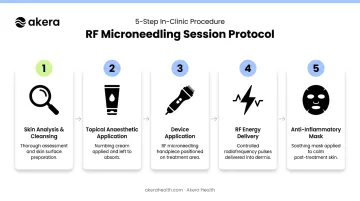
A typical RF microneedling session follows a structured protocol:
- Skin analysis and cleansing — the clinician assesses the treatment area
- Topical anaesthetic application — applied ahead of the procedure to minimise discomfort
- Device application — the handpiece is passed over the skin; patients feel warmth and mild pressure
- RF energy delivery — the device delivers energy at the selected dermal depth
- Anti-inflammatory mask — applied post-treatment to calm redness and swelling
The experience should be manageable. It is not painless, but with a topical anaesthetic, most patients describe it as tolerable.
Results Timeline
Expectations matter here. RF skin tightening is not an immediate transformation:
- First few days — some patients notice mild initial tightening from collagen contraction
- Three weeks onward — visible improvements in skin texture and firmness begin to emerge
- 1–6 months — the main collagen remodelling benefit continues to develop progressively
Session protocols in the literature range from one to six sessions depending on the device and the degree of skin laxity. At Akera Health, the treating dermatologist determines the number of sessions based on individual assessment — accounting for skin laxity, age, and treatment goals.
Akera Health's Approach
At Akera Health, Morpheus8 Pro RF Microneedling is performed under dermatologist supervision, with treatment plans personalised to each patient's age, skin type, and specific concerns. With over 5,000 sessions completed across its HSR Layout and HRBR Layout branches and a 4.9/5 Google rating from 350+ reviews, the clinic has a documented track record in this treatment.
Patient Kritika Sharma, who underwent multiple Morpheus8 sessions, described: "My skin looks tighter, brighter, and more rejuvenated... I noticed a visible reduction in fine lines and enlarged pores."
If you're in Bengaluru and considering RF skin tightening, a consultation at Akera Health will help determine whether Morpheus8 Pro is the right option for your skin concerns. Book via akerahealth.com/pages/contact.
Frequently Asked Questions
What is RF face skin tightening?
RF face skin tightening is a non-surgical procedure that uses controlled radiofrequency energy to heat the deeper layers of facial skin, stimulating collagen and elastin production. The result is firmer, smoother, more lifted skin — without incisions or significant downtime.
Does RF skin tightening really work?
Clinical studies support RF skin tightening for mild to moderate skin laxity, with results developing gradually over 1–6 months. Outcomes depend on the technology used, number of sessions, and baseline skin condition. Expect measurable firming, not surgical-level correction.
How long do RF skin tightening results last?
Current clinical studies typically follow patients for 3–6 months, with some evidence reaching 12 months. Durability depends on the technology, the patient's skin, and ongoing skincare habits. Maintenance sessions help sustain results as the skin continues to age naturally.
How much does RF face tightening cost in Bengaluru?
Cost varies based on the technology, treatment area, and number of sessions required. At Akera Health, Morpheus8 Pro RF Microneedling starts from ₹10,000 per session. A consultation with a dermatologist is the most reliable way to get an accurate quote for your specific needs.
Is RF skin tightening safe for Indian skin tones?
RF targets heat in the dermis through tissue resistance rather than melanin, making it less likely to cause pigmentation issues than many laser treatments. Studies on Fitzpatrick skin types IV–VI show a generally favourable safety profile, though transient hyperpigmentation can occur. A dermatologist consultation helps determine your individual suitability.
How many RF sessions are needed to see results?
This varies by the degree of skin laxity, the RF technology used, and individual skin response. Study protocols range from one to six sessions. At Akera Health, your dermatologist will assess your skin and recommend a session plan based on your specific concerns rather than a generic protocol.