Introduction
Unwanted hair is something most people deal with — whether driven by genetics, hormonal conditions like PCOS, or simply personal preference. The challenge isn't finding a solution; it's knowing which of the dozens of available options actually suits your skin type, body area, and long-term goals.
Shaving is quick but rarely a lasting fix. Waxing hurts but lasts longer. Laser sounds permanent but requires a real commitment. And somewhere between the pharmacy shelf and the clinic waiting room, the decision gets genuinely confusing.
This guide cuts through that noise. It covers every major hair removal method — how each works, how long results last, who each suits best, and what to watch out for — so you can make a decision based on facts rather than marketing.
Key Takeaways
- Hair removal falls into two categories: depilation (surface removal) and epilation (root removal) — the difference determines how long results last.
- Shaving and depilatory creams are quick and affordable but need frequent repetition.
- Waxing, sugaring, and threading deliver weeks of smoothness by pulling hair from the root.
- Laser hair reduction offers the longest-lasting results but requires multiple sessions and a financial commitment.
- Electrolysis is the only clinically recognised method for permanent hair removal.
- The best method depends on your hair type, skin tone, treatment area, and how much upkeep you're comfortable with.
What Is Hair Removal?
Hair removal is the intentional elimination of body or facial hair — done for aesthetic, hygienic, or medical reasons. For people with conditions like PCOS or hormonal imbalances, hirsutism affects 5%–10% of women according to the Endocrine Society, making hair removal a clinical concern, not just a cosmetic one.
Understanding the two core categories matters before choosing any method:
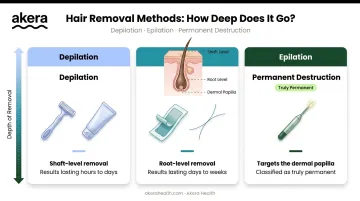
- Depilation removes hair at the shaft — the part visible above the skin. Results are short-lived (hours to days). Methods: shaving, depilatory creams.
- Epilation removes hair from the root, including the follicle and bulb. Results last days to weeks. Methods: waxing, sugaring, threading, laser, electrolysis.
- Permanent destruction (electrolysis only) targets the dermal papilla itself — the structure responsible for hair growth — which is why it's the only method classified as truly permanent.
The right method depends on your skin tone, hair texture, body area, and whether you want temporary convenience or long-term reduction — which is exactly what the sections below break down.
Types of Hair Removal Methods
Methods aren't interchangeable. Each targets hair at a different point — the shaft, the root, or the follicle — which directly determines how long results last and what side effects to expect.
Shaving and Depilatory Creams
Shaving cuts the exposed hair shaft at skin level using a razor. It's the fastest, most accessible at-home option, with results lasting roughly one to a few days before regrowth appears. One persistent myth worth dismissing: shaving does not make hair grow back thicker or darker. The blunt tip can feel coarser, but the hair itself hasn't changed.
Key considerations:
- Best for: Legs, underarms, face (men), large areas needing quick results
- Risks: Razor burn, nicks, ingrown hairs — especially in the bikini area
- Cost: Very low; no professional needed
Depilatory creams (such as Veet or Nair) work differently — thioglycolic acid dissolves the keratin bonds in the hair shaft so it can be wiped away. Results last slightly longer than shaving.
Important rules for depilatory creams:
- Always patch test 24 hours before use (per AAD, Veet India, and Nair guidance) — not 48 hours as sometimes stated
- Never use a leg formulation on facial or pubic skin; area-specific formulations exist for a reason
- Misuse or leaving cream on too long can cause chemical burns
Waxing, Sugaring, and Threading
All three pull hair from the root, which is why results last significantly longer than shaving — typically three to six weeks.
| Method | How It Works | Best For | Results Duration | |--------|-------------|----------|-----------------|\n| Soft wax | Applied thinly, removed with fabric strips | Legs, arms, large areas | 3–6 weeks | | Hard wax | Applied thickly, removed without strips | Bikini line, underarms, sensitive areas | 3–6 weeks | | Sugaring | Sugar-lemon-water paste, removed with hair growth direction | Sensitive skin, all body areas | ~3 weeks | | Threading | Twisted cotton thread traps and removes rows of hair | Eyebrows, upper lip, facial precision | 4–5 weeks |
What separates these methods in practice:
- Sugaring is water-soluble and generally causes less irritation than wax, with reduced ingrown hair risk — useful for sensitive skin types
- Threading involves minimal skin contact, making it a preferred option for those using topical skincare actives
- Waxing and retinoids don't mix — the AAD warns that prescription retinoids and retinol can cause skin to tear during waxing. Avoid facial waxing while using retinol, and people on isotretinoin should avoid waxing entirely
- Hair must be approximately 6 mm long for wax or sugar paste to grip effectively
Laser Hair Removal
Laser hair removal uses selective photothermolysis: concentrated light energy targets melanin (pigment) in the hair follicle, converts to heat, and damages the follicle's growth structures. Because this only works on hair in the active (anagen) growth phase — and follicles cycle asynchronously — multiple sessions are essential.
What to expect:
- The AAD recommends 6 or more sessions, typically spaced 4–6 weeks apart
- Results after the first session show 10%–25% reduction in regrowth
- Laser is regulated as permanent hair reduction, not permanent removal — the FDA defines this as a long-term stable reduction measured at 6, 9, and 12 months post-treatment
Strengths:
- Longest-lasting results of all non-electrolysis methods
- Can treat large areas: legs, back, underarms, face
- Regrowth tends to be finer and lighter over time
- Effective for PCOS-related hirsutism when combined with dermatologist oversight
Limitations:
- Does not work on blonde, grey, white, or red hair — these lack sufficient melanin for the laser to target
- Post-treatment skin is photosensitive; sun exposure must be avoided
- Must be performed by a trained professional to avoid burns, hyperpigmentation, or scarring
Skin tone is a real factor to consider. Older laser systems carried documented risks for Fitzpatrick Type IV–VI skin — common across South Asian skin tones. A 2016 study of 71 Indian patients with Fitzpatrick Types IV–VI using low-fluence, high-repetition 810 nm diode technology reported no burns, hyperpigmentation, or hypopigmentation, supporting the safety of diode-based approaches for deeper skin tones.
At Akera Health in Bengaluru, laser hair reduction is performed using the Soprano Platinum, which targets the three main structures of the hair follicle at three different wavelengths. Each client receives a dermatologist-led evaluation before treatment begins, with settings calibrated to their skin type and tone. Sessions start from ₹2,500, supervised by a board-certified dermatologist.

Electrolysis
Electrolysis is the only method recognised as permanently removing hair. A fine probe is inserted into each individual follicle to deliver an electrical current that destroys the dermal papilla — the structure responsible for hair growth. Crucially, it works on all hair colours and all skin types, unlike laser, which requires melanin in the hair.
Three modalities exist:
- Galvanic: Direct current causes chemical destruction of the papilla
- Thermolysis: High-frequency current generates heat to destroy it
- Blend: Combines both for a chemical-plus-thermal effect
The trade-off is time. Because every follicle is treated individually, electrolysis is most practical for small areas — upper lip, chin, eyebrows. Larger areas require months of regular appointments.
Limitations:
- Higher pain levels than most other methods
- Risk of temporary redness; scarring is possible if improperly performed
- Should only be performed by a qualified professional or board-certified dermatologist
How to Choose the Right Hair Removal Method
The right method is the one that fits your specific situation — not simply the most advanced option. Four factors guide a sound decision:
1. How long do you want results to last?
- Long-term reduction with minimal ongoing maintenance → laser
- A few weeks of smoothness → waxing or sugaring
- Quick, occasional grooming → shaving
2. What's your skin tone and hair colour?
- Darker skin tones with coarse, dark hair → modern diode laser (well-suited); clinics using platforms like Soprano Platinum are specifically designed to work safely across all Indian skin tones
- Light, fine, grey, or blonde hair → laser will not be effective; consider waxing or electrolysis
- PCOS or hormonally driven excess hair → a dermatologist consultation is advisable before committing to any method, as hair may continue regrowing until the underlying hormonal cause is managed; clinics like Akera Health in Bengaluru offer assessments specifically for hormonally driven hair concerns
3. Which body area are you treating?
| Area | Recommended Methods |
|---|---|
| Eyebrows / facial precision | Threading, electrolysis |
| Upper lip / chin | Threading, laser, electrolysis |
| Underarms / bikini | Hard wax, laser |
| Legs / back / chest | Shaving, laser, soft wax |
| Pubic area | Hard wax, laser; avoid depilatory creams |
4. What's your budget?
- Lowest upfront cost: shaving, depilatory creams
- Mid-range: waxing, sugaring, threading
- Higher upfront, lower long-term cost: laser (reduces need for repeated sessions over time)
- Highest total time investment: electrolysis (permanent results, but many sessions required)
Common Mistakes to Avoid
A few avoidable errors account for most disappointing or harmful hair removal experiences:
- Choosing laser for the wrong hair colour. Laser targets melanin. If your hair is grey, white, blonde, or red, laser will not produce results — electrolysis is the appropriate option.
- Skipping patch tests with depilatory creams. A 24-hour patch test is non-negotiable. Chemical burns from depilatory misuse are entirely preventable.
- Waxing over retinoid-treated skin. As noted, this can cause skin tearing. Pause retinoids for 2–5 days before waxing, and avoid waxing entirely if you're on isotretinoin.
- Expecting permanent results from temporary methods. Shaving, waxing, and threading are temporary. Laser reduces regrowth long-term. Only electrolysis permanently destroys the follicle — knowing the difference prevents frustration.
- Skipping a pre-treatment assessment for laser. A proper consultation identifies contraindications, confirms hair and skin suitability, and ensures the device is calibrated correctly for your skin type.
Conclusion
Hair removal is not one-size-fits-all. Each method works at a different depth, lasts a different duration, and suits a different combination of skin tone, hair type, and body area.
Here's how the main options compare:
- Shaving and depilatory creams — convenient, low cost, surface-level results
- Waxing, sugaring, and threading — longer-lasting, removes hair at the root
- Laser hair reduction — sustained reduction for suitable hair and skin types, best results under dermatologist supervision
- Electrolysis — the only method that delivers genuine permanent removal
For those dealing with PCOS-related hirsutism or darker skin tones — where the stakes of choosing the wrong method are higher — a dermatologist consultation is the clearest next step. At Akera Health, Dr. Lavina Mittal and her team assess your skin type, hair profile, and underlying conditions to recommend the right approach — including laser hair reduction using the Soprano Platinum, which is safe across all skin tones.
Frequently Asked Questions
What are the main types of hair removal?
Hair removal falls into two categories: depilation (surface removal via shaving or depilatory creams) and epilation (root removal via waxing, sugaring, threading, laser, or electrolysis). The key difference is duration — depilation lasts hours to days; epilation lasts weeks to months or longer.
What hair removal methods provide permanent results?
Electrolysis is the only method recognised for permanent hair removal, as it destroys the dermal papilla of each follicle. Laser hair removal provides long-term reduction — significantly reduced regrowth that is stable over time — but does not guarantee complete elimination for all clients.
What is the best hair removal method?
There's no single answer. Laser suits those wanting long-term reduction on dark hair. Waxing or sugaring suits those wanting weeks of smoothness without a clinic commitment. Shaving suits those who want quick, zero-effort maintenance. The body area, hair colour, skin tone, and budget all factor in.
What is the best hair removal method for pubic hair?
Hard wax is widely recommended — it adheres to hair without gripping sensitive skin. Laser is effective for long-term reduction in this area. Shaving is safe but carries higher ingrown hair risk. Avoid depilatory creams on the pubic area; the chemical sensitivity risk is significant.
Is laser hair removal safe for darker skin tones?
Modern diode and multi-wavelength systems — such as the Soprano Platinum — are clinically appropriate for South Asian and darker skin tones. Older systems carried real pigmentation risks, but technology has advanced considerably. The critical factor is choosing a clinic with dermatologist supervision and equipment suited to your skin tone.
How many sessions does laser hair removal require?
Most people require 6 or more sessions, typically spaced 4–6 weeks apart, to target hair across all growth cycles. Maintenance sessions may be needed annually. Results vary based on hair density, colour, and hormonal factors. Those with PCOS may see continued regrowth until the underlying hormonal cause is addressed alongside treatment.