What stops most people from acting sooner is a misconception: that hair restoration is purely cosmetic. It isn't. At its best, it's a clinical process that addresses scalp health, systemic imbalances, and follicle biology — with measurable, lasting results.
This guide breaks down 5 evidence-grounded benefits of hair restoration, who they help most, and why waiting often makes the problem harder — and more expensive — to fix.
Key Takeaways
- Hair restoration treats root causes — hormonal imbalances, inflammation, nutrient deficiency — not just visible symptoms
- Treatments like PRP and GFC are minimally invasive, taking under an hour with virtually no downtime
- A 2023 meta-analysis of 10 RCTs found PRP produced an average of 25 more hairs/cm² compared to control groups
- Early intervention works better — dormant follicles can still respond, but permanently damaged ones cannot
- Restored hair density has documented links to improved self-esteem, social confidence, and quality of life
What Is Hair Restoration?
Hair restoration covers a range of non-surgical clinical treatments that stimulate follicle activity, repair the scalp environment, and encourage the body to regrow hair. Unlike a hair transplant, no grafts are harvested and no incisions are made.
Common modalities include:
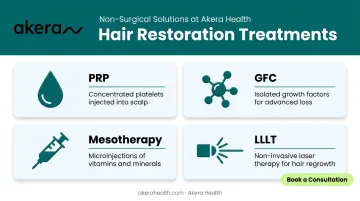
- PRP (Platelet-Rich Plasma) — concentrated platelets from your own blood, injected into the scalp to deliver growth factors to follicles
- GFC (Growth Factor Concentrate) — a more refined preparation where growth factors are isolated before injection, suited for more advanced hair loss cases
- Mesotherapy — intradermal microinjections delivering vitamins, minerals, or targeted agents depending on the formulation
- Low-Level Laser Therapy (LLLT) — a non-invasive light-based treatment that energises follicles without any injections
Hair restoration works best for individuals with:
- Early to moderate androgenic alopecia (pattern hair loss)
- Stress-related or seasonal shedding
- Postpartum hair loss
- Hormonally driven loss linked to PCOS or hypothyroidism
It is not suited for advanced or complete baldness, where follicles are no longer active.
At Akera Health, both PRP and GFC are offered under a Plasma Hair Restoration programme, with treatment plans built around each patient's specific hair loss pattern and needs — assessed by MD-qualified dermatologists before any treatment begins.
5 Key Benefits of Hair Restoration
The benefits below reflect clinically observable outcomes — not marketing language — when treatment is applied correctly and consistently.
Benefit 1: Improved Scalp Health and Follicle Environment
Most over-the-counter products treat the hair shaft — not the scalp environment that hair actually grows from. That distinction matters clinically.
Treatments like PRP deliver platelet-derived growth factors — including VEGF, PDGF, and IGF-1 — directly into the scalp tissue. These compounds support angiogenesis (new blood vessel formation) and prolong the active growth phase of follicles.
In practical terms: they improve the blood supply and biological environment that follicles need to produce hair.
This matters most for individuals who've noticed gradual thinning over time rather than sudden shedding. Gradual thinning typically signals follicle miniaturisation — follicles that are dormant or reduced in output, not permanently gone. These are the follicles most responsive to restoration.
Who benefits most from this:
- Individuals with diffuse thinning or a widening parting
- Those who've noticed texture changes before visible density loss
- Patients with early androgenetic alopecia (hereditary pattern loss)
Benefit 2: Targets Root Causes, Not Just Symptoms
Hair loss is frequently a signal of something systemic. Treating the scalp alone — without identifying what's driving the loss — is why so many people cycle through products without results.
In a clinical study of 135 Indian women presenting with acquired alopecia, 73.4% had anaemia and 17% had thyroid disorders. These findings don't mean every hair loss case has the same cause — but they underscore why a diagnostic-first approach matters.
Common systemic contributors include:
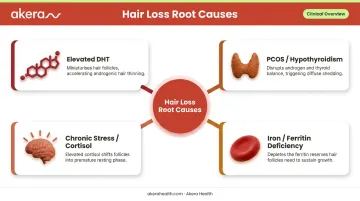
- Elevated DHT — the primary androgen implicated in follicle miniaturisation
- PCOS or hypothyroidism — hormonal conditions that disrupt the hair growth cycle
- Iron or ferritin deficiency — reduces the energy available for follicle activity
- Chronic stress and cortisol elevation — can trigger telogen effluvium, pushing follicles into a resting phase prematurely
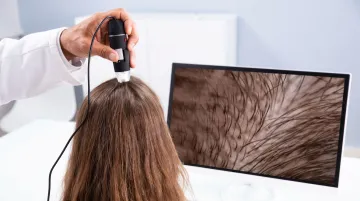
The diagnostic process typically involves history-taking, trichoscopy, a pull test, and targeted blood work — ferritin, thyroid function, androgen levels — to distinguish androgenetic alopecia from telogen effluvium or endocrine causes.
Treating the underlying condition alongside scalp intervention consistently produces more durable results than scalp treatment alone.
Benefit 3: Minimally Invasive with Little to No Downtime
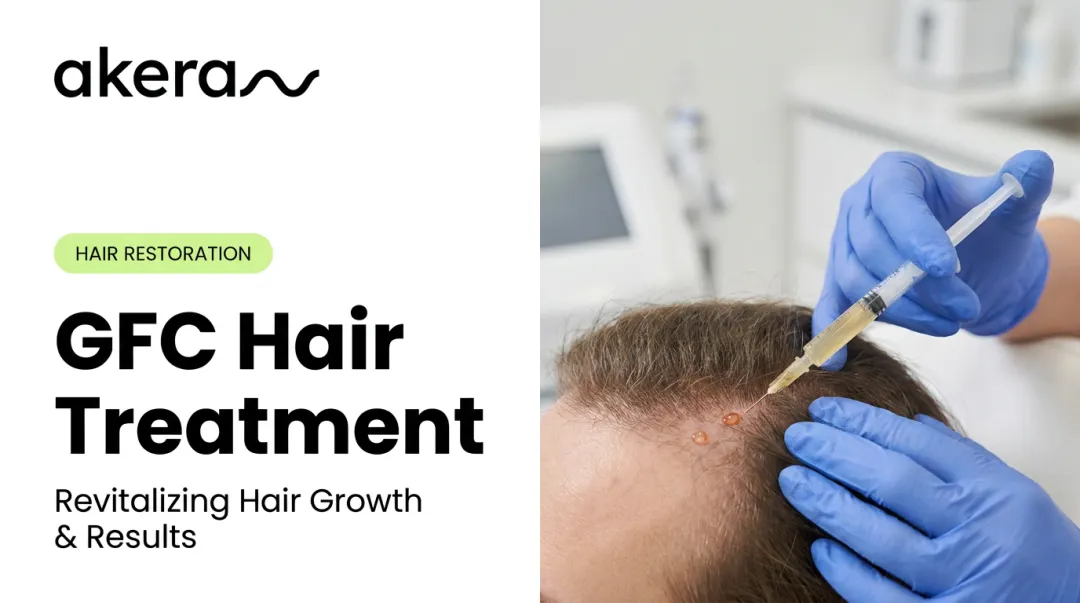
Unlike surgical hair transplants — which involve operative graft harvesting, several days of crust management, and restrictions on head immersion for two to four weeks — PRP and GFC are administered through fine scalp injections following a straightforward process:
- A blood sample is drawn from the arm in a sterile environment
- The sample is centrifuged to separate platelets and growth factors
- The concentrate is injected directly into thinning areas of the scalp
A numbing cream is applied beforehand, most patients report minimal discomfort, and the session takes under an hour. Most people return to normal activities the same day.
Reported adverse events from PRP are typically mild and transient — localised redness, minor swelling, or brief tenderness at injection sites. A 2023 safety review found no serious adverse reactions across the trials it assessed.
This makes non-surgical restoration particularly practical for:
- Working professionals who can't afford surgical recovery time
- Individuals with health conditions that make surgery inadvisable
- Those in the early stages of hair loss where surgery isn't yet warranted
"Minimally invasive" doesn't mean less effective. For moderate hair loss cases, well-administered non-surgical protocols produce results that are clinically meaningful — and far less disruptive.
Benefit 4: Promotes Long-Term, Natural Hair Regrowth
PRP and GFC use the patient's own biological material — no foreign substance is introduced, which means virtually no risk of allergic response or rejection. That autologous quality is what makes them well-suited for long-term protocols.
The results from these treatments build over time rather than appearing overnight. A realistic timeline looks like this:
| Timeframe | What to Expect |
|---|---|
| 4–6 weeks | Reduced shedding, improved scalp texture |
| 3–6 months | Visible regrowth, baby hairs appearing |
| 6–12 months | Measurable density improvements |
| 6–18 months | Duration of results before maintenance |
The evidence supports meaningful outcomes for many patients. A 2023 meta-analysis of 10 randomised controlled trials found PRP produced 25.09 more hairs/cm² compared to control groups — a statistically significant result, though with high variability between protocols. GFC shows promising early results, but the evidence base is smaller and still developing.
Results are long-lasting, not permanent. Maintenance sessions every 6–12 months help sustain regrowth, particularly when an underlying cause (genetics, hormonal pattern) remains active.
Benefit 5: Restored Confidence and Quality of Life
A 2022 systematic review links androgenetic alopecia to lower self-esteem, social anxiety, emotional distress, and reduced life satisfaction — with several studies reporting greater impact among women. The psychological toll is well-documented and consistently underestimated in clinical practice.
In a North Indian clinical study of 200 men with androgenetic alopecia, the mean DLQI score was 13.52 — indicating a very large effect on daily life quality — with personal relationships identified as the most affected domain.
Hair restoration addresses this directly. Patients frequently report:
- Greater willingness to engage in social and professional situations
- Reduced anxiety around grooming and presentation
- Improved self-perception as density visibly improves session by session
There's also a practical compounding effect: as patients see results, they stay more consistent with treatment — and consistency is what drives durable outcomes. The visible improvement becomes its own motivation.
What Happens When Hair Loss Is Left Untreated
Follicle miniaturisation is a progressive process. The longer it continues without intervention, the harder reversal becomes — not because treatment stops working, but because follicles that have been inactive for years are less responsive than those that are dormant but recently affected.
The consequences of delayed treatment extend beyond the scalp:
- Worsening inflammation and fibrosis around follicles, making them less accessible to treatment
- Emotional withdrawal from social or professional situations tied to appearance
- Deteriorating systemic health when the underlying cause — a hormonal condition, nutritional deficiency — continues unaddressed
Patients who delay treatment end up needing more sessions, more intensive protocols, and a longer road to results that earlier action could have reached sooner. In short, waiting costs more — in both time and money — than starting early.
How to Get the Most from Your Hair Restoration Treatment
Hair restoration is not a one-session fix. Results build across a course of treatment, and how you support that process between sessions matters.
During Treatment
- Attend sessions consistently at recommended intervals — protocols typically involve 3–6 initial sessions, 4–6 weeks apart
- Communicate openly with your dermatologist about any changes in shedding, texture, or scalp condition
- Track progress with photographs taken in consistent lighting so you and your clinician can assess what's working
Between Sessions
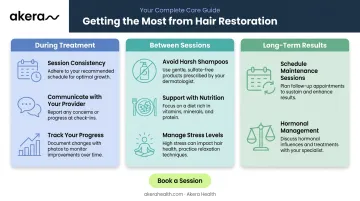
- Avoid harsh shampoos, sulphates, and heat styling in the days immediately following a session
- Support follicle health through diet: adequate protein, iron, biotin, and zinc underpin the hair growth cycle
- Stay hydrated and manage stress, since elevated cortisol is a known trigger for telogen effluvium
For Long-Term Results
- Maintenance sessions (typically every 6–12 months) are recommended once the initial course is complete
- If your hair loss has a hormonal cause (PCOS, thyroid dysfunction), managing that condition alongside scalp treatment is essential for durable outcomes
Following these steps consistently improves how your scalp responds to treatment and helps sustain results over time. At Akera Health's clinics in HSR Layout and HRBR Layout, Bengaluru, every hair restoration plan begins with a personalised trichological assessment. Readers experiencing hair loss can book a consultation with one of their board-certified dermatologists. Professional services start from ₹5,500.
Conclusion
The five benefits of hair restoration — improved scalp health, root-cause treatment, minimal invasiveness, natural long-term regrowth, and restored confidence — are not aspirational claims. They are measurable outcomes observed when treatment is administered correctly, monitored consistently, and supported by an accurate diagnosis.
Hair loss is a treatable condition. The earlier it's addressed, the more responsive the follicles are and the better the outcomes tend to be. Waiting doesn't make it easier — and the follicles lost to prolonged inaction are harder to recover.
That's why acting early matters. Treatments like PRP and GFC available today are more targeted and better understood than they were even five years ago. At Akera Health, every hair restoration plan begins with a dermatologist-led diagnosis — because getting the cause right is what makes the results last. If you're noticing early signs of hair loss, book a consultation to understand what's driving it and what can be done.
Frequently Asked Questions
Frequently Asked Questions
Is it possible to restore hair?
Yes, in most cases — particularly when follicles are still present but dormant rather than permanently damaged. Treatments like PRP and GFC can reactivate dormant follicles and encourage new growth. Results depend on the cause, duration of hair loss, and how early treatment begins.
Why is Gen Z losing hair?
Common triggers include chronic stress, disrupted sleep, poor nutrition (protein and iron deficiency), and hormonal fluctuations. Family history, smoking, and high BMI are also linked to early-onset hair thinning in younger adults. Because causes vary, an accurate diagnosis matters before starting any treatment.
How many sessions of hair restoration are needed to see results?
Most protocols recommend 3–6 initial sessions spaced 4–6 weeks apart, followed by maintenance sessions every 6–12 months. Timelines vary based on the type and severity of hair loss, as well as how consistently the treatment course is completed.
Is hair restoration safe for women with PCOS or hormonal imbalance?
Yes, but scalp treatment works best when combined with hormonal management. Treating the root hormonal cause — elevated androgens, insulin resistance — alongside PRP or GFC produces significantly more durable results than scalp treatment alone. A dermatologist can guide this combined approach.
What is the difference between PRP and GFC hair restoration?
PRP delivers concentrated platelets that release growth factors after injection. GFC goes a step further — growth factors are isolated during processing and injected as a more concentrated fraction. Both use the patient's own biological material; GFC is often preferred for more advanced hair loss due to its higher growth factor concentration.
Does hair restoration have permanent results?
Hair restoration produces long-lasting but not technically permanent results. Most patients require maintenance sessions every 6–12 months to sustain density improvements, particularly when the underlying cause — genetics, hormonal pattern — remains active. Regular maintenance is what keeps those improvements holding over time.