Introduction
Hair loss in India is far more common than most people realise. A population-based study found AGA prevalence at 58% among Indian men aged 30–50, with rates climbing past 73% by the early 40s. For women, the picture is equally concerning — hormonal hair loss frequently starts in the late 20s and accelerates through the 30s.
Most people cycle through topical treatments for months before seeking a clinical evaluation — by which point follicle damage has already progressed significantly.
GFC (Growth Factor Concentrate) treatment is now a clinical option at more dermatology clinics across India, but it's often misunderstood. Patients encounter it without a clear sense of how it differs from PRP, why results vary between individuals, or what actually determines whether a course of treatment succeeds.
This article covers how GFC works, its genuine clinical advantages over PRP, and what determines whether a course of treatment actually succeeds.
Key Takeaways
- GFC is a purified growth factor concentrate made from your own blood, processed to be more potent than standard PRP
- Clinical evidence shows GFC produces earlier improvements in hair count and shaft diameter compared to PRP
- Most patients see shedding reduce after sessions 2–3, with visible regrowth at the 3–6 month mark
- A full course typically requires 3–4 sessions spaced 4–6 weeks apart, followed by maintenance every 6–12 months
- GFC can be combined with medications, topical treatments, or other hair restoration therapies for enhanced results
What Is GFC Hair Treatment?
GFC stands for Growth Factor Concentrate — an autologous hair restoration therapy, meaning it uses the patient's own blood rather than any external substance.
How the Preparation Works
The process begins with a blood draw, typically 20–25 mL. The blood is placed into specialised tubes containing a platelet-activating agent, inverted several times, and allowed to stand for approximately 30 minutes before centrifugation. This activation step causes platelet alpha granules to release their contents before the acellular upper layer is collected.
The result is a clear, straw-coloured preparation free of red blood cells and white blood cells — a concentrated solution of growth factors ready for scalp injection.
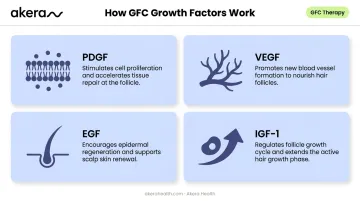
The key growth factors present include:
- PDGF — supports hair canal formation and fibroblast activity
- VEGF — promotes new blood vessel formation around follicles
- EGF — drives epithelial cell and hair shaft proliferation
- IGF-1 — supports follicle growth and angiogenic signalling
What Conditions GFC Treats
GFC is most effective for follicles that are weakened or dormant — not permanently destroyed. It is primarily used for:
- Androgenetic alopecia (male and female pattern hair loss)
- Telogen effluvium (stress or hormonal-triggered shedding)
- Alopecia areata in early-to-moderate presentations
The clinical goal: reactivate follicle stem cells, improve perifollicular blood supply, and shift follicles from the resting phase (telogen) back into active growth (anagen). Results build progressively over a structured course of sessions — with measurably thicker, denser hair as the outcome.
Key Advantages of GFC Hair Treatment
Higher Growth Factor Concentration with Less Inflammation
The core structural difference between GFC and standard PRP is what gets removed during preparation. PRP retains red blood cells and white blood cells alongside platelets. GFC eliminates both, leaving only the growth factor concentrate collected above the gel separator.
This matters for two reasons:
Consistency: Standard PRP relies on a double-spin centrifugation process where growth factor yield varies based on the individual's platelet count and the technician's preparation method. GFC's closed-system preparation produces a more standardised result session to session.
Tolerability: A 2025 retrospective comparison of 42 patients (25 PRP, 17 GFC) found that PRP produced significantly more erythema than GFC (p < 0.05). The same study showed GFC achieved earlier improvements in total hair count, shaft diameter, and Global Aesthetic Improvement Scale scores — with hair count improvement after the second session reaching statistical significance.
Patients who saw inconsistent or underwhelming results with PRP — or who are at moderate stages needing faster follicle stimulation — are the clearest candidates for switching.
Minimal Discomfort with No Meaningful Downtime
GFC injections are administered with fine needles directly into the scalp, with topical anaesthetic applied beforehand. Sessions typically run 45–60 minutes.
Because GFC contains no red or white blood cells, post-injection inflammation is lower than PRP. In a five-patient pilot study, injection-site pain was mild in 80% and moderate in 20%, with erythema and scalp irritation resolving spontaneously within hours to a few days. A separate case series using nerve blocks reported no infection, redness, or itching across eight weeks of follow-up.
For working adults in Bengaluru who cannot afford recovery time, there is no procedure-mandated leave required. Patients typically return to normal activity the same day or the next morning.
Lower discomfort also improves treatment adherence. Patients who find a procedure tolerable are far more likely to complete the full 3–4 session course — and it's across those sessions that results accumulate.
Follicle Reactivation and Scalp Environment Improvement
GFC's impact goes beyond slowing shedding. The growth factors act on the scalp's microenvironment in specific ways:
- VEGF increases perifollicular vascularisation, improving nutrient delivery to follicles
- PDGF supports fibroblast activity and connective tissue around follicle structures
- EGF promotes epithelial repair and hair shaft cell proliferation
In a 24-week pilot study of five patients receiving three monthly GFC sessions, all five showed improved hair appearance on global photography by week 24. Trichoscopy confirmed increased density, reduced shaft-diameter variability, and fewer yellow dots (a trichoscopic marker of follicle miniaturisation). A hair-pull test that was positive in 60% of patients at baseline was negative in all patients four months after completing therapy — four of five patients rated themselves "very satisfied."
Unlike treatments that only suppress active shedding, GFC works on the scalp's underlying biology. That distinction matters because improvements in follicle environment tend to persist after the treatment course concludes, not just during it.
At Akera Health, GFC can be combined with medications, topical treatments, or even post-hair transplant recovery care, depending on the patient's individual clinical picture.
GFC vs. PRP: How the Two Compare
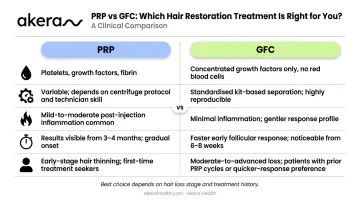
Both GFC and PRP are autologous, non-surgical treatments — the patient's own blood is the source material for both. The difference lies in what ends up in the syringe.
| Feature | PRP | GFC |
|---|---|---|
| Blood components retained | Platelets + RBCs + WBCs | Growth factors only (acellular) |
| Preparation consistency | Variable (depends on platelet count, double-spin method) | More standardized (closed-system kit) |
| Post-injection inflammation | Higher (more erythema reported) | Lower |
| Early results (hair count, diameter) | Slower initial response | Earlier improvement at session 2–3 |
| Six-month outcomes | Better hair diameter and GAIS scores in one comparative study | More bulbar enlargement; early gains |
| Availability | Widely available | Available at dermatology clinics with closed-system kits |
The 2025 comparative study found that GFC produced faster early improvements, while PRP showed stronger hair diameter and aesthetic scores at six months. Each treatment has a clear performance profile — the right choice depends on the patient's hair loss stage, prior treatment history, and what they need from the protocol.
When PRP may be preferred: Early-stage thinning, patients without previous treatment, or where cost is the primary consideration.
When GFC is often the better fit: Moderate hair loss, patients with prior poor PRP response, or those who need faster, more consistent follicle stimulation with less post-session discomfort.
At Akera Health, Dr. Lavina Mittal assesses hair loss grade, duration, and clinical history during the initial consultation to recommend whichever protocol fits the patient's situation — not a default preference for one over the other.
What Happens When Hair Loss Goes Untreated
Androgenetic alopecia is progressive. Research shows that while bald scalp retains hair follicle stem cells, it has fewer progenitor cells — suggesting the stem cell-to-progenitor conversion becomes impaired over time. This conversion failure is the underlying reason follicles stop producing healthy hair.
Once the follicle loses its structural anchoring, the damage may be permanent. The window for regenerative treatments like GFC to produce meaningful results narrows as follicle miniaturisation advances.
The biological progression carries a measurable psychological toll. A North Indian study of 200 men with AGA found a mean DLQI score of 13.52 — a level indicating very large impact on quality of life — with personal relationships rated the most affected domain.
Two patterns consistently delay effective treatment:
- Topical minoxidil manages symptoms but doesn't address the follicle environment — and hair loss returns within 3–4 months of stopping it
- Untreated AGA has no stable plateau; each month of delay reduces the number of follicles that remain viable candidates for reactivation
How to Get the Best Results from GFC Treatment
GFC works as a structured course, not a single session. Here's what that looks like in practice:
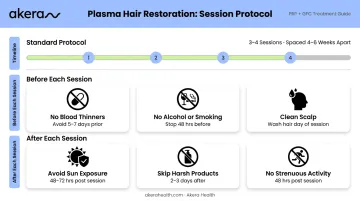
Standard protocol:
- Initial course: 3–4 sessions spaced 4–6 weeks apart
- Maintenance: sessions every 6–12 months after the initial course
- Skipping sessions after early improvement is one of the most common reasons patients fall short of full results
Before each session:
- Avoid blood-thinning medications (aspirin, NSAIDs) for several days prior
- Avoid alcohol and smoking in the 48–72 hours before treatment
- Arrive with a clean scalp, free of heavy styling products
After each session:
- Avoid direct scalp sun exposure for 48–72 hours
- Skip harsh shampoos, chemical treatments, or heat styling for 2–3 days
- Avoid strenuous physical activity for 48 hours to minimise scalp sweating and disruption to the injection sites
At Akera Health, each hair restoration plan starts with an assessment by Dr. Lavina Mittal — covering hair loss grade, hormonal history, and scalp condition. She then determines the right session frequency and whether GFC should be combined with complementary treatments, such as topical therapies or medications, for the best long-term outcome. Akera Health has completed 5,000+ sessions across the HSR Layout and HRBR Layout clinics, earning a 4.9/5 Google rating from 350+ reviews.
Conclusion
GFC's value comes from three things working together: a purer, more consistent growth factor preparation; a low-discomfort treatment experience that patients actually complete; and a biological impact on the scalp that extends well beyond the treatment course itself.
Durable, visible results depend on how consistently the treatment is followed. Patients who get the most out of GFC tend to share three habits:
- Complete the full initial course without skipping sessions
- Maintain appropriate scalp care between appointments
- Return for maintenance sessions as recommended by their dermatologist
For androgenetic alopecia and hormonal hair loss, GFC stands out as a well-supported non-surgical option — particularly when guided by a dermatologist who can adjust the protocol to your specific hair loss pattern and stage.
Frequently Asked Questions
Is GFC better than PRP for hair loss?
GFC delivers a purer, more consistent preparation with less post-injection inflammation, and clinical evidence shows faster early gains in hair count and shaft diameter. PRP, however, showed stronger results on some metrics at the six-month mark. Both are effective — the right choice depends on your hair loss stage and treatment history.
Is GFC better than minoxidil for hair loss?
They work differently. Minoxidil is a topical vasodilator requiring daily application, and shedding returns when you stop. GFC stimulates follicle reactivation directly, typically producing more durable results for moderate hair loss — and a dermatologist may recommend both together for additive effect.
How long do results from GFC hair treatment last?
Most patients maintain visible improvement for 12–18 months following a complete course. Maintenance sessions every 6–12 months are recommended to sustain those results. Longevity depends on the underlying cause of hair loss, lifestyle factors, and consistency with aftercare.
Why does GFC hair treatment cost more than topical alternatives?
The cost covers the single-use closed-system kit required for sterile preparation, the clinical expertise for precise scalp injection, and a multi-session protocol. Unlike daily topical treatments, results persist well beyond the treatment period, reducing long-term dependence on maintenance products.
How many sessions are needed before results become visible?
Most patients complete 3–4 sessions in the initial course, with noticeable reduction in shedding typically appearing after sessions 2–3. Visible new growth generally becomes apparent at the 3–6 month mark as follicles progress through the anagen cycle.
Does GFC hair treatment have side effects?
Side effects are mild and temporary: minor redness, tenderness, swelling, or a brief burning sensation at injection sites. These typically resolve within 24–48 hours. Because GFC uses only the patient's own blood components, the risk of allergic reaction is very low.