Introduction
You're standing in front of the mirror, scrutinising acne scars that won't budge, pigmentation that seems to spread, or skin that's lost its brightness. You've heard that chemical peels and microneedling can help — but which one actually addresses your problem?
This is a question many patients in Bengaluru struggle with, and the frustration is legitimate. Choosing the wrong treatment doesn't just waste money; it can mean longer recovery, suboptimal results, or — in darker Indian skin tones — the risk of making hyperpigmentation worse.
That outcome depends on the mechanism — and chemical peels and microneedling work through entirely different ones. Their effectiveness hinges on whether your concern lives at the skin's surface or deeper within its structure.
What follows breaks down how each treatment works, what it's genuinely suited for, and how to match the right option to your skin.
Key Takeaways
- Chemical peels exfoliate damaged surface layers — best for pigmentation, sun damage, dullness, and uneven tone
- Microneedling triggers collagen production from within — superior for acne scars, fine lines, enlarged pores, and skin laxity
- Peels show faster visible surface results; microneedling delivers gradual, structural, longer-lasting improvements
- Indian skin tones face a higher PIH risk with peels — acid selection matters; microneedling is generally safer across all skin types
- Combining both treatments in sequence, under dermatologist supervision, delivers more complete and lasting results
Chemical Peel vs. Microneedling: Quick Comparison
| Factor | Chemical Peel | Microneedling |
|---|---|---|
| Mechanism | Acid solution removes damaged outer skin layers | Micro-needles trigger wound healing and collagen production |
| Downtime | 3–14 days depending on depth | 1–3 days of redness and mild swelling |
| Best For | Pigmentation, sun damage, dullness, acne, mild texture | Acne scars, fine lines, pore size, skin laxity |
| Skin Tone Safety | Requires careful acid selection for darker tones | Safe for all skin tones including Fitzpatrick IV–VI |
| Sessions Needed | 3–6 for optimal results | 3–6 sessions, 4–6 weeks apart |
| Starting Price | ₹3,000 per session (superficial peel) | ₹10,000 per session (Morpheus8 Pro) |
What Is a Chemical Peel?
A chemical peel applies a formulated acid solution (glycolic, salicylic, lactic, mandelic, or TCA) to the skin surface, causing controlled exfoliation. Dead and damaged skin layers shed in the days that follow, revealing fresher skin underneath.
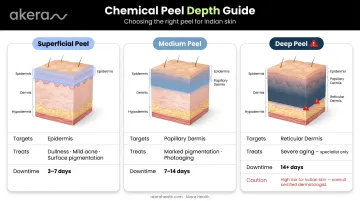
The Three Depth Levels
The depth of a peel determines both its impact and its recovery time:
- Superficial peels target the outermost epidermal layer. Suited for dullness, mild acne, and surface pigmentation. Downtime: 3–7 days of scaling
- Medium peels reach into the papillary dermis, addressing more marked pigmentation changes and photoaging. Downtime: 7–14 days, with swelling possible in the first 48 hours
- Deep peels penetrate the reticular dermis for severe wrinkles and significant skin damage — but carry substantially higher risk and are rarely appropriate for Indian skin
What Chemical Peels Treat Best
Peels have strong clinical evidence for several epidermal concerns. A 2024 systematic review covering 24 studies and 1,075 patients confirmed that peels can be effective for melasma, while a separate systematic review of 12 RCTs and 387 participants showed consistent improvement in acne with superficial peels.
Core benefits include:
- Reducing melasma, sun spots, and post-acne discolouration
- Brightening dull, uneven skin tone
- Treating active acne by unclogging congested pores
- Smoothing mild surface roughness
A Critical Note for Indian Skin
The IADVL's standard guidelines for chemical peels are explicit: superficial peels are usable in Indian skin types, but medium-depth peels require extreme caution in Fitzpatrick IV–VI, and deep phenol peels are not recommended. In a study of 473 superficial peel treatments in skin types III–VI, post-inflammatory hyperpigmentation (PIH) occurred in 1.9% of cases — a low rate, though not negligible.
Gentler acids (salicylic, mandelic, and lactic) carry a lower PIH risk on darker complexions. At Akera Health, chemical peels are performed using plant-based formulations and supervised by a board-certified dermatologist, with acid selection tailored to each patient's skin type and concern.
Who Should Consider a Chemical Peel
Chemical peels suit patients dealing with:
- Post-acne marks and surface discolouration
- Melasma or sun-damaged skin
- Overall dullness and congested pores
- A visible brightness boost ahead of a specific event or occasion
What Is Microneedling?
Microneedling — also called collagen induction therapy — uses a device with fine, sterile needles to create thousands of controlled micro-punctures in the skin. These micro-injuries trigger the body's wound-healing response, stimulating new collagen and elastin production.
Why It Works: The Collagen Science
Collagen production naturally declines with age, as research on chronologically aged skin confirms, with substantially lower type-I procollagen levels in older adults and reduced fibroblast activity. Microneedling effectively restarts that production cycle — which is why it excels at structural skin concerns like atrophic acne scars and fine lines.
A 2019 systematic review found improvement in all 33 included articles examining microneedling for atrophic acne scars, while a 2023 study of 32 subjects with a mean age of 56.3 years found significant wrinkle improvement after repeated treatments.
RF Microneedling: The Next Level
Standard microneedling delivers mechanical wound healing. RF (radiofrequency) microneedling adds radiofrequency energy at targeted dermal depths, creating thermal coagulation zones that stimulate collagen contraction and longer-term remodelling. This makes it particularly valuable when skin laxity and deeper structural concerns are involved.
Akera Health's Morpheus8 Pro RF Microneedling combines both mechanisms. Patient Aarushi Malhotra described her results as skin that feels "firmer, smoother, and much more youthful" after targeting acne scars and texture. Another patient, Kritika Sharma, reported "a visible reduction in fine lines and enlarged pores" after several sessions.
Microneedling and Indian Skin
Unlike chemical peels and laser treatments, microneedling does not target melanin. This means it carries minimal PIH risk, making it a consistently safer option for the darker skin tones prevalent across India. That's a meaningful clinical advantage for patients who've been advised to avoid more aggressive surface treatments.
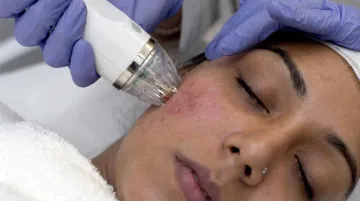
Results build gradually over 3–6 months as collagen remodelling continues. Most patients complete 3–6 sessions spaced 4–6 weeks apart before seeing optimal improvement.
Who Should Consider Microneedling
Microneedling is the stronger match for patients with:
- Atrophic (pitted) acne scars
- Enlarged pores
- Fine lines and early wrinkles
- Overall skin texture irregularities
- Mild skin laxity
- Stretch marks
Which Treatment Is Right for You?
The decision comes down to five variables: depth of concern, skin tone, downtime tolerance, desired speed of results, and long-term goals.
Choose a Chemical Peel If:
- Your primary concern is pigmentation — melasma, dark spots, post-acne marks, or sun damage
- You want visible surface brightening within days of treatment
- Your skin concern is largely epidermal, not structural
- You're dealing with active acne or congested pores
Choose Microneedling If:
- Your primary concern is atrophic acne scarring, enlarged pores, fine lines, or early laxity
- You want long-term, collagen-driven structural improvement
- You have a darker skin tone and are concerned about PIH risk from peels
- You can commit to gradual improvement over multiple sessions
What About Combining Both?
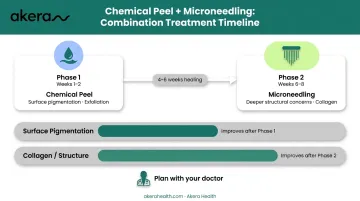
A "chemical peel first, microneedling later" sequence has solid clinical backing. A 2025 meta-analysis confirmed combination benefit for scar-plus-pigmentation presentations, with protocols spanning 3–6 sessions at 2–6 week intervals. Peels address surface discoloration and exfoliation first; after 4–6 weeks of healing, microneedling targets deeper structural concerns. The two cannot be done simultaneously; sequencing and spacing must be planned with a dermatologist.
The Honest Caveat
Active acne, rosacea tendency, history of PIH, recent isotretinoin use, and your current skincare regimen all influence which treatment is appropriate — and at what depth. Akera Health's consultation process evaluates each of these factors before any treatment is recommended.
Conclusion
Chemical peels are the stronger choice when the concern lives at or near the surface — tone, pigmentation, brightness. Microneedling is more effective when the concern is structural — scarring, texture, firmness. The best outcomes often come from a thoughtful combination of both, planned in the right sequence.
If you're in Bengaluru and ready for a treatment plan built around your skin — not a generic protocol — book a personalised consultation at Akera Health with Dr. Lavina Mittal (MBBS, MD). Every plan is tailored to your skin type, lifestyle, and goals. Visit akerahealth.com/pages/contact to get started.
Frequently Asked Questions
Is it better to do microneedling or chemical peel?
Neither is universally better — the right choice depends on your skin concern. Chemical peels suit surface pigmentation and dullness; microneedling is more effective for acne scars and structural texture issues. A dermatologist can assess which is appropriate for your specific skin type and history.
Which comes first, microneedling or chemical peel?
When combining both, a chemical peel is typically done first for surface exfoliation and pigmentation. After 4–6 weeks of healing, microneedling addresses deeper structural concerns. Always follow a dermatologist's guidance on sequencing.
Will a chemical peel make you look younger?
Yes. Peels improve fine lines, sun damage, uneven tone, and dullness, all of which contribute to a more youthful appearance. For deeper wrinkles or significant skin laxity, microneedling or a combination approach tends to deliver more lasting rejuvenation.
Is 40 too old for microneedling?
Not at all. Microneedling is particularly beneficial for patients in their 40s and beyond because it addresses age-related collagen decline directly. There is no upper age limit; treatment suitability is assessed based on skin condition, not age.
Can microneedling and chemical peels be combined for better results?
Yes. Combining both delivers comprehensive improvement: peels clear surface pigmentation while microneedling rebuilds deeper skin structure. Space treatments 4–6 weeks apart and follow dermatologist guidance on sequencing for safe results.
Are chemical peels safe for darker Indian skin tones?
Certain peels are safe when selected carefully. Acids like salicylic, mandelic, and lactic are gentler options that reduce post-inflammatory hyperpigmentation (PIH) risk in Fitzpatrick IV–VI skin, which is common across Indian patients. Dermatologist supervision, correct acid selection, and appropriate concentration are essential — at Akera Health, all peels are performed by certified dermatologists with Indian skin types in mind.