Introduction
Tattoo regret is more common than most people admit. Career changes, relationship shifts, outgrowing a design from a younger era — the reasons differ, but the question doesn't: can this actually be removed?
Q-switched Nd:YAG laser has become the most clinically validated, non-scarring method for tattoo removal available today. Unlike older approaches — salabrasion, surgical excision, or ablative CO2 lasers — it targets ink without destroying the skin surface. That distinction makes it the standard of care in dermatology practices worldwide, including in India.
This article covers what you need to know before committing to treatment: how the technology works, what clinical studies say about real-world results, how many sessions to expect, what the safety profile looks like for Indian skin, and how to choose the right clinic.
Key Takeaways
- Q-switched Nd:YAG delivers nanosecond bursts that shatter ink particles without scarring surrounding skin
- Most patients need 6 or more sessions; professional or multicoloured tattoos often require 10+
- 96.6% patient satisfaction was reported in an 89-patient Indian cohort study (Padhiar et al., 2019)
- The 1064 nm wavelength is specifically preferred for darker Indian skin tones (Fitzpatrick IV–V)
- Sessions are spaced weeks apart — rushing them reduces efficacy and increases risk
How Q-Switched Nd:YAG Laser Works for Tattoo Removal
The Physics of Q-Switching
"Q-switching" refers to how the laser manages its resonator losses to store energy and release it in ultra-short, high-peak-power pulses — typically 5–10 nanoseconds for conventional Nd:YAG systems (the range extends to 100 ns). That burst intensity is what distinguishes Q-switched devices from continuous-beam lasers, and it's what makes them capable of shattering ink particles rather than simply heating them.
The underlying principle is selective photothermolysis: the laser wavelength is matched to the absorption spectrum of tattoo ink, so energy is absorbed preferentially by pigment particles while surrounding skin tissue is largely spared. Because pulse duration is shorter than the thermal relaxation time of ink particles, energy stays concentrated at the target.
Research confirms that Q-switched treatment involves both photothermal and photoacoustic components: rapid heating causes thermal expansion, which generates pressure waves that mechanically fragment the ink.
Two Wavelengths, Different Targets
| Wavelength | Primary Use | Why It Works |
|---|---|---|
| 1064 nm | Black and dark blue inks | Deeper dermis penetration; lower melanin absorption — safer for darker skin |
| 532 nm | Red, orange, and yellow inks | Targets shallower layers and lighter pigments |
Black ink is generally the most responsive to treatment: small particle size, no metallic elements, and it absorbs all wavelengths. Green ink is notably more resistant to native Nd:YAG wavelengths and may require alternative approaches.
What Happens After Each Session
Laser energy shatters ink into microscopic fragments. The body then clears them through a gradual process:
- Macrophages engulf the disrupted pigment particles
- Lymphatic channels transport the debris to regional lymph nodes for elimination
- Transepidermal crusting releases some fragments through the skin surface
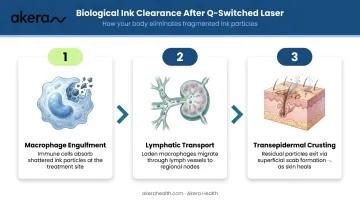
This is why tattoos fade progressively over weeks after each session, not immediately on the table.
Efficacy: What Clinical Evidence Says
The Gujarat Cohort Study
The most directly relevant Indian evidence comes from Padhiar et al. (2019), a randomised prospective study of 89 patients at a tertiary care centre in Gujarat. The patient profile closely mirrors the broader Indian population: 86.5% Fitzpatrick type IV, with blue-black tattoos accounting for 92.1% of cases.
Key findings:
- 78.7% of participants received 6 or more sessions
- 13.5% required 10 or more sessions
- 49.4% were very satisfied with outcomes; 47.2% were satisfied — 96.6% overall satisfaction
- Zero participants developed scarring
These numbers reflect realistic outcomes, not guarantees. Results varied meaningfully based on tattoo type, ink density, and treatment parameters.
Amateur vs. Professional Tattoos
This distinction matters more than most patients realise. Amateur tattoos — applied without professional equipment, using less ink at shallower depths — respond significantly faster and show better clearance at earlier sessions. In the Padhiar study, amateur tattoos (70.8% of the cohort) consistently outperformed professional ones.
A 2026 systematic review of 46 human studies found that black and blue pigments generally required 4–8 sessions to reach ≥75% clearance. That threshold is not the same as complete removal, and professional or heavily layered tattoos can require considerably more.
The Role of Fluence
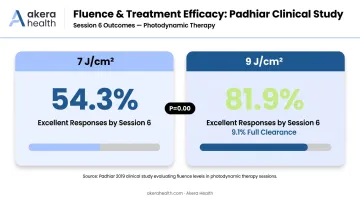
Treatment parameters directly affect outcomes. The Padhiar study compared 7 J/cm² versus 9 J/cm² in amateur tattoos. By the 6th session, 9 J/cm² produced excellent responses in 81.9% of patients (with 9.1% achieving full clearance), versus 54.3% excellent responses at 7 J/cm² — a statistically significant difference (P=0.00). Fluence calibration by an experienced dermatologist is, in practice, one of the primary variables determining how well a tattoo responds.
What to Realistically Expect
- Amateur, blue-black tattoos: strongest candidates for near-complete clearance within 6–8 sessions
- Professional single-colour tattoos: likely 8–10 sessions for significant clearance
- Multicoloured or cover-up tattoos: may require 10+ sessions; substantial fading is achievable, but total removal is not guaranteed for all cases
Factors That Influence How Many Sessions You'll Need
Tattoo Characteristics
- Type: Amateur tattoos clear faster than professional ones
- Colour: Black and blue respond predictably; red and orange require 532 nm; green is more resistant
- Size and ink density: Larger, more densely inked tattoos need more sessions
- Age: Older tattoos may respond faster — ink naturally breaks down over time
- Layering: Cover-up tattoos involve multiple ink layers at varying depths, making clearance significantly harder
Skin Type — Especially Relevant for Indian Patients
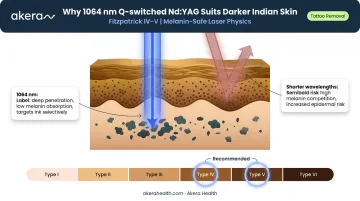
Most Indian patients fall into Fitzpatrick skin type IV–V. At these skin tones, epidermal melanin competes with tattoo ink for laser energy — which is exactly why the 1064 nm wavelength is preferred. Its lower melanin absorption reduces that competition, making it the safer choice for darker skin.
The risk of post-inflammatory hypopigmentation or hyperpigmentation still exists and is managed through careful parameter calibration. This is why treatment by a qualified dermatologist — not a beauty clinic or untrained technician — makes a meaningful difference in outcomes.
Session Intervals
Different clinical studies used intervals ranging from 3–4 weeks to 8–12 weeks between sessions. The Padhiar study used 4-week intervals, while some protocols recommend waiting at least 8 weeks after the first few sessions to allow the lymphatic system to clear fragmented ink fully.
Rushing sessions does two things: it increases the risk of adverse effects, and it reduces overall efficacy by not allowing complete clearance between rounds.
The Treatment Process: What to Expect
Pre-Treatment Consultation
Every session course begins with a thorough dermatologist-led consultation. The dermatologist evaluates tattoo size, colour, ink depth, skin type, and medical history to design a personalised treatment plan — including wavelength selection and fluence settings appropriate to your specific tattoo and skin.
At Akera Health, Dr. Lavina Mittal and the clinical team conduct individual assessments before any laser session begins, using the TriBeam Q-switched Nd:YAG system. The clinic offers tattoo removal at both its HSR Layout and HRBR Layout locations in Bengaluru.
Disclose to your dermatologist:
- Medications, especially anticoagulants or blood thinners
- History of keloid or hypertrophic scarring
- Active skin infections at or near the tattoo site
- Pregnancy or breastfeeding
- Photosensitive conditions or use of isotretinoin
During the Session
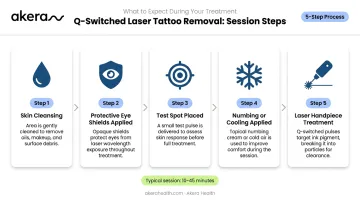
- Skin is cleansed and the area is prepared
- Protective eye shields are worn — wavelength-specific, not just sunglasses
- A test spot may be placed to confirm laser settings are appropriate for your skin's response
- Numbing cream or cooling may be applied for comfort
- The laser handpiece passes over the tattooed area in controlled pulses — sessions typically last 10–45 minutes depending on tattoo size
Immediately after pulsing, you'll see white "frosting" — a normal response representing rapidly formed gas vacuoles in the skin. This fades within minutes and does not indicate clearance itself. Mild pain, described as a rubber band snap, is common. Ice packs are typically applied post-session.
How well you care for skin between sessions directly affects both healing and results.
Post-Treatment Care
- Keep the area covered for 24–48 hours
- Apply prescribed topical antibiotic ointment
- Avoid soaking the treated area
- Strictly avoid direct sun exposure — use a broad-spectrum SPF 50+ sunscreen
- Do not pick or scratch healing skin
- Wait the recommended interval before your next session (typically 6–8 weeks)
Safety Profile: Side Effects and Contraindications
What the Clinical Data Shows
From the Padhiar 89-patient cohort (predominantly Fitzpatrick IV):
| Side Effect | Incidence |
|---|---|
| Pain during/after session | 74.2% |
| Erythema and oedema | 68.5% |
| Pinpoint bleeding | 11.2% |
| Hypopigmentation | 12.4% |
| Skin darkening | 6.7% |
| Burns or blisters | 2.2% |
| Scarring | 0% |
The data is reassuring overall. Immediate effects like redness, swelling, and discomfort typically resolve within hours to a few days. Pigmentation changes are usually temporary, though they need careful management in darker skin tones — which is why Fitzpatrick IV–VI patients benefit from a lower-fluence, staged approach.
Who Should Not Undergo This Treatment
Absolute contraindications:
- Active bacterial, viral, or fungal skin infections at the treatment site
- Pregnancy or breastfeeding
- Unstable vitiligo or psoriasis over the tattooed area
- Known tattoo granuloma or localised allergic tattoo reaction
Relative cautions (discuss with your dermatologist):
- History of keloid or hypertrophic scarring
- Anticoagulant or blood-thinning medications
- Isotretinoin use within the past 6 months
- History of herpes simplex in the treatment area
- Unrealistic expectations about complete removal in a fixed number of sessions
Q-Switch vs. Pico Laser: Which Should You Choose?
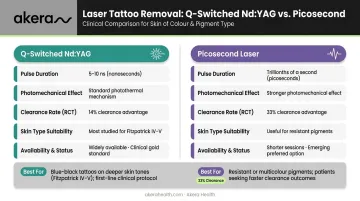
The core difference is pulse duration. Q-switched Nd:YAG lasers deliver pulses in nanoseconds (5–10 ns); picosecond lasers operate in trillionths of a second. Both involve photothermal and photoacoustic effects, but picosecond pulses confine energy more tightly, producing a stronger photomechanical fragmentation effect.
A prospective randomised study by Lorgeou et al. (2018) compared the two directly in 49 patients: after study treatments, >75% clearance occurred in 33% of picosecond-treated areas vs. 14% with nanosecond treatment (P=0.008). For black and blue tattoos specifically, the figures were 34% vs. 9%. That said, the study did not establish that pico lasers require fewer total sessions overall, and no current consensus recommends picosecond over Q-switched Nd:YAG specifically for Fitzpatrick IV–V Indian skin.
So which option is right for you? That depends on your tattoo's characteristics, ink colours, and skin type — all assessed at consultation. In general:
- Q-switched Nd:YAG remains the most widely studied and clinically proven option, particularly for blue-black tattoos and darker Indian skin tones
- Picosecond lasers can be considered for stubborn residual pigment or resistant colours after a Q-switch course
- Neither approach is universally superior — the decision should be individualised
Akera Health uses the TriBeam Q-switched Nd:YAG system for tattoo removal. For patients in Bengaluru wondering which approach suits their specific tattoo and skin, a consultation with the clinical team at either location will give you a personalised assessment at either the HSR Layout or HRBR Layout clinic.
Frequently Asked Questions
How much does Q-switch laser tattoo removal cost?
In India, per-session costs for Q-switch laser tattoo removal typically range from approximately ₹2,500 to ₹9,000, varying with tattoo size, colour complexity, ink depth, and clinic expertise. Most patients need 6 or more sessions, so total cost accumulates accordingly. A consultation with a qualified dermatologist will give you an accurate estimate for your case.
Is Q-Switch or Pico better for tattoo removal?
Both are effective, but Q-switched Nd:YAG is the better-researched standard — particularly for blue-black tattoos and darker Indian skin tones. Pico lasers may offer faster clearance for certain resistant colours. The right choice depends on your tattoo type, skin assessment, and the technology available at your clinic.
How many sessions are needed to remove a tattoo with Q-switch laser?
Most patients require a minimum of 6 sessions; professional and multicoloured tattoos often need 10 or more. Sessions are spaced weeks apart, and results vary based on ink type, density, colour, and skin type.
Is Q-switched Nd:YAG laser safe for darker Indian skin tones?
Yes — when performed by a qualified dermatologist who calibrates settings for Fitzpatrick type IV–V, the 1064 nm Q-switched Nd:YAG is the preferred option for dark ink in Indian skin. It carries lower melanin absorption than shorter wavelengths. The risk of pigmentation changes is not zero but is minimised by experienced operator judgment.
Can Q-switch laser completely remove all tattoo colours?
Black and dark blue inks respond best to 1064 nm. Red, orange, and yellow are treated with 532 nm. Green is notably more resistant to standard Nd:YAG wavelengths. Complete removal is achievable for many tattoos — particularly amateur blue-black ones — but is not guaranteed for all, especially professionally applied or multicoloured tattoos.
What should I avoid after a Q-switch laser tattoo removal session?
Key aftercare steps:
- Avoid direct sun exposure and apply SPF 50+ consistently
- Do not soak the treated area or pick at healing skin
- Use your dermatologist's prescribed ointment and wait the full interval between sessions