This guide covers everything you need to know: what microneedling actually does inside your skin, which concerns it treats best, what the procedure feels like, realistic result timelines, and who makes a good candidate.
Key Takeaways
- Microneedling works by triggering your skin's natural wound-healing response to produce new collagen and elastin
- It's most effective for rolling and boxcar acne scars, fine lines, enlarged pores, and uneven texture
- Multiple sessions spaced weeks apart are needed; visible improvement builds over 3–6 months
- Post-treatment downtime is minimal; most people return to normal activities within 24–48 hours
- Its heat-free mechanism means a lower risk of post-inflammatory hyperpigmentation, making it well-suited for darker Indian skin tones
What Is Microneedling and How Does It Work?
Microneedling (clinically called percutaneous collagen induction therapy) is a minimally invasive procedure where a device fitted with fine needles creates hundreds of controlled micro-injuries across the skin's surface. No skin is removed. No heat is delivered. The needle punctures alone do the work.
The Biological Cascade
When the needles penetrate the dermis, they trigger the skin's standard wound-healing response:
- Platelet activation releases growth factors, including platelet-derived and transforming growth factors
- Fibroblast recruitment (the cells responsible for producing structural proteins) is stimulated
- New collagen and elastin (types I, III, and VII) are synthesised and deposited in the treated area
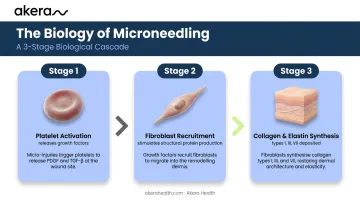
This cascade isn't just theoretical — the clinical evidence backs it up. A histological study of Fitzpatrick III–IV patients confirmed significant increases in collagen I, III, VII, and tropoelastin at three months after six microneedling sessions. Since collagen production naturally declines from your mid-twenties onward, this remodelling effect is particularly valuable for addressing signs of ageing.
Professional Microneedling vs. Dermarolling vs. Microdermabrasion
These three are often confused, but they work very differently:
| Treatment | Mechanism | Depth | Where It Acts |
|---|---|---|---|
| Professional microneedling | Motorised vertical needle penetration | Varies by area and indication (e.g., up to 1.5 mm for acne scars) | Dermis |
| At-home derma rollers | Rolling at an angle across skin | Superficial layers only | Epidermis surface |
| Microdermabrasion | Physical abrasion using crystals or a diamond tip | Surface only | Stratum corneum |
The FDA has authorized no medical microneedling device for over-the-counter sale, and at-home rollers cannot reach the dermal depth where real structural remodelling occurs. Microdermabrasion takes a different approach altogether: it exfoliates dead surface cells but does not stimulate collagen production in the deeper layers.
What Skin Concerns Can Microneedling Treat?
Acne Scars
This is where the evidence is strongest. The same primary study found good-to-very-good responses in rolling and boxcar acne scars, with clinician-rated overall scar improvement of 51–60%. Ice-pick scars — which are narrow and deep — showed only moderate improvement with standard microneedling and typically require different interventions.
A 2021 review of 9 randomised trials and 341 participants supports microneedling for atrophic scars, while noting that protocols vary and most trials are small.
Fine Lines, Wrinkles, and Skin Laxity
Collagen rebuilding in the dermis gradually makes skin firmer and more elastic. Studies in Fitzpatrick III–IV patients have shown visible improvement in facial rhytids alongside the histological collagen changes — meaning the improvements aren't just measurable under a microscope, they're visible in the mirror.
Enlarged Pores and Uneven Texture
When collagen accumulates around follicle openings, pores appear smaller and surface texture becomes smoother. Clinical reviews support improved skin appearance and texture, though pore size alone is difficult to isolate as a clinical endpoint.
Hyperpigmentation and Melasma
Because microneedling is mechanical rather than thermal, it doesn't target melanin or deliver heat energy — which means it carries a meaningfully lower risk of triggering post-inflammatory hyperpigmentation (PIH) compared to laser-based treatments. That said, a 2021 safety review still identifies PIH as a realistic risk in darker skin. "Lower risk" is not the same as "no risk."
Most clinical studies on melasma also combine microneedling with topical treatments like tranexamic acid or sunscreen — so results shouldn't be attributed to needling alone. A dermatologist consultation before treatment is essential for anyone with active pigmentation concerns.
Stretch Marks and Body Areas
Microneedling isn't limited to the face. It can be used on the neck, décolletage, abdomen, and thighs for stretch marks or areas with mild skin laxity.
What to Expect Before, During, and After Microneedling
Before the Procedure
A thorough consultation comes first. Your dermatologist will review your skin concerns, health history, current medications, and treatment goals — and will often take photographs for baseline comparison.
General preparation guidance, consistent with Cleveland Clinic and standard dermatology practice, includes:
- Stop retinoids for a few days before treatment, as directed by your clinician
- Avoid excessive sun exposure — wait until any tan or sunburn has completely cleared
- Disclose all medications, including blood thinners, recent isotretinoin use, and any acne treatments
- Skip NSAIDs like ibuprofen in the days prior if your dermatologist advises it
Your clinician will provide instructions specific to your skin type and the device being used. Akera Health's dermatologists tailor pre-treatment guidance based on each patient's individual skincare routine and concerns.
During the Procedure
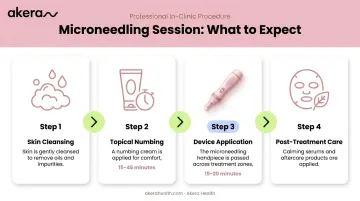
A typical professional microneedling session follows this sequence:
- Skin cleansing — the face is cleansed of all makeup, oils, and product residue
- Topical numbing — a lidocaine-based cream is applied and left for 15–45 minutes
- Device application — the microneedling handpiece is moved systematically across the treatment area (approximately 15–20 minutes for a full face)
- Post-treatment care — a calming mask or serum may be applied to reduce initial redness and inflammation
Most patients describe the sensation as mild warmth or a light scratching feeling. Deeper settings used for significant acne scarring can cause minor discomfort, especially near bony areas like the jawline or forehead. Some pinpoint bleeding is normal and expected at deeper depths.
After the Procedure
Immediately after treatment, your skin will look and feel like a moderate sunburn — red, warm, and slightly swollen. Here's what to expect in the days following:
- Days 1–2: Redness and skin tightness; some sensitivity to touch
- Days 2–5: Redness gradually subsides; mild flaking or dryness may appear — the Cleveland Clinic notes this can persist for up to 5 days, though individual recovery varies
- Most patients can resume normal activities and light makeup within 24–48 hours
Aftercare essentials:
- Apply a gentle, fragrance-free moisturiser consistently
- Use broad-spectrum SPF 50+ daily — especially critical given Bengaluru's year-round sun exposure
- Skip active ingredients (retinol, glycolic acid, alcohol-based toners) for several days
- Avoid direct sun exposure until redness has fully resolved
Akera Health's Bask Sunscreen SPF 50+ range — available in variants for oily/combination, normal, and dry/sensitive skin — is a practical daily option during the post-treatment recovery period.
When Will You See Microneedling Results?
Microneedling results are gradual — collagen remodelling is a biological process, and visible improvements build over weeks and months rather than days.
Realistic expectations by timeframe:
| Timeframe | What You May Notice |
|---|---|
| 1–3 weeks post-session | Some improvement in skin texture and brightness |
| 1–3 months | Visible improvements in skin quality; histological collagen changes confirmed in studies |
| 3–6 months | Peak collagen remodelling; most significant visible results |
| Ongoing | Maintenance sessions can sustain and build on results |
Treatment schedules vary based on the device used, the depth of treatment, and the concern being addressed. The FDA's pivotal acne scar study used three sessions on days 1, 30, and 60, with a six-month follow-up. The Cleveland Clinic notes that sessions are typically 3–8 weeks apart.
At Akera Health, the number of sessions is determined by your dermatologist based on your specific skin concerns and objectives — no two treatment plans look the same.
Professional Microneedling vs. At-Home Devices
The core difference comes down to depth, precision, and safety.
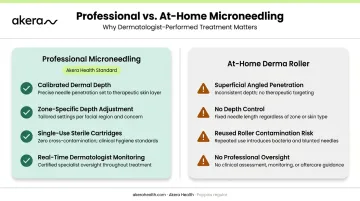
Why professional devices outperform at-home rollers:
- Clinic devices drive needles straight down at calibrated depths, reaching the dermis where remodelling actually occurs — at-home rollers move at angles and stay superficial
- Dermatologists adjust depth by facial zone and indication (shallower around the orbital rim, deeper over thicker skin with acne scars)
- Single-use sterile cartridges eliminate cross-contamination risk; at-home rollers that aren't perfectly sterilised between uses can introduce bacteria and worsen breakouts
- A dermatologist monitors your skin's response in real time and adjusts the treatment accordingly
If needling alone isn't enough for your concerns, there's a step up worth knowing about.
For patients with significant skin laxity, deep wrinkles, or stubborn scarring, Morpheus8 RF Microneedling — offered at Akera Health — combines microneedling with radiofrequency energy delivery. The RF component heats tissue at depths of up to 8mm, triggering collagen contraction and remodelling that needle-only devices cannot reach.
Who Should (and Shouldn't) Get Microneedling?
Good Candidates
- Adults concerned about rolling or boxcar acne scars, fine lines, enlarged pores, or mild skin laxity
- People with uneven texture or mild pigmentation who want gradual, cumulative improvement
- Individuals with darker skin tones (Fitzpatrick III–V) who are not suitable candidates for heat-based laser treatments
Consult a Dermatologist First — or Avoid Entirely
Some conditions make microneedling inappropriate or require medical clearance:
- Active acne breakouts or cold sores — needling can spread infection across the treatment area
- Blood thinners or clotting disorders — increased bleeding risk
- Eczema or psoriasis in the treatment area — risk of triggering a flare
- History of keloid scarring — may stimulate excessive scar tissue formation
- Recent chemotherapy or radiotherapy — compromised healing capacity
- Pregnancy — flagged as a discussion point in FDA materials
A consultation with a qualified dermatologist helps determine whether microneedling suits your skin — or whether RF microneedling or another approach is a better fit. At Akera Health's HSR Layout and HRBR Layout clinics, Dr. Lavina Mittal and her team review your skin, medical history, and goals before any treatment is recommended.
Frequently Asked Questions
What does microneedling do for your skin?
It creates controlled micro-injuries that trigger your skin's natural repair process, stimulating fibroblasts to produce new collagen and elastin. Over several months, this progressively improves texture, firmness, the appearance of acne scars, and pore size.
What does your skin look like 2 days after microneedling?
Skin typically appears pink to red — similar to mild sunburn — and may feel tight or dry. Light flaking can begin by day two. Most people can resume normal activities with gentle skincare; significant redness usually subsides by day 2–5 depending on the individual.
Is microneedling better than Botox?
They address different problems and aren't interchangeable. Microneedling rebuilds skin structure — improving texture, scars, pores, and static lines — through collagen stimulation, while Botox temporarily relaxes muscles to smooth dynamic wrinkles. Both are sometimes combined as part of an anti-ageing programme.
How many microneedling sessions do you need to see results?
Most people need multiple sessions, with protocols varying by indication — the FDA's pivotal study used three sessions over 60 days. Improvements continue building for up to 3–6 months post-treatment.
Is microneedling safe for Indian skin tones?
It's considered one of the more appropriate options for Fitzpatrick III–V skin because it uses no heat or light energy, reducing the risk of post-inflammatory hyperpigmentation compared to laser resurfacing. That said, PIH risk isn't eliminated entirely — professional supervision remains essential.