The honest answer: forehead filler can deliver real improvements for the right patient, but it also carries more risk than most other filler sites on the face. The forehead's dense vascular anatomy makes injector skill and patient selection genuinely critical — not just standard disclaimers.
This article covers how forehead filler works, what results you can realistically expect, the risks you need to understand, what the procedure involves, and who is (and isn't) a suitable candidate.
Key Takeaways
- Forehead filler uses hyaluronic acid to treat static lines (visible at rest) — not the same as Botox, which addresses muscle-driven dynamic wrinkles
- The forehead is a higher-risk injection area due to its vascular connections to the eye; which makes injector qualification especially critical
- Clinical studies show results may persist 12–18 months depending on the filler and individual factors
- Those with predominantly dynamic wrinkles are often better suited to Botox than filler
What Is Forehead Filler and How Does It Work?
Forehead filler is a minimally invasive injectable treatment using hyaluronic acid (HA) — a substance naturally present in the body — to add volume beneath the skin, fill in deep static lines, and smooth the forehead's surface.
Static vs. Dynamic Wrinkles: Why the Distinction Matters
Understanding this difference determines which treatment you actually need:
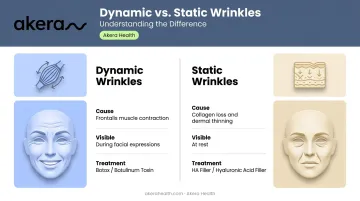
- Dynamic wrinkles form from repeated muscle movement — the horizontal lines that appear when you raise your eyebrows. Driven by frontalis muscle contraction, they're primarily treated with botulinum toxin (Botox)
- Static wrinkles remain visible even when your face is at rest, caused by dermal thinning, reduced elasticity, and collagen breakdown — these are the target for HA filler
Choosing filler for predominantly dynamic wrinkles won't address the underlying cause. Your consultation should identify which type you're dealing with before any treatment decision is made.
Why Hyaluronic Acid?
HA fillers are the standard choice for the forehead for two practical reasons. Their smooth consistency integrates well with delicate tissue in this area, and they are reversible — an enzyme called hyaluronidase can dissolve HA filler if complications arise or the result needs correcting. In a high-risk area like the forehead, that reversibility matters.
What Results Can You Expect from Forehead Filler?
The visible outcome is a softening of deep horizontal forehead lines and mild volumising to create a smoother, more even contour — without surgery or extended downtime.
Timeline of Results
- Immediately after: Volume improvement is visible, though mild swelling may temporarily affect the final appearance
- Days 1–3: Swelling and redness typically subside; a 2024 review of dermal filler adverse effects notes transient oedema generally resolves within a few days
- Day 21 onwards: The settled, accurate result becomes apparent
How Long Does It Last?
Duration varies by product, injection technique, and individual. A prospective 18-month study published in the Journal of Cosmetic Dermatology — which included 84 patients treated with a superficial HA filler on the forehead — found that measurable improvement persisted in 66% of patients at 18 months. A separate 10-patient forehead augmentation series showed measurable improvement at 12 months.
These are product- and technique-specific findings.
Setting Realistic Expectations
Filler will not eliminate wrinkles entirely or replicate surgical results. The goal is natural-looking softening. Patients with deep static lines may still see some residual creasing after treatment.
Most patients schedule a maintenance session roughly once a year. Scheduling touch-ups before results fully fade helps prevent lines from deepening again.
Risks of Forehead Filler You Should Know
The forehead is one of the higher-risk areas for filler injections — largely due to the region's underlying anatomy, which places major blood vessels in close proximity to injection sites.
The Most Serious Risk: Vascular Occlusion
The supratrochlear and supraorbital arteries — both present in the forehead — are branches of the ophthalmic artery, which supplies the eye. A 2025 meta-analysis published in Folia Morphologica found that the supratrochlear artery becomes more superficial as it ascends, and that anatomical variability means no injection plane can be assumed risk-free.
If filler is inadvertently injected into one of these vessels, it can block blood flow. Potential consequences include:
- Skin necrosis (tissue death)
- Vision disturbance
- In rare but documented cases, irreversible vision loss
A 2020 systematic review identified 44 published HA filler-associated vision loss cases, with the forehead and glabella among the commonly implicated sites. This risk exists even with a qualified injector, though proper training, technique, and anatomical knowledge reduce it significantly.
Common Mild Side Effects
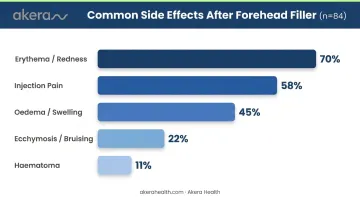
In the 84-patient forehead cohort referenced above, immediate post-treatment reactions included:
- Erythema (redness): 70% of patients
- Injection pain: 58%
- Oedema (swelling): 45%
- Ecchymosis (bruising): 22%
- Haematoma: 11%
All of these resolved by day 90, and no severe adverse event was recorded in this study — though the sample size is too small to exclude rare vascular events. Beyond these immediate reactions, a smaller subset of patients may experience complications that emerge days or weeks later.
Less Common Complications
- Filler migration: HA can shift from its original placement. A 2019 case report documented an orbital mass following forehead and lateral eyebrow filler injections
- Tyndall effect: A blue-grey tint visible through thin skin when filler is placed too superficially. Hyaluronidase is the established treatment
- Asymmetry and lumps: Usually correctable, particularly with HA filler
- Over-correction: Forehead skin is relatively taut and thin. Excessive filler volume can create an unnatural bulging appearance and may affect brow and eyelid position over time
For all these reasons, forehead filler requires a conservative approach — starting with lower volumes and adjusting across sessions — performed by an injector with specific training in facial vascular anatomy.
What to Expect During and After the Procedure
The Consultation
Before any injection, a qualified injector will assess your facial anatomy, skin quality, wrinkle type, and goals. This is also when contraindications should be identified. The FDA advises against treatment when active inflammation or infection is present at the intended site, and a 2020 clinical-practice review identifies pregnancy, breastfeeding, and known hypersensitivity to filler components as contraindications.
At Akera Health, dermatologist-led consultations include an in-depth assessment of skin condition, anatomy, and individual goals to determine whether forehead filler, Botox, or another approach is most appropriate.
The Procedure
- Cleansing — the treatment area is thoroughly prepared
- Numbing — topical anaesthetic cream or local anaesthetic is applied; many HA fillers also contain lidocaine
- Injection — small amounts of filler are placed at precise depths using a fine needle or microcannula. A typical session takes 20–30 minutes
- Aftercare briefing — post-treatment instructions are provided before you leave

After the Treatment
Patients can typically resume normal daily activities the same day. The AAD recommends waiting until the next day before strenuous exercise and avoiding touching the treated area. Avoid direct sun exposure immediately after treatment.
Beyond these immediate steps, a few habits support longer-lasting results:
- Use a broad-spectrum SPF daily — photoprotection is well-supported for maintaining overall skin quality
- Do not touch or massage the treated area unnecessarily
- Maintain a skincare routine that supports collagen production (retinoids are a well-researched option)
Akera Health's Sunscreen SPF 50+ is available in formulations for oily, normal, and dry skin types — a straightforward addition to your post-treatment routine.
Who Is (and Isn't) a Good Candidate?
Not everyone with forehead lines is a filler candidate — and getting that distinction right is what separates a good outcome from a disappointing one.
Suitable Candidates
A 2021 international expert consensus identifies suprabrow volume loss, prominent brow ridges, and loss of forehead convexity as the primary forehead filler indications. Generally, good candidates:
- Have static lines visible at rest, not just during expression
- Show mild to moderate volume loss in the forehead area
- Have realistic expectations about softening lines, not eliminating them
- Have no relevant contraindications
Who Should Not Get Forehead Filler
- Those with predominantly dynamic wrinkles — Botox is the more appropriate treatment
- Individuals who are pregnant or breastfeeding
- Anyone with an active skin infection in the treatment area
- Those with a known allergy to filler components
- Patients with very thin or fragile skin (higher risk of Tyndall effect and over-correction)
- Anyone expecting surgical-level correction from a non-surgical procedure
At Akera Health, dermatologists make this Botox-vs-filler distinction explicitly during every consultation — dynamic wrinkles are addressed with wrinkle relaxers; structural volume loss is addressed with HA filler.
Alternatives to Forehead Filler
Botox
For dynamic forehead wrinkles — the most common type — Botox is typically the first recommendation. A 2025 peer-reviewed review confirms botulinum toxin as the primary treatment for dynamic forehead lines because it reduces frontalis muscle activity. It does not address true volume deficiency, but for many patients, dynamic lines are the primary concern. Botox and filler are sometimes combined when both dynamic and static components are present.
RF Microneedling
For patients who want improvement without injectables, RF microneedling is an effective non-injectable alternative. A 2021 clinical and histologic study found that fractional RF microneedling produced dermal remodelling including new collagen and elastin formation. Akera Health's Morpheus8 Pro works through this mechanism — and can be combined with anti-ageing injectables to extend results — making it a strong choice for patients focused on skin quality and gradual tightening.
Medical-Grade Skincare
For early-stage lines or ongoing maintenance, dermatologist-recommended topicals can meaningfully improve skin over time:
- Retinoids: A 2022 systematic review found that most included studies reported significant improvement in photoageing-related wrinkling with topical tretinoin
- Broad-spectrum SPF: A 2021 review found good evidence that daily photoprotection helps prevent photoageing
These are not substitutes for filler or Botox, since topicals cannot fill established volume loss. They are, however, a sensible long-term strategy that complements any injectable treatment plan.
Frequently Asked Questions
How long do forehead fillers last?
Clinical studies show results persisting in most patients at 12–18 months, though duration varies by product, injection depth, and individual factors. Most patients return for a maintenance session roughly once a year.
Is filler good for the forehead?
It can be, specifically for static lines and mild volume loss — but it's not suitable for everyone. The forehead is a higher-risk area, so results depend heavily on accurate candidacy assessment and injector experience.
Is forehead filler painful?
Discomfort is generally minimal. Topical numbing cream or local anaesthetic is applied beforehand, and most HA fillers contain lidocaine. Patients may feel mild pressure or tenderness during injection.
What is the difference between forehead filler and Botox?
Botox relaxes the muscles responsible for expression-driven (dynamic) wrinkles. Filler adds volume to treat static lines visible even at rest. They target different problems and can be used together when both are present.
Can forehead fillers go wrong?
Complications are possible, including vascular occlusion, migration, asymmetry, and in rare cases, vision loss. Choosing a qualified injector who understands forehead anatomy and has emergency protocols — including hyaluronidase on hand — is essential.
Who should not get forehead filler?
Forehead filler is not recommended for those who are pregnant or breastfeeding, have an active skin infection in the area, or are allergic to filler components. Predominantly dynamic wrinkles are better addressed with Botox. A dermatologist assessment will confirm whether you're a suitable candidate.