Research published in 2016 confirms that hirsutism affects 70–80% of women with PCOS — making it one of the most common and emotionally distressing features of the condition.
This guide answers the questions that matter most: whether laser hair removal actually works for hormonal hair, which laser is safe for Indian skin tones, how many sessions to realistically expect, and what results actually look like — so you can make an informed decision, not just a hopeful one.
Key Takeaways
- Hirsutism affects 70–80% of women with PCOS — it's a medical symptom, not a cosmetic flaw
- Laser hair removal significantly reduces hair density and coarseness, but works as a long-term management tool, not a permanent cure
- PCOS patients typically need more sessions than average due to continuous hormonal stimulation
- Nd:YAG and Diode lasers are the clinically preferred options for Indian skin tones (Fitzpatrick IV–VI)
- Pairing laser treatment with hormonal therapy (oral contraceptives or metformin) delivers better, longer-lasting results
Why PCOS Causes Excess Hair Growth (Hirsutism)
PCOS triggers elevated androgens — testosterone and DHEA-S — that act directly on hair follicles. Inside the follicle, an enzyme called 5-alpha-reductase converts testosterone into the more potent dihydrotestosterone (DHT). DHT enlarges follicles, extends their growth phase, and converts fine, barely visible vellus hairs into thick, dark, coarse terminal hairs.
PCOS facial hair looks and behaves differently from normal body hair because the stimulus is continuous — not seasonal or temporary. The androgen signal doesn't switch off between cycles.
Why Temporary Methods Fall Short
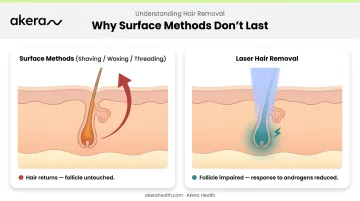
Shaving, waxing, and threading all work at the surface. They remove the hair shaft but leave the follicle completely intact. Because the androgen signal never stops, the follicle simply produces another hair — returning faster and coarser than before.
A follicle-targeting approach addresses what surface methods cannot: the follicle itself. Laser energy damages the follicle at its root, reducing its ability to respond to androgen signals — which is why results last significantly longer than any surface method.
Does Laser Hair Removal Actually Work for PCOS?
Yes — but the honest framing matters here. Laser is best understood as long-term management rather than a permanent cure.
Here's why: laser energy destroys actively growing hair follicles by heating them to the point of impairment. But with PCOS, ongoing androgen production can continue stimulating dormant follicles that weren't active during treatment. So while treated hairs are significantly reduced, new follicles can be recruited over time.
What the Clinical Evidence Shows
A prospective study by McGill et al. followed 60 women with PCOS through alexandrite laser treatment. After six sessions, participants showed a 31% mean reduction in hair count, with the hair-free interval extending from under 2 weeks after early sessions to over 4 weeks after 10 sessions. 95% of participants reported satisfaction — worth noting because measured clearance and lived experience don't always match. Significant improvement in daily routine can coexist with incomplete clearance.
A 2024 systematic review in JAMA Dermatology analysed six studies totalling 423 women with PCOS and confirmed that laser treatment improved both hirsutism severity and psychological outcomes, particularly at higher fluence settings.
Research consistently documents meaningful improvements in anxiety, depression scores, and self-confidence among women who complete laser treatment for hirsutism. For many, going from daily shaving to managing occasional regrowth changes how they start their day — and how they feel in it.
A Word on Paradoxical Hypertrichosis
There's a rare but real risk worth knowing: paradoxical hypertrichosis, where insufficient laser energy stimulates rather than destroys deep hormonal follicles. The numbers tell a clear story:
- 3% pooled prevalence across a meta-analysis of over 9,700 patients overall
- 33% rate among PCOS patients receiving facial alexandrite treatment in one study
- 14% rate among women without PCOS in the same study
PCOS patients specifically need medical-grade equipment calibrated at appropriate energy levels by someone who understands hormonal hair. This is not a scenario where lower cost equals lower risk.
What Type of Laser Works Best for PCOS and Indian Skin?
The right laser depends on two factors: your skin tone and the depth of the hormonal follicle. For most Indian women — who fall predominantly in the Fitzpatrick IV–VI range — melanin-rich skin requires careful wavelength selection to avoid burns or post-inflammatory hyperpigmentation (PIH).
| Laser Type | Fitzpatrick IV–VI Suitability | Notes |
|---|---|---|
| Nd:YAG (1064 nm) | Best for darker skin | Longest wavelength, lowest melanin absorption, deepest penetration |
| Diode (~810 nm) | Good for medium-to-dark skin | Strong follicle penetration, suitable with proper cooling |
| Alexandrite (755 nm) | Use cautiously | Effective but narrower safety margin on darker skin |
| IPL (home or clinic) | Not recommended for PCOS | Broad-spectrum, insufficient depth, no evidence for PCOS use |
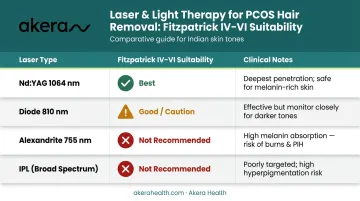
The Endocrine Society's hirsutism guideline specifically recommends long-pulse Nd:YAG or diode laser with cooling for women of colour — and a systematic review found Nd:YAG significantly favoured over IPL for reducing PIH risk in skin of colour (OR 0.26). This matters especially when choosing between clinic-grade and home devices.
Why Home IPL Consistently Fails PCOS Patients
Home IPL devices emit broad-spectrum, low-power light that cannot reach the depth of a hormonally stimulated follicle. They may temporarily slow surface hair, but they rarely destroy the root — and carry the same paradoxical hypertrichosis risk when energy is insufficient for follicle depth.
Akera Health's Approach
At Akera Health in Bengaluru, laser hair reduction is performed using the Soprano Platinum — a multi-wavelength diode platform validated for use across all Fitzpatrick skin types. Before any session, Dr. Lavina Mittal and the clinical team review each patient's skin tone, hair type, PCOS diagnosis, and current medications to calibrate treatment settings appropriately. For PCOS patients, this assessment carries extra weight: hormonal profile and skin characteristics together determine both the wavelength selection and the number of sessions required.
How Many Laser Sessions Do You Need for PCOS Hair Removal?
More than average. The 2023 International PCOS Guideline confirms that women with PCOS may need more sessions than women with idiopathic (non-hormonal) hirsutism. The McGill PCOS cohort averaged 12 treatments — nearly double the 6–8 sessions typical for non-hormonal cases. Three biological reasons explain why:
- Hair cycle timing — laser only works on hairs in the active growth (anagen) phase, and only a fraction of follicles are there at once
- Hormonal fluctuations — androgen levels shift with the menstrual cycle, stress, and weight, creating unpredictable growth windows
- Dormant follicle activation — elevated androgens can recruit previously inactive follicles, even after successful sessions
Session-by-Session Progression
| Milestone | What to Expect |
|---|---|
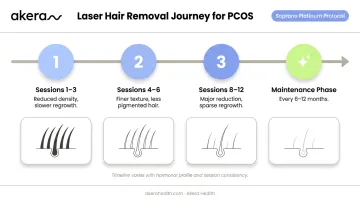
| After 3 sessions | Noticeable reduction in density; regrowth slower and patchier |
| After 6 sessions | Significant texture change — hair finer and less pigmented; daily shaving replaced by occasional maintenance |
| After 8–12 sessions | Major reduction in visible hair; regrowth sparse and much finer |
Timelines shift depending on your hormonal profile, hair coarseness, and how consistently sessions are spaced — so treat these milestones as a guide, not a guarantee.
Maintenance Is Part of the Process
Maintenance sessions every 6–12 months are standard for PCOS patients. Because PCOS keeps the hormonal trigger active, some degree of ongoing management is expected — and completely normal. The shift from daily shaving to an annual or biannual touch-up represents a significant improvement in daily quality of life.
Should You Combine Laser with Hormonal Treatment?
Research consistently supports combining laser with hormonal management over laser alone. A randomised trial by Dorgham et al. assigned 150 women with PCOS to three groups: diode laser alone, laser plus metformin, or laser plus a combined oral contraceptive. Both combination groups outperformed laser alone in hair reduction and maintenance outcomes, with the oral contraceptive group showing the strongest quality-of-life improvement.
The mechanism makes sense: medications that reduce androgen levels — oral contraceptives, anti-androgens, or metformin for insulin resistance — limit the continuous follicle stimulation that creates new hair growth between sessions. Each laser session becomes more effective because fewer dormant follicles are being recruited.
What This Means Practically
- You don't need to wait for hormones to be perfectly balanced before starting laser
- Disclose all medications to your laser provider — being on metformin or an oral contraceptive is relevant information that affects session planning
- Consult your gynaecologist or endocrinologist about whether hormonal treatment is appropriate for your PCOS type — this decision sits outside the dermatologist's scope
Lifestyle Factors Worth Noting
Lifestyle changes alone don't reliably reduce visible hirsutism; the evidence base is limited. Still, maintaining a stable weight can modestly reduce circulating androgen levels, which may support both hormonal management and laser outcomes. Consider it supportive context, not a treatment in itself.
What to Expect Before, During, and After Your Sessions
Before Your Session
- Stop waxing, plucking, and threading at least 4 weeks before starting — the follicular root must be present for laser to work
- Shave the area the day before each session
- Disclose your PCOS diagnosis and all medications to your provider — this directly affects how settings are calibrated
- Avoid sun exposure and protect skin with SPF 50+ in the weeks leading up to treatment
- Pause retinoids before sessions — confirm the specific interval with your dermatologist, as this varies
During the Session
A cooling gel is applied to the treatment area first, then the handpiece delivers laser energy to the follicle. The sensation feels similar to a rubber band snap, though the built-in cooling mechanism keeps discomfort minimal. Most clients at Akera Health find Soprano Platinum sessions quite tolerable, with only mild redness appearing immediately after.
How long the session takes depends on the area being treated:
- Upper lip or chin: typically 10–20 minutes
- Full face and jawline: 30–45 minutes
- Larger body areas: longer, depending on coverage
For PCOS patients specifically: the provider's experience with hormonal hair — and their ability to set appropriate energy levels — matters more than finding the lowest price.
After Your Session
- Redness and mild swelling are normal for 1–3 days
- Treated hairs shed over the following days to weeks — this is not regrowth
- Apply SPF 50+ daily — this is especially critical for Indian skin tones, where thermal injury carries a higher risk of post-inflammatory hyperpigmentation (PIH)
- Avoid heat exposure — saunas, hot showers, and intense exercise for 48 hours
- Use gentle skincare and skip active ingredients (acids, exfoliants) for a few days
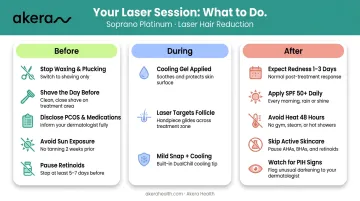
At Akera Health, aftercare instructions and follow-up scheduling are provided at the end of every session — including what to watch for, such as shedding timelines and early PIH signs, so nothing is left to guesswork between appointments.
Frequently Asked Questions
Does laser hair removal work for PCOS?
Yes — laser is the most effective long-term method for managing PCOS-related hirsutism. It's best described as management rather than a cure: treated hair regrows significantly finer and sparser, but ongoing hormonal stimulation means maintenance sessions remain part of the process.
What is the best hair removal method for PCOS?
Laser hair removal is the most practical option — it targets the follicle across large areas in fewer sessions than any alternative. Electrolysis delivers permanent results follicle-by-follicle but is impractical for widespread hirsutism. Waxing, threading, and shaving offer no lasting benefit.
How many laser hair removal sessions are needed for PCOS?
PCOS patients typically need more sessions than those with non-hormonal hair growth, due to continuous androgen stimulation of dormant follicles. The McGill PCOS cohort averaged 12 treatments. Maintenance sessions every 6–12 months are standard after the initial course.
What type of laser is best for Indian skin with PCOS?
For darker Indian skin tones (Fitzpatrick IV–VI), Nd:YAG (1064 nm) is the safest option — its longer wavelength minimises melanin absorption and hyperpigmentation risk. Diode laser (~810 nm) — including platforms like Soprano Platinum — is equally suitable for Indian skin when paired with appropriate cooling. Home IPL devices are not recommended for PCOS hair.
Can I get laser hair removal while on PCOS medication?
Yes — and being on hormonal medications like oral contraceptives or metformin often improves laser outcomes by reducing androgen-driven new hair growth. Always disclose all current medications to your provider before beginning treatment.
Will laser hair removal results last permanently with PCOS?
Complete permanent removal is unlikely while PCOS remains active — the hormonal stimulus continues to recruit dormant follicles. Most patients achieve dramatic, long-lasting reduction that makes day-to-day life significantly easier, with periodic top-ups rather than constant removal.